
Transportation Finance
The Boston region is consistently ranked among the most congested areas in the United States. At the same time, its public transit system has been underfunded for decades. As the organization that conducts the federally required transportation planning process for the Boston region, the Boston Region MPO is uniquely positioned to investigate regional policy solutions that simultaneously address congestion and identify sustainable transportation funding sources.
 Roadway-Pricing Policies
In December 2025, the MPO published a white paper (PDF) (HTML) that evaluated the data sources and analytical tools available to study potential roadway-pricing systems in the Boston region. Using a hypothetical downtown cordon-pricing scenario, the analysis explored how these tools could be used to estimate impacts on congestion, travel behavior, revenue generation, and equity.
Earlier work on this topic includes a 2023 study on roadway-pricing policies (PDF) (HTML) study on roadway-pricing policies (appendices) that assessed strategies for raising revenues to fund the transportation system, such as by charging for the use of high-occupancy travel lanes. The MPO researched five case studies of other urban areas in the United States that employed roadway-pricing strategies to reduce congestion, improve air quality, and raise revenue for multimodal transportation infrastructure investment. Investigating the benefits and challenges described in the case studies helps decision-makers to better understand what policies might be suitable for Massachusetts. In July 2024, the MPO published a two-page roadway-pricing policy summary (PDF) of key learnings from the study.
 MBTA Funding Strategies
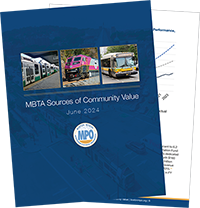
As of June 2024, the MBTA is expected to face an annual budgetary gap of $700 million due to a decrease in fare revenue since the COVID-19 pandemic as well as limited growth in the MBTA’s primary funding source, the statewide sales tax. The MBTA engaged the Boston Region MPO to conduct a technical analysis of funding strategies used by peer transit agencies for their potential to generate revenue for the MBTA. The MPO evaluated 10 different strategies in three focus areas: vehicle access fees, road usage fees, and value generated by transit to understand their revenue potential in the Massachusetts context. The results of this research were presented to the MBTA Board of Directors on June 20, 2024.