Home » Our Work
Vision Zero Action Plan: A Roadmap to Safer Streets
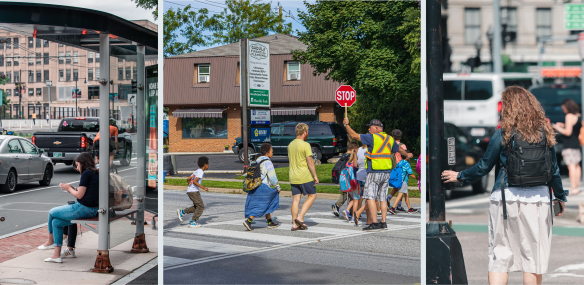
The Vision Zero Action Plan was endorsed by the Boston Region MPO on March 5, 2026. The Action Plan serves as a roadmap for the 97 communities in the region to work together to reach the MPO's commitment to eliminating fatal and serious injury crashes from our streets. Check out the resources below and get in touch with us about roadway safety in your community.
Read the Action Plan Explore the Dashboard
Vision Zero Action Plan and Related Resources
- Boston Region MPO Vision Zero Resolution (PDF)
- Executive Summary (PDF | HTML)
- Vision Zero Action Plan (PDF | HTML)
Executive Summary Translations
- Resumen Ejecutivo (PDF | HTML)
- Sumário executivo (PDF | HTML)
- 执行总结 (PDF | HTML)
- 執行總結 (PDF | HTML)
- Rezime Egzekitif (PDF | HTML)
- Tóm Tắt Dự Án (PDF | HTML)
Appendices
- Appendix A: Acronyms (PDF | HTML)
- Appendix B: Existing Conditions (PDF | HTML)
- Appendix C: High-Injury Network Methodology (PDF | HTML)
- Appendix D: High-Risk (Systemic) Network Methodology (PDF | HTML)
- Appendix E: Municipal Crash Data Profiles (PDF)
- Appendix F: Engagement (PDF | HTML)
- Appendix G: Policy and Process (PDF | HTML)
Additional Resources
- Vision Zero Engagement: Walk Audit Academies (PDF | HTML)
- Vision Zero Engagement: Distracted Driving Education (PDF | HTML)
- Strategy and Countermeasure Toolboxes (PDF | HTML)
Vision Zero Data Dashboard
The MPO's Vision Zero Data Dashboard is designed to empower local communities to tackle their local roadway safety challenges. It provides clear, actionable data on where crashes occur, who is involved, and what the primary causes are. Cities and towns can use this information to make data-driven decisions and implement effective safety interventions.
To learn more about the dashboard and the data, or to discuss best practice interventions in your municipality, please contact Ali Kleyman at akleyman@bostonmpo.org.
Explore the Vision Zero Dashboard
Let us know what areas feel unsafe
Vision Zero Events
Check back for future safe streets events in the region.
What is Vision Zero?
Vision Zero is an approach to transportation safety that declares that we do not have to accept deaths and serious injuries from traffic crashes on our streets. Rather than viewing serious crashes as an inevitable side effect of moving around our cities and towns, Vision Zero asks us to design a safer transportation system that accounts for human error, reduces vehicle speeds, builds safer infrastructure, and uses data to prioritize equity and safety for all roadway users.
A New Vision for Safety
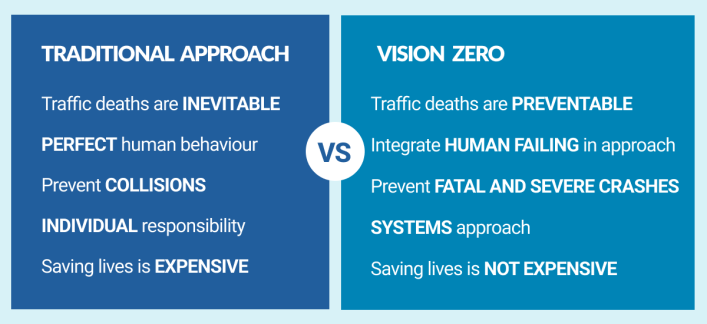
Source: Vision Zero Network
While Vision Zero establishes the goal of zero deaths and serious injuries on our streets, the Safe System Approach provides a more detailed framework for reaching that goal. The Safe System Approach aims to address and mitigate the risks inherent in the transportation system by building and reinforcing multiple layers of protection to both prevent crashes from happening in the first place and minimize the harm caused to those involved when crashes do occur. This holistic and comprehensive strategy focuses both on human mistakes and vulnerability and promotes a system designed with many redundancies in place to protect all road users. The Safe System Approach also embraces all types of roadway safety countermeasures and acknowledges that a multidisciplinary approach is required to address the full range of possible safety risks. The five Safe System elements—safe road users, safe vehicles, safe speeds, safe roads, and post-crash care—work together to create shared responsibility for the safety of all road users.
Safe System Approach Principles

Source: Federal Highway Administration
The Vision Zero Action Plan sets out projects, strategies, and policies to move the region towards safer, healthier, and more equitable mobility for residents and visitors of the region. In addition to setting a path toward zero roadway deaths and serious injuries, the Action Plan unlocks future funding opportunities through the Safe Streets and Roads for All (SS4A) Grant Program.
Vision Zero Task Force
The Vision Zero Task Force was formed to provide targeted feedback, guidance, and recommendations during the development of the Vision Zero Action Plan. The task force includes municipal leaders, state and federal partners, and advocates for walking, biking, schools, and accessibility.
| Name | Title |
|---|---|
| Kristopher Carter | Chief Possibility Officer, MassDOT |
| Alex Epstein | Somerville Alliance for Safe Streets Steering Committee |
| Charlotte Fleetwood | Senior Transportation Planner, Boston Transportation Department |
| JR Frey | Town Engineer, Town of Hingham |
| James Fuccione | Executive Director, Massachusetts Healthy Aging Collaborative |
| Tina Hein | Vice Chair Select Board, Town of Holliston; Massachusetts Safe Routes to School Outreach Coordinator |
| Brendan Kearney | Co-Executive Director, WalkMassachusetts |
| Jeremy Marsette | Town Administrator, Town of Sherborn |
| Galen Mook | Executive Director, MassBike |
| Shavel'le Olivier | Executive Director, Mattapan Food and Fitness Coalition |
| Kathryn Quigley | Deputy Director of Strategic Planning, MBTA Systemwide Accessibility |
| Brad Rawson | Director, Mobility Division, City of Somerville |
| Katarina Torres Radisic | Community Organizer, Riders Transportation Access Group (RTAG) |
| Ryan Williams | City Councilor, City of Melrose |
| Stephen Winslow | City Councilor, City of Malden |
| Maria Kunhardt | Federal Highway Administration |
| Michael Pezzullo | Federal Highway Administration |
| Kenneth Miller | Federal Highway Administration |
Recordings and Vision Zero Resources
June 2025 Public Forum Recording (Opens YouTube)
January 2025 Public Forum Recording (Opens YouTube)
Vision Zero 101 Basics
Subscribe to Updates on Our Vision Zero Action Plan
Contact
Ali Kleyman, Principal Planner
Vision Zero Program
akleyman@bostonmpo.org
visionzero@bostonmpo.org