
Executive Summary
The Boston Region MPO
Metropolitan planning organizations (MPO) are responsible for providing forums for coordination on regional transportation goals and decision-making about how to allocate federal transportation funds for capital projects and planning studies through a continuing, comprehensive, and cooperative (3C) planning process. Each metropolitan area in the United States with a population of 50,000 or more—also known as an urbanized area—is required by federal legislation to establish an MPO and conduct a 3C planning process.
The Boston Region MPO’s planning area encompasses 97 cities and towns, stretching from Boston north to Ipswich, south to Marshfield, and west to Interstate 495. Figure ES-1 shows the map of the Boston Region MPO’s member municipalities.
The MPO’s board has 23 voting members. Several state and regional agencies, advisory organizations, and the City of Boston are permanent voting members, while 12 municipalities are elected as voting members for three-year terms. Eight of these municipal members represent each of the eight subregions of the Boston region, and four represent at-large municipal seats. The Federal Highway Administration (FHWA) and Federal Transit Administration (FTA) participate on the MPO board as advisory, nonvoting members. The MPO board makes transparent and collaborative decisions about transportation planning and funding in the Boston region, informed by data, analysis, and public input.
The MPO is supported by a staff of planners, data analysts, engineers, and other professionals.
Figure ES-1
Municipalities in the Boston Region
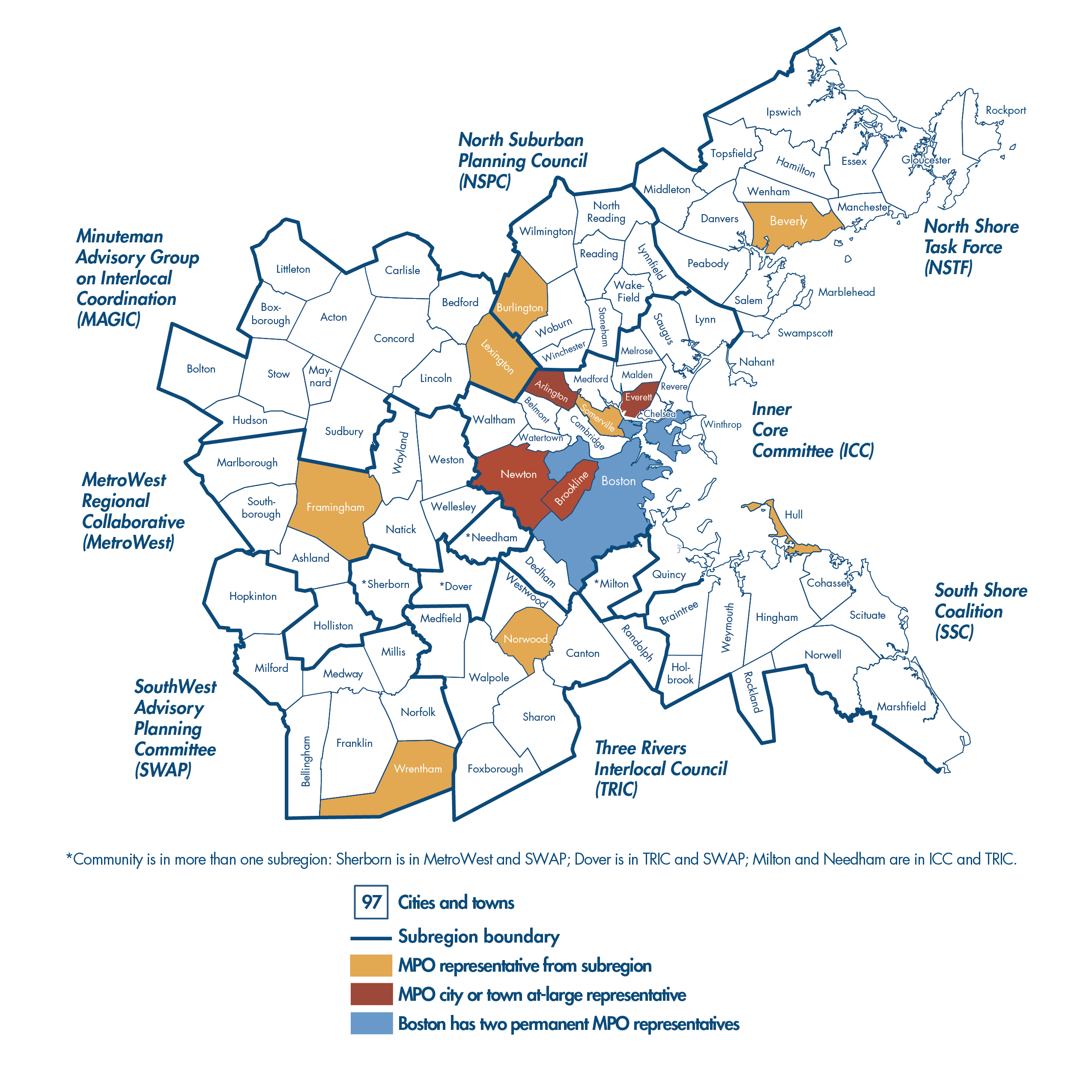
*Community is in more than one subregion: Sherborn is in MetroWest and SWAP; Dover is in TRIC and SWAP; Milton and Needham are in ICC and TRIC.
The Unified Planning Work Program (UPWP)
The MPO’s work is guided by a 20-year vision for a modern, safe, reliable, robust, and well-connected multimodal transportation system for the region. This vision is described in the MPO’s current Long-Range Transportation Plan (LRTP), Destination 2050. The transportation planning work funded through the UPWP is integral to achieving this regional vision.
The UPWP is a one-year planning document and financial plan that outlines how the Boston region will allocate its federal transportation planning funds for a given federal fiscal year (FFY) in alignment with its long-term vision, goals, and objectives. Overall, it describes the 3C metropolitan planning process for the Boston Region.
The development of the UPWP involves the prioritization of federal funding for transportation planning work, including MPO programs, studies, and technical analyses, to be implemented in a given year to support the region’s goals. The scopes and budgets of the prioritized work are documented in the UPWP.
In addition to MPO-funded work, staff carry out work funded by external grant programs and conduct planning analyses and studies funded by state transportation agencies, such as the Massachusetts Department of Transportation (MassDOT) and the Massachusetts Bay Transportation Authority (MBTA).
UPWP Programs and Studies
The total amount of funding (inclusive of federal funding and matching funds) programmed in this UPWP is $7,852,348. These funds are provided by both the FHWA and FTA, with MassDOT supplying the required matching funds. Federal funds originating from FHWA, known as FHWA 3C Planning (PL) funds, are distributed across MPO regions using a formula developed by the Massachusetts Association of Regional Planning Agencies. Federal funds originating from the FTA are known as FTA 3C Planning (Section 5303) funds, and since 2019, MassDOT has transferred Section 5303 funds from the FTA to the FHWA for administration as a Consolidated Planning Grant. The MPO uses this funding to conduct the following programs and plans:
MPO Programs and 3C Planning
Long-Range Transportation Plan (LRTP)
The LRTP guides decision-making on transportation investments in the Boston region over the next two decades. It serves as the MPO’s guiding document, establishing the regional transportation vision, goals, objectives, and investment approaches under which the MPO operates. The MPO adopted the current LRTP, Destination 2050, in 2023 and anticipates adopting the next LRTP in 2028.
Schedule: ongoing
FFY 2027 budget: $421,362
FFY 2027 anticipated outcomes and deliverables:
- Memorandum detailing the process for establishing performance measures associated with MPO goal areas and pilot, including constraints such as feasibility and deliberations from MPO board and Community Advisory Council discussions
- Memorandum detailing the process to establish a set of strategies that the MPO could pursue to advance priority goal areas
- Memorandum detailing preliminary results from scenario planning explorations
- Board and staff deliberations on content of the in-progress plan, documented through meeting minutes
Transportation Improvement Program (TIP)
The TIP is a financially constrained program of planned multimodal investments in the region’s transportation system over a five-year period. The TIP is guided by the goals and objectives established in the LRTP and is updated annually.
Schedule: ongoing
FFY 2027 budget: $344,760
FFY 2027 anticipated outcomes and deliverables:
- The FFYs 2028–32 TIP
- Documentation of progress made on performance measures through the programming of TIP projects
- Procedure for delivering and monitoring design contracts for TIP projects, including identification of design process outcomes and improvements
- Development of a formal process for utilizing regionally prioritized TIP funding to support early stage planning efforts that align with existing design funding offerings
- Monitoring the success of and iterating upon the MPO’s project programming and cost-change policies with policy updates as needed
- Additional analysis to help pinpoint needs for targeted municipal outreach
- Amendments and administrative modifications to the FFYs 2027–31 TIP
Unified Planning Work Program
The UPWP is developed annually and includes descriptions and budgets for work that MPO staff will conduct to support the MPO’s goals and objectives during the upcoming FFY.
Schedule: ongoing
FFY 2027 budget: $143,820
FFY 2027 anticipated outcomes and deliverables:
- FFY 2028 UPWP
- Engagement in the development of the FFY 2028 UPWP from the public and MPO board
- Improvements to the UPWP document and development process
- Support for the MPO’s UPWP Committee
- Regular reporting on FFY 2027 UPWP implementation
- Amendments and administrative modifications to the FFY 2027 UPWP
Public Engagement Program
The MPO engages the public in the transportation planning process to enhance decision-making by highlighting the transportation needs and priorities of communities throughout the region, as well as the local impacts of transportation planning decisions. The Public Engagement Program ensures that the MPO’s planning and decision-making processes are transparent and responsive to public input, providing members of the public with meaningful opportunities to participate.
Schedule: ongoing
FFY 2027 budget: $400,860
FFY 2027 anticipated outcomes and deliverables:
- Fulfill federally required engagement activities, such as public review periods, to support the 3C planning process in accordance with the Public Engagement Plan.
- Host approximately 10 Community Advisory Council meetings and facilitate connections to MPO staff and the board
- Draft a municipal engagement strategy
- Implement a stakeholder tracking database
- Publish public engagement dashboard updates
- Develop engagement resources and guidance for MPO staff
- Host the Community Planning Lab
Performance-Based Planning and Programming (PBPP)
The MPO’s PBPP work involves using data to develop and evaluate progress toward performance targets for roadway and transit safety, highway and transit assets, congestion management, travel time reliability, and air quality and emissions, in annual, two-year, and four-year horizons for the region's transportation system. PBPP helps ensure that the MPO’s planning and investments are yielding progress toward the MPO’s goals.
Schedule: ongoing
FFY 2027 budget: $121,380
FFY 2027 anticipated outcomes and deliverables:
- Federally required reporting on performance target setting
- Improvements to the content and functions of the Performance Dashboard
- Performance analysis of the projects funded in the FFYs 2028–32 TIP in relation to how they will support improvements in various performance areas and make progress toward performance targets
- Proposal of MPO region-specific safety targets
- Plan for launching project-specific air quality performance monitoring
- Methodologies and performance metrics that can be used to evaluate the impact of investments and inform future evaluation criteria
Community Transportation Access (CTA) Program
The CTA Program supports the MPO’s investment in a transportation system that meets the needs of the Boston region's residents by assessing the impacts of MPO investments on their economic well-being and quality of life. The CTA Program also ensures that the MPO complies with Title VI and other existing federal and state civil rights regulations throughout its work.
Schedule: ongoing
FFY 2027 budget: $202,000
FFY 2027 anticipated outcomes and deliverables:
- Title VI Report, if requested by MassDOT
- Plain language documents for technical CTA Program work products
- Development of metrics to assess the impacts of projects, in the aggregate, in the 2028 LRTP
- Analyses of the expected impacts of TIP projects, in the aggregate, in the FFYs 2028–32 TIP
- Updated Language Assistance Plan
Congestion Management Process (CMP) Program
The CMP program is responsible for monitoring and making recommendations to address congestion, mobility, and safety needs within the region’s transportation system.
Schedule: ongoing
FFY 2027 budget: $121,380
FFY 2027 anticipated outcomes and deliverables:
- Streamlined process for communicating and delegating data storage, analysis, and review with relevant MPO staff
- Publication of CMP network integrated with roadway reliability performance measures
- Draft of multimodal performance measure dashboard including measures encouraging mode shift in addition to cross-program performance measures overlapping with the Freight Planning and Transportation Impact Mitigation programs
- Increased collaboration with the Multimodal Mobility Infrastructure Program by providing CMP- or mobility-related technical assistance where possible
Transportation Impact Mitigation (TIM) Program
The TIM program assesses potential threats from natural hazards to the region and addresses risks to transportation assets posed by severe weather. This program also ensures that the MPO complies with the Clean Air Act and the Environmental Protection Agency’s transportation conformity regulations.
Schedule: ongoing
FFY 2027 budget: $149,940
FFY 2027 anticipated outcomes and deliverables:
- Initiation of the Regional Vulnerability Assessment with adopted framework
- Inventory of Evacuation Routes for the North Shore Task Force subregion
- Project application scoring for the TIP for risk mitigation and adaptive capacity
- Processed air quality data
- Identification of additional air quality-related studies or initiatives
- Assistance with resiliency- or air quality-related technical assistance projects
- Environmental stakeholder engagement
- Required air quality analyses and reporting
Freight Planning Program
The freight program plans for the policies and infrastructure that enable the movement of freight and goods by road, rail, water, and air.
Schedule: ongoing
FFY 2027 budget: $126,480
FFY 2027 anticipated outcomes and deliverables:
- Draft Regional Freight Decarbonization Plan Framework
- Publish, promote, and monitor progress of the Regional Freight Action Plan
- Update Freight data visualizations with relevant datasets from the Freight Action Plan and Critical Urban Freight Corridors
Regional Model Enhancement
This program supports the research and development of improvements to the regional travel demand model maintained by the MPO. The model is programmed to represent projections of population and employment in the region, which informs the development of the MPO’s LRTP. It is also used for statewide emissions estimates and to support specific planning and policy analyses by the MPO, municipalities, and state agencies.
Schedule: ongoing
FFY 2027 budget: $945,540
FFY 2027 anticipated outcomes and deliverables:
- TDM23 (travel demand model) maintenance updates to incorporate fixes, performance improvements, and new capabilities for project analysis
- TDM23 enhancements to support LRTP scenarios
- TDM28 development and calibration for the 2028 LRTP
- Initial version of TDMX exploratory platform
- Regional FTA Simplified Trips-on-Project Software updates and maintenance
- Model utility improvements and expansion
Data Program
The data program leads strategic efforts to improve how data are used, developed, and shared in support of the MPO and its stakeholders.
Schedule: ongoing
FFY 2027 budget: $586,500
FFY 2027 anticipated outcomes and deliverables:
- Data maturity assessment results
- Updated data strategy and roadmap
- Data needs assessment results and recommendations for central data repository, reference data, and public-facing data catalogue.
- Expanded use of Documentation Platform to three or more programs.
- Data request responses and updated data request handling guidelines
- Assessments and recommendations for up to three existing or emerging datasets
- Curated, enhanced reference data, tools, and distribution for FFY 2028 TIP scoring cycle.
- Standardized and centralized data repository for use internally on most or all agency work, with guidelines on data management, querying, and use, including foundational reference datasets.
Active Transportation Planning Program
This program uses data collection, analysis, and technical assistance to improve safety and comfort for people walking, bicycling, and rolling in the Boston region.
Schedule: ongoing
FFY 2027 budget: $187,680
FFY 2027 anticipated outcomes and deliverables:
- Summary of key insights and feedback from the Active Transportation Steering Committee
- Needs assessment for active modes in the region and report documenting research, methods, and results of the regional gap analysis.
- Bicycle and pedestrian volume counts and high-level trends such as the impact of weather, seasonality, facility types, and other roadway characteristics.
- Performance metrics and baseline figures for the safety, usage, and connectivity of the active transportation network in the region.
Multimodal Mobility Infrastructure Program
This program conducts studies of roadways, corridors, and intersections to address regional and community transportation needs.
Schedule: ongoing
FFY 2027 budget: $382,500
FFY 2027 anticipated outcomes and deliverables:
- Updated corridor and intersection selection process to include the data from the Vision Zero and Neutralizing Onerous Heat Effects on Active Transportation (NO-HEAT) planning efforts
- Selection of corridor and intersection study locations
- Updated methodology and steps for site-specific studies to support the project pipeline
- Recommendations for selected corridor improvements
- Recommendations for selected intersection improvements
- White paper with key findings from land use and transportation exploration
- Recommendations for incorporating findings from mode shift research into planning work
- Existing conditions analysis for the Mobility Action Plan
- Updated Managing the Curb Space Guidebook
Support to the MPO and its 3C Process
Under this program, staff implement MPO policies, plan and coordinate the delivery of information for MPO decision-making, and support the operation of the MPO and its committees. It also involves providing support for MPO meeting management.
Schedule: ongoing
FFY 2027 budget: $1,065,716
FFY 2027 anticipated outcomes and deliverables:
- Hosted MPO meetings, subcommittee meetings, and Transit Working Group meetings
- Coordination with state and federal partners
- Coordination with neighboring MPOs, including participating in coordination meetings with northern, southern, and western neighboring MPOs
- Editorial and graphics support
- Participation in the federal recertification process
Technical Assistance
In addition to the above programs and studies, the MPO funds and conducts technical assistance work through the Road Safety Audits and Community Transportation Technical Assistance programs. The Road Safety Audits program funds staff’s participation in road safety audits led by MassDOT at high-risk crash locations. Through the Community Transportation Technical Assistance Program, staff provide municipalities with advice on addressing multimodal concerns in their communities.
Schedule: ongoing
FFY 2027 Road Safety Audits budget: $10,000
FFY 2027 Community Transportation Technical Assistance budget: $135,000
FFY 2027 anticipated outcomes and deliverables:
- Participation in Road Safety Audits as requested by MassDOT
- Documentation of Road Safety Audit recommendations
- Technical assistance consultations to municipalities, Metropolitan Area Planning Council (MAPC) subregions, Regional Transit Authorities, and Transportation Management Associations
- Technical memos documenting the work, recommendations, and outcomes of technical assistance consultations
FFY 2027 Discrete Studies
Roadway Pricing Technical Evaluation: Iterative Scenario Analysis
In FFY 2025, MPO staff completed the first phase of a roadway pricing study that analyzed a conceptual roadway pricing scenario and assessed how available data and tools could be applied to measure potential impacts this scenario would have on congestion, revenue, and equity in the region. In FFY 2027, staff will build upon this initial study by using travel demand models, Replica (a large mobility data provider), and other available data to evaluate different variations on the conceptual roadway pricing framework. This iterative approach will reveal the tradeoffs between different roadway pricing scenarios and evaluate the equity impacts of the status quo of free road access.
Schedule: October 2026–September 2027
Budget: $75,000
Anticipated outcomes and deliverables:
- A white paper describing the scenarios evaluated and the impacts of roadway pricing scenarios on vehicle miles traveled, transit ridership, air quality, and revenue generation
- Evaluation of the geographic and demographic impacts of roadway pricing across the Boston region
Impact of Parking Supply on Property Values
Reducing parking supply is a key strategy for managing travel demand; however, developers often express concern that reducing parking supply will make a project appear less financially viable to lenders. This study aims to evaluate the relationship between parking supply and property values to provide insight into this concern. MPO staff will use available data to analyze the interaction between parking spaces per square foot and sale price for particular properties. The analysis would control for a number of variables that influence property value and establish separate conclusions for commercial and residential properties.
Schedule: October 2026–September 2027
Budget: $40,000
Anticipated outcomes and deliverables:
- A report detailing the data, methods, and analysis results that highlights the key findings of how parking supply relates to residential and commercial property values and how those insights can inform parking policy decisions
Opportunities for the Boston Region MPO to Support Transit-Oriented Development
Regional planning agencies can support transit-oriented development (TOD) by aligning transportation investments with emerging growth patterns and addressing areas of existing density that have low connectivity, while considering planned growth, transportation network capacity, and regional employment and demographic trends. This study will use peer research, including a literature review and interviews with peer MPOs and agencies, to identify effective strategies for the Boston Region MPO to support the objectives of TOD.
Schedule: October 2026–September 2027
Budget: $35,000
Anticipated outcomes and deliverables:
- A brief explanation of the research findings on how the MPO can support TOD through planning, programming, and policy work
FFY 2027 Budget
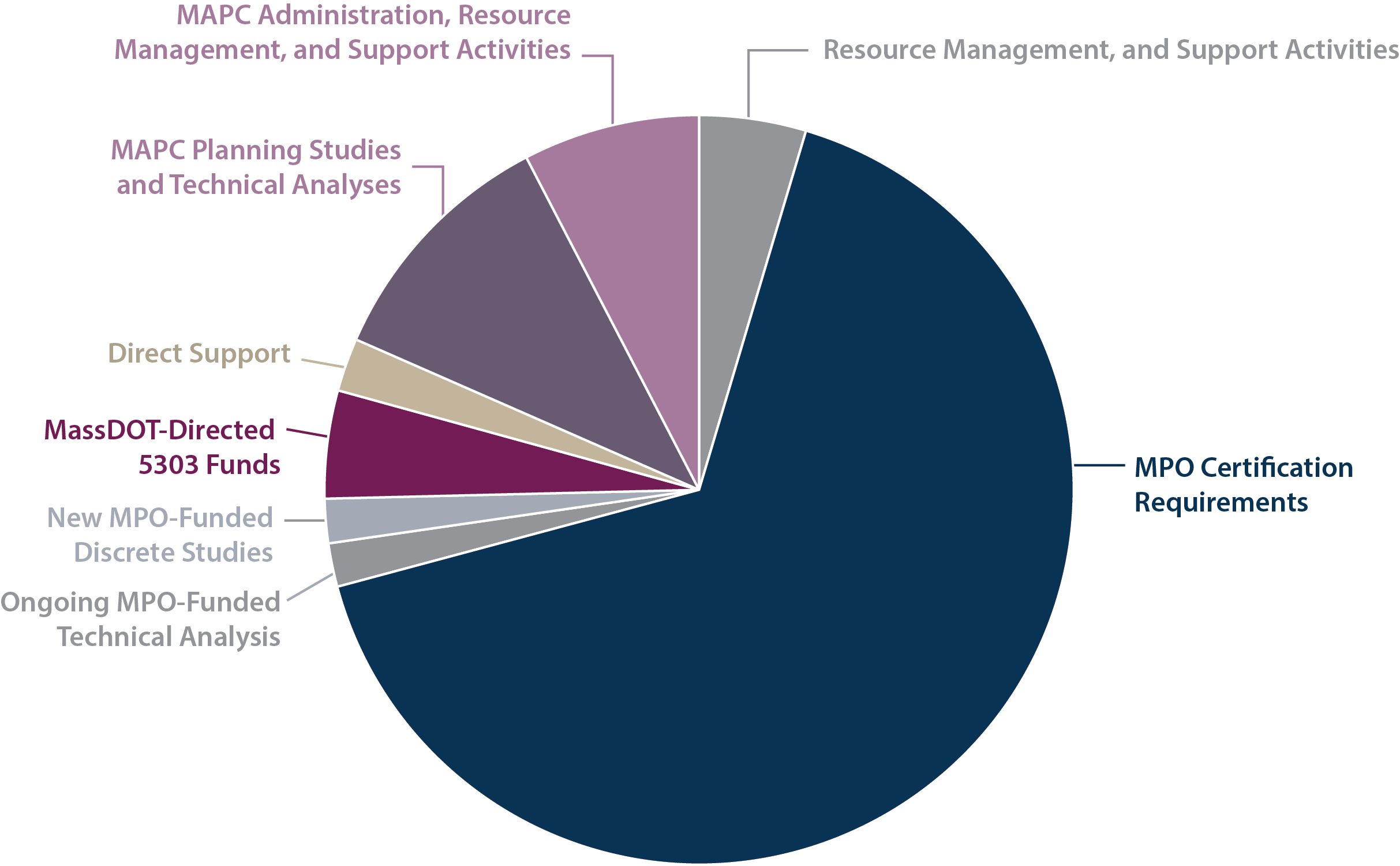
Table ES-1 contains the budget allocated for the MPO’s 3C planning activities in FFY 2027. The table reflects the FHWA PL funds and FTA Section 5303 funds, which the Boston Region MPO and MAPC expect to spend in FFY 2027. This information is also shown in the chart (Figure ES-2) below.
Table ES-1
Unified Planning Work Program Budget for FFY 2027
| 3C Studies and Programs by Budget Categories | Proposed FFY 2027 Boston Region MPO Budget |
| Resource Management and Support Activities | $362,120 |
| MPO Certification Requirements | $5,199,918 |
| Ongoing MPO-Funded Technical Analyses | $147,700 |
| New MPO-Funded Discrete Studies | $150,000 |
| MassDOT-Directed 5303 Funds | $365,412 |
| Direct Support | $180,000 |
| Total FFY 2027 Boston Region MPO Budget | $6,405,150 |
| 3C Studies and Programs by MAPC Budget Categories | Proposed FFY 2027 MAPC Budget |
| MAPC Planning Studies and Technical Analyses | $848,000 |
| MAPC Administration, Resource Management, and Support Activities | $599,198 |
| Total MAPC FFY 2027 UPWP Programmed Funds | $1,447,198 |
| Agency Supporting MPO/3C Work | Proposed FFY 2027 Budget |
| Boston Region MPO | $6,405,150 |
| MAPC | $1,447,198 |
| 3C Budget Subtotal | $7,852,348 |
| FFY 2027 UPWP Budget | $7,852,348 |
| Note: This budget includes salary, overhead, and direct support costs. |
Figure ES-2
Unified Planning Work Program Budget for FFY 2027
Developing the UPWP
Updates to Ongoing Programs and Continuing Activities
The annual process of creating the UPWP includes updating the scopes and anticipated deliverables for ongoing programs, technical analysis activities, certification requirements, and administrative support activities, as well as evaluating ideas for discrete studies.
Ideas for ongoing program activities, technical analysis activities, and studies come from the following sources:
- Guidance issued by FHWA and FTA
- Input gathered from the MPO’s UPWP Committee, which oversees the development of the UPWP document
- Feedback gathered from the Community Advisory Council
- Existing planning documents, such as the MPO’s LRTP Needs Assessment and MAPC’s long-range plan for smart growth in the Boston region
- MPO staff-identified needs that emerge from continual interactions between the MPO staff, state and local agencies, organizations, and community groups
- Input gathered through ongoing public engagement
Public Engagement
MPO staff conduct public engagement throughout the development of the UPWP. Engagement includes meetings with MAPC subregional groups, community-based organizations, and other interested stakeholders, as well as attendance at community meetings and events. Input from members of the public and other stakeholders is summarized in the UPWP document and used by staff to inform future scoping, planning, and engagement work.
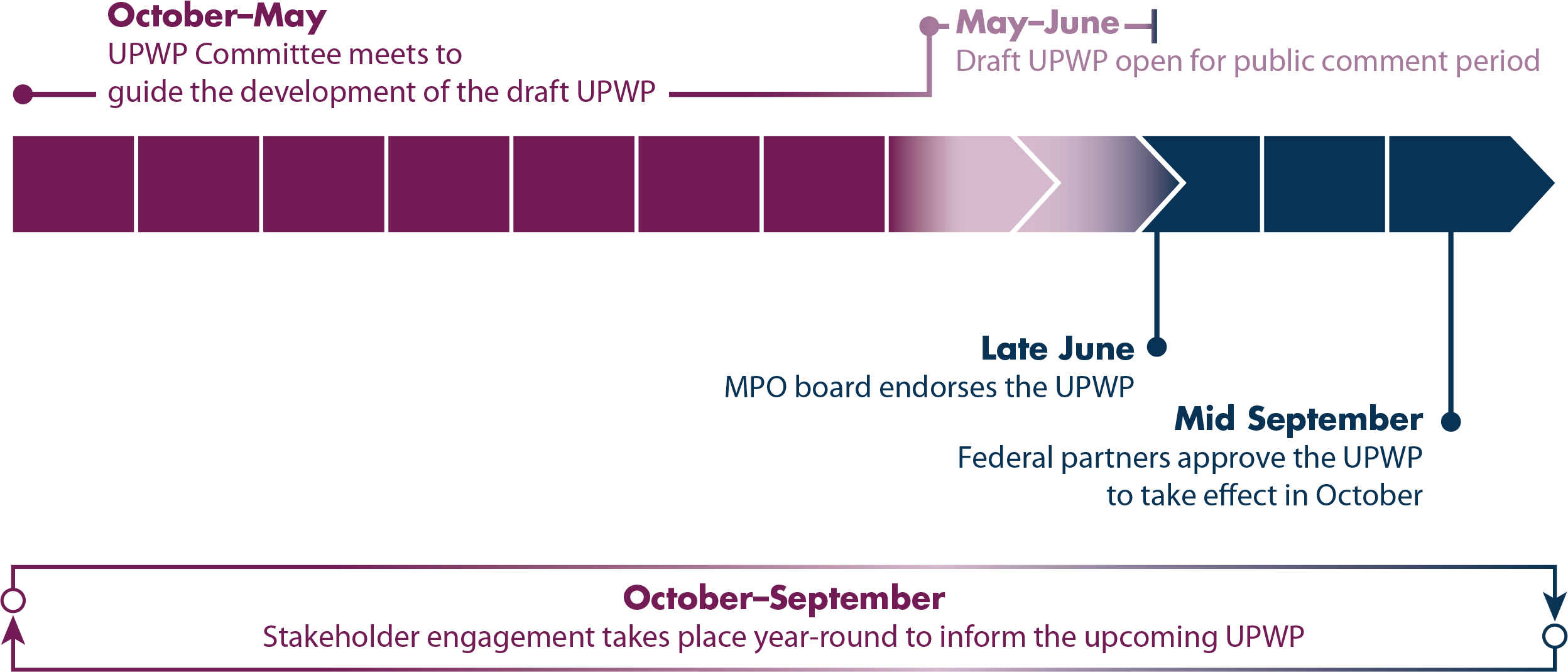
Toward the end of the document development process, the MPO board votes to release a draft UPWP for public review. MPO staff post the document on the MPO’s website (bostonmpo.org) and publicize its release via an email distribution list that includes municipal contacts, interested members of the public, and other regional stakeholders, as well as through social media. Comments received during the public review period are presented to the MPO board to review and consider. The public review period for the FFY 2027 UPWP began on May 8 and ended on May 29.
Figure ES-3 illustrates the annual UPWP development timeline.
Figure ES-3
UPWP Development Timeline
Measuring Progress
The MPO monitors the progress of programs and studies by performing the following tasks:
- Approving detailed work programs and scopes
- Reviewing monthly progress reports
- Tracking program and study budgets and spending via quarterly reports
- Approving the release of deliverables based on whether the objectives stated in the work program or scope were met and whether the stated deliverables were produced