October 2026
Chapter 1—Technical Foundations of Pedestrian Lighting
Chapter 2—Literature Review: Scales of Intervention
Chapter 3—Funding Identification and Alignment
Chapter 4 —Municipal Engagement
Chapter 5—Next Steps and Implementation Roadmap
Project Manager: Scott Pouder, AICP
Project Principal: Jenn Emiko Concannon, AICP
Contributors: Steven Andrews
Graphics: Kenneth Dumas, Kim DeLauri, Olivia Graham
Editorial: David Davenport
Special thanks to Bonnie Polin, the City of Salem, the Town of Swampscott, the City of Milwaukee, and the North Jersey Transportation Planning Authority
The preparation of this document was supported by Federal Highway Administration through MPO §5303 Contract 131249. Central Transportation Planning Staff is directed by the Boston Region Metropolitan Planning Organization (MPO). The MPO is composed of state and regional agencies and authorities, and local governments.
Central Transportation Planning Staff
Boston Region Metropolitan Planning Organization
State Transportation Building
Ten Park Plaza, Suite 2150
Boston, Massachusetts 02116
857.702.3700 | ctps@ctps.org | bostonmpo.org
Civil Rights Notice to the Public
Welcome. Bem Vinda. Bienvenido. Akeyi. 欢迎. 歡迎
You are invited to participate in our transportation planning process, free from discrimination. The Boston Region Metropolitan Planning Organization (MPO) is committed to nondiscrimination in all activities and complies with Title VI of the Civil Rights Act of 1964, which prohibits discrimination on the basis of race, color, or national origin (including limited English proficiency). Related federal and state nondiscrimination laws prohibit discrimination on the basis of age, sex, disability, and additional protected characteristics.
For additional information or to file a civil rights complaint, visit www.bostonmpo.org/mpo_non_discrimination.
To request this information in a different language or format, please contact:
Boston Region MPO Title VI Specialist
10 Park Plaza, Suite 2150
Boston, MA 02116Phone: 857.702.3700
Email: civilrights@ctps.org
For people with hearing or speaking difficulties, connect through the state MassRelay service, www.mass.gov/massrelay. Please allow at least five business days for your request to be fulfilled.
The Boston Region Metropolitan Planning Organization (MPO) sought to provide towns and cities within the region with an understanding of pedestrian lighting and implementation strategies to enhance safety. This report includes five sections:
According to the National Highway Traffic Safety Administration, approximately 76 percent of pedestrian fatalities occur in dark and low-light conditions, and inadequate pedestrian-scale lighting designs are significant contributing factors. The Federal Highway Administration (FHWA) lists lighting as a proven safety countermeasure, recommending lighting be considered at intersections with a history of nighttime crashes and a high volume of non-motorized users. Further, FHWA states “lighting can reduce crashes up 42 percent for nighttime injury crashes at intersections and 33 to 38 percent for nighttime crashes at rural and urban intersections” (Federal Highway Administration. n.d.). A total of 123 pedestrian crashes resulting in fatal or serious injuries occurred during dark or dusk lighting conditions or on unlit roadways in the Boston Metropolitan Planning Organization (MPO) region.
This report will review pedestrian lighting through a holistic approach. While pedestrian-scale lighting is often defined by lower-intensity fixtures on shorter poles, it should also be recognized as a safety countermeasure designed to provide vertical illumination at intersections and crossings (Patterson and Gillespie 2011, 6-7). According to the FHWA Pedestrian Lighting Primer, roadway-scale lighting configurations can also be calibrated to provide sufficient vertical illuminance at intersections, ensuring positive contrast for pedestrian visibility (Federal Highway Administration 2022, 39). However, while the majority of this document focuses on safety, it also provides a cursory review of aesthetic and environmental considerations within plans and approaches, as well as an understanding of Light-Emitting Diode (LED) retrofitting processes.
The Massachusetts Department of Transportation (MassDOT) is developing practical guidance that allows planners to evaluate poor lighting at intersections, midblock crossings, and roundabouts. In conjunction with the guide, MassDOT will provide a list of high-, medium-, and low-ranked crossings where planners may target their initial review. The Boston Region MPO built upon MassDOT’s initial prioritized crossings to identify municipalities with the highest rate and share of dark-condition pedestrian crashes across the region. This was followed by a series of interviews that revolved around safety and ownership themes, working with local communities to better understand current lighting conditions at identified intersections and obstacles in the upgrade or replacement process.
The Boston MPO will collaborate with MassDOT on upcoming guidance and develop case studies with guidance for future projects.
This document is designed for modular use, allowing planners to navigate directly to the sections most relevant to their lighting needs. The Boston Region MPO will offer towns and cities a technical overview of pedestrian lighting and where it may be addressed within the planning process. Further, this report will equip municipalities with funding sources for installation and a roadmap toward implementation.
Illuminance is the measure of how much light is falling onto a surface. It is measured in units of lux or foot-candles (referred to as fc). Vertical illuminance refers to light falling on a vertical plane (such as a pedestrian's body) above the roadway surface. By projecting light toward the intersection or midblock crossing from the direction of oncoming traffic, positive contrast renders the pedestrian brighter than their background. Horizontal illuminance measures the light falling on the roadway surface itself. This is the amount of light a motorist will see on the ground as they approach an intersection (Maine Department of Transportation 2024., 14) (see Figure 1).
Pedestrian lighting guidance is primarily based on federal research, professional standards, and applied studies that scale illumination levels based on pedestrian exposure and potential conflict rather than a single fixed national standard. Current research emphasizes that crosswalk light levels should achieve 20 lux vertical illuminance or higher (Terry et al. 2020, 30). However, these are objectives rather than guarantees of safety. Lighting engineers evaluate lighting design based on overall system performance and intersection and crosswalk characteristics. If lighting provides visibility and safety, departure from guidance is acceptable.
Figure 1
Horizontal and Vertical Illuminance
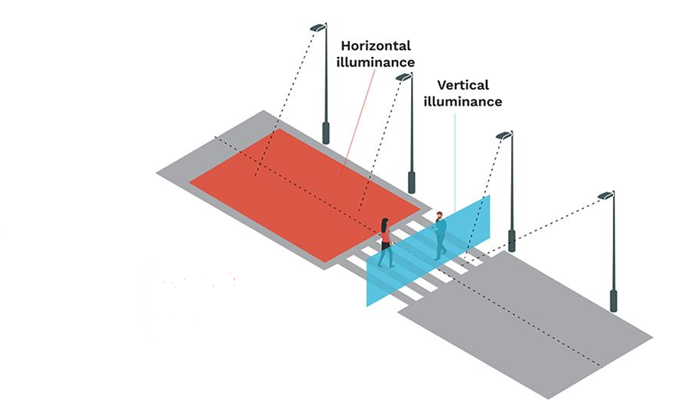
Source: Schréder Group: How to Light Pedestrian Crossings
Contrast is a visible relationship that determines the appearance of an object and the difference between the object and its background. In the context of pedestrian lighting, this refers to the visibility of a pedestrian at a crosswalk or midblock crossing. There are two types of contrast:
Figure 2
Negative and Positive Contrast
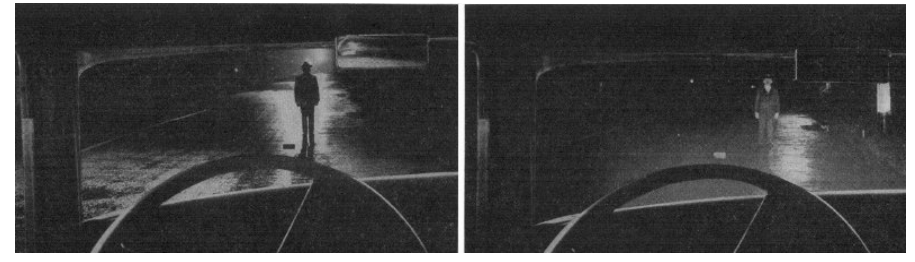
Negative contrast on left; positive contrast on right.
Source: Visual Expert: Seeing Pedestrians at Night
A uniformity ratio describes the measured light in an area, indicating the evenness of lighting. This is typically calculated as the ratio of average horizontal illuminance to minimum horizontal illuminance. Significant dark and bright spots create poor uniformity, which can be more dangerous than consistently low light levels. One effect of poor uniformity causes the ‘Zebra Effect,’ (Asahi Optics 2026) which creates alternating bright pools of light with dark shadows in between (see Figure 3). At intersections, a poor uniformity ratio of 6:1 means the brightest parts of the crosswalk are six times brighter than the darkest parts. Agencies recommend a uniform ratio between 4:1–3:1 (Van Houten et al. 2025, 12).
Figure 3
Zebra Effect
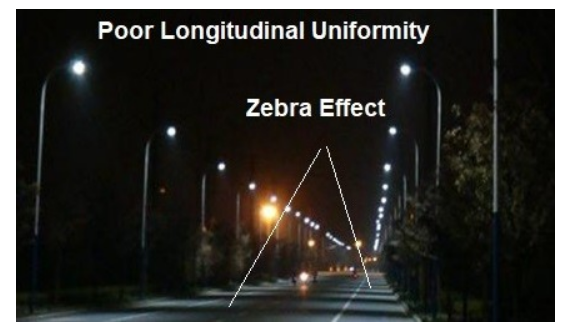
Source: Asahi Optics: Solving Three Common Street Lighting Issues Through
Optical Lenses and Simulation
Light Emitting Diode (LED) technology offers a range of lighting options and outputs. This allows designers to set site-specific illuminance targets (Pattison, Lee, and Donnelly 2022, 7) and, through LED luminaires, “deliver light to target areas without casting light in unintended directions” (US Department of Energy 2014, 2). Further, this technology provides a wide range of Correlated Color Temperature (CCT) options. This is important for balancing pedestrian visibility with environmental concerns (Federal Highway Administration 2022, 21). Older lighting technologies, such as High Pressure Sodium (HPS), were limited in their ability to provide suitable light to pedestrian facilities and crosswalks (Terry et al. 2020, 1). Now, LED technologies can be strategically placed at locations with higher pedestrian volumes or safety needs, while providing targeted illumination of crosswalks, intersections, and street corners to improve pedestrian visibility and nighttime safety (Markowitz and Schwendinger 2023, 25).
LED technologies are replacing legacy HPS fixtures as outdoor lighting undergoes a significant transition. Between 2017 and 2020, The Metropolitan Area Planning Council awarded 61 municipalities grant funding to retrofit their existing lighting infrastructure. This collective procurement effort reduced greenhouse gas emissions and lowered electricity usage and operational costs. These retrofits allow communities to implement smart lighting technologies. According to a recent Institute of Transportation Engineers journal article, smart lighting upgrades are categorized into three types:
CCT measures the color appearance of white light sources emitted by a lamp. Lower values, such as 2,700K, produce a warm, yellowish glow, while higher values, such as 5,000K, emit a cool, blue-white light (see Figure 4) (Federal Highway Administration 2022, 16). The Federal Highway Administration’s (FHWA) pedestrian lighting primer recommends implementing a CCT range between 3,000-4,000 K (neutral white) along pedestrian facilities adjacent to the roadway and at crosswalks. Research indicates that lower CCT (2200 K) LEDs provide less visibility for drivers detecting pedestrians compared to 4000 K or 5000 K, suggesting that lighting interventions should use LEDs of at least 3000 K (Terry et al. 2020, 33).
Figure 4
Color Temperature in Kelvin
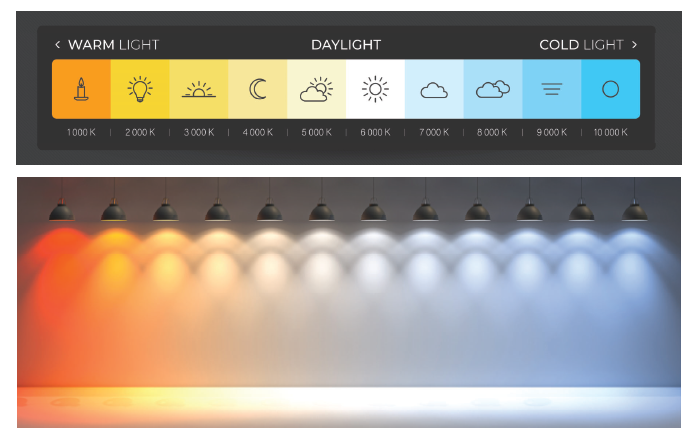
Source: Maine Department of Transportation: Maine DOT Crosswalk Lighting Guidelines, 2024
However, DarkSky International recommends a maximum CCT of 3,000 K. Blue lighting can compromise human vision. Further, 4000 K CCT can result in a 2.5 percent increase in light pollution due to atmospheric scattering (International Dark-Sky Association 2022, 2) and can suppress melatonin secretion, leading to sleep disruption (Jo et al. 2021, 2). Agencies can balance CCT requirements by applying warmer lighting in residential and environmentally sensitive areas to reduce light pollution, while reserving higher-contrast 3000-4000 K lighting for high-traffic pedestrian locations.
Light fixtures, or luminaires, are complete lighting units. Fixtures include the components to distribute light, position and protect the light source, and connect the system to the electrical power supply (Illuminating Engineering Society n.d.c). Illuminating Engineering Society (IES) classifies luminaire light distribution into five categories (see Figure 5) based on their lateral throw. Type I and II are linear distribution patterns for walkways and streets, while Type III creates asymmetrical coverage for large roadways and parking lots. Type IV emphasizes forward-throw, lateral projections, and Type V provides circular distribution (Greaney 2025).
Figure 5
Luminaire Light Distribution Types
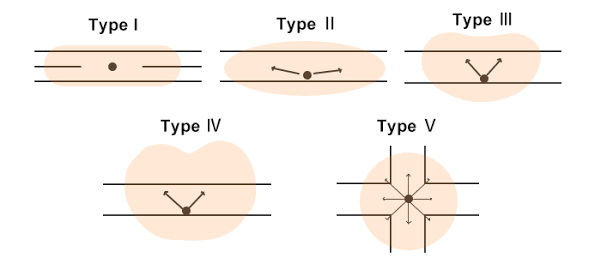
Source: Brightlx: What Is IES Light Distribution Type I, Type II, Type III, Type IV, Type V?, 2024
Pedestrian-scale lighting helps define a streetscape and creates a sense of place while also contributing to safety and comfort (New Jersey Bicycle and Pedestrian Resource Center 2019). This design uses a lower pole height with a range from 10 to 18 feet (Markowitz and Schwendinger 2023, 25). However, other research defines “pedestrian-scale” as any mounting height below 20 to 21 feet (Terry et al. 2020, 31). Lower pole and luminaire heights also have the added benefit of providing high levels of vertical illumination (Gibbons et al. 2023, 64). “Roadway lighting is mounted at a higher elevation and provides a higher level of horizontal illuminance” (Terry et al. 2020, 30) with a typical height above 20 feet. Roadway lighting casts optical distributions to provide better uniformity along the roadway. At a crosswalk, a luminaire affixed at a lower height can provide a higher level of vertical illuminance than the same luminaire placed on a taller pole. Further, according to the FHWA’s Street Lighting for Pedestrian Safety, research indicated that lower mounting heights allow motorists to see pedestrians from a greater distance.
Obtrusive lighting occurs when luminaires emit light that extends beyond their intended area, such as private residences or the night sky. It consists of three types of light pollution: spill light (or trespass), glare, and sky glow (see Figure 6).
Disability glare occurs when an emitted light source reduces retinal image (Illuminating Engineering Society n.d.a) and happens when stray light scatters inside the eye, creating a 'veiling luminance'. This prevents the driver from seeing adequately. Disability glare decreases the ability to see objects at a distance (Federal Highway Administration 2022, 16); thus, a driver may not have the reaction time needed to stop at an appropriate time and has a shorter visibility distance. This type of glare also reduces the detection of objects. For example, in a study conducted by the NHTSA to measure headlight glare, if an object is not detected within the driver's field of view within one second, “glare increases the percentage of times that people cannot see objects” (National Highway Traffic Safety Administration 2007, 14).
Figure 6
Obtrusive Lighting
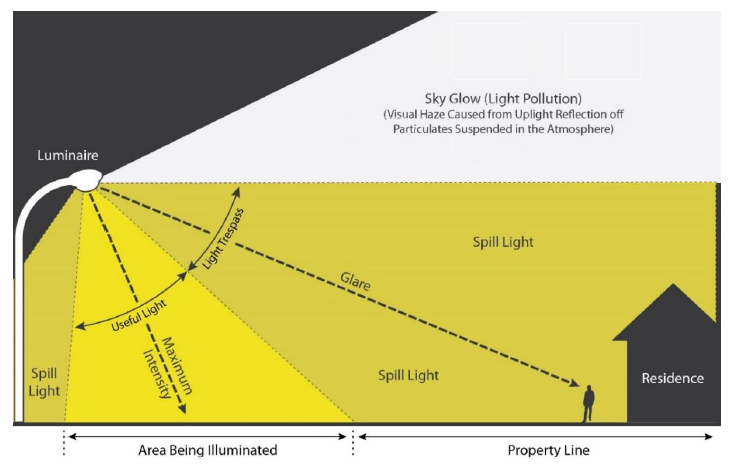
Source: Federal Highway Administration: Pedestrian Lighting Primer, 2022
IES and DarkSky International developed a Backlight-Uplight-Glare (B-U-G) rating system (between 0 and 5). This measures the amount of light emanating in all directions and is a guide for controlling unwanted light (Iowa Statewide Urban Design and Specifications 2020, 9) (see Figure 7). The rating values are based on total lumen output in various angular distributions (City of San Antonio 2019, 24), which include backlight (B), uplight (U), and glare (G). Backlight measures the lumen distribution away from the street and uplight evaluates the lumen distribution above the horizontal plane, considering light spill and sky glow, respectively (Iowa Statewide Urban Design and Specifications 2020, 9). Finally, glare measures the light emitted from the luminaire at high angles, between 75 and 90 degrees, which causes discomfort or disability glare for road users (Maine Department of Transportation 2024, 23).
Figure 7
Light Distribution by Backlight, Uplight, and Glare
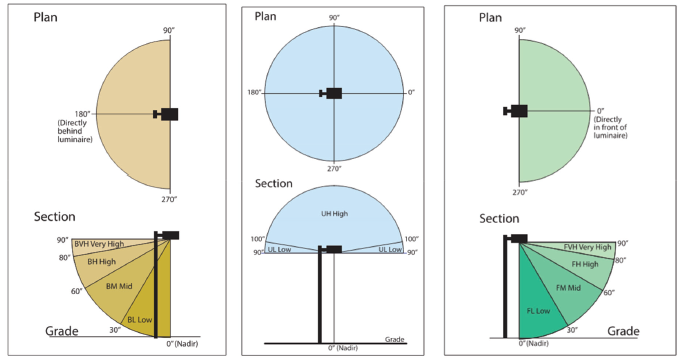
Source: Maine Department of Transportation: Maine DOT Crosswalk Lighting Guidelines, 2024
DarkSky International recommends shielding luminaires to direct light downward while minimizing light spill. The Maine Department of Transportation (MaineDOT) compared “two pedestrian-style luminaires and their associated BUG ratings.” MaineDOT tested a globe-style luminaire against a “full cutoff” luminaire (see Figure 8). The globe-style luminaire scattered and distributed much higher lumens for each category, while the full cutoff eliminated uplight (U0) and reduced backlight and glare (Maine Department of Transportation 2024, 24).
In Princeton, New Jersey, The Witherspoon Street project went through three phases of development to create a pedestrian-oriented street intended to provide a safer, friendlier corridor that meets the needs of all its users. This included pedestrian-scale lighting featuring early 20th-century style refractive globe (acorn) fixtures (see Figure 9). Following the installation and activation of lighting fixtures, the pedestrian-scale lighting produced a harsh glare, affecting both pedestrians and motorists. Further, the luminaire received an uplight rating of U4 on the Backlight, Uplight, Glare (BUG) rating system. This contributed to sky glow and, while there were improvements in safety, residents also noted light trespass within their homes. Princeton is collaborating with PSE&G to select new fixtures with lower BUG ratings (Jones 2024). Before installing or retrofitting pedestrian lighting at project sites, Boston MPO Region towns and cities may want to evaluate fixture orientation and CCT in context with surrounding land uses.
Figure 8
Maine DOT BUG Rating Test
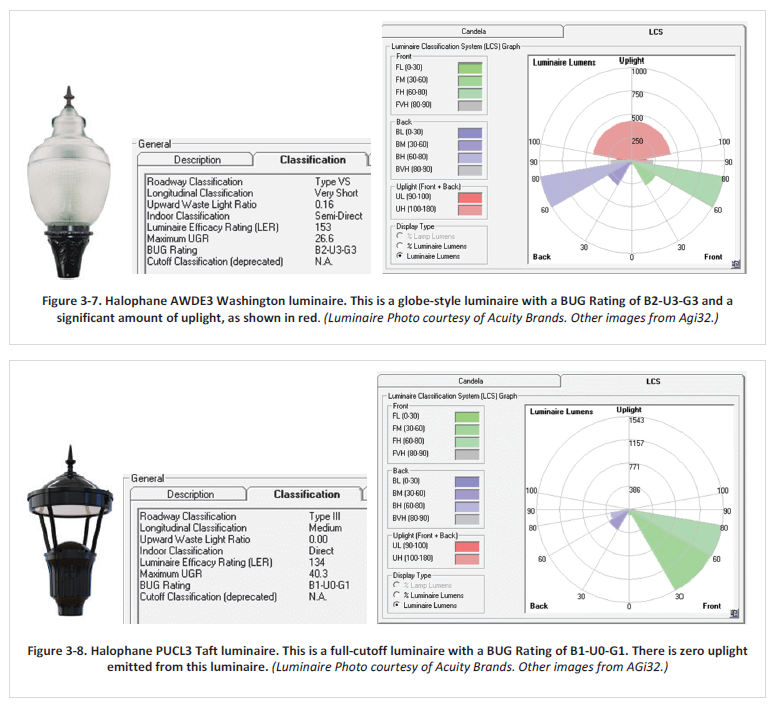
BUG = backlight, uplight, glare rating system.
Source: Maine Department of Transportation: Maine DOT Crosswalk Lighting
Guidelines, 2024
Figure 9
Princeton Witherspoon Street Project
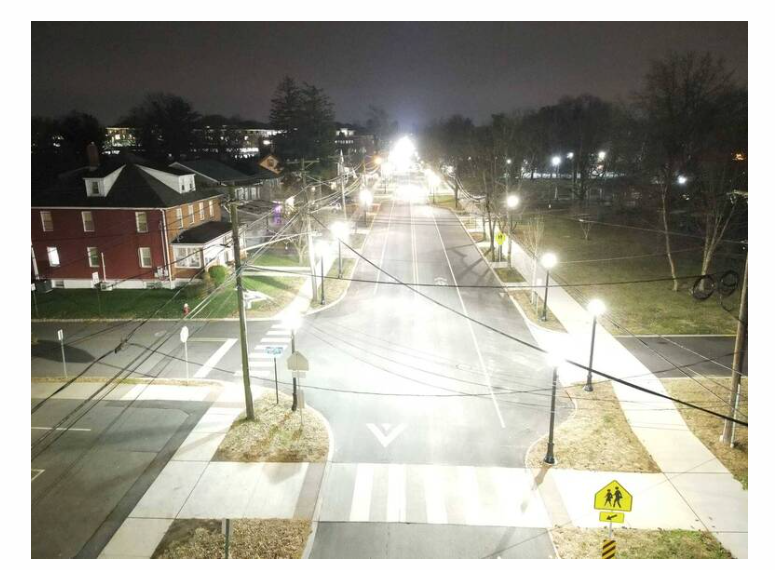
Source: TAPinto Princeton: A Bright Finish for Witherspoon Street Leaves Princeton
Asking New Questions, 2024
On July 1, 2026, the Massachusetts State Senate passed a bill to establish Dark Sky Principals for new outdoor lighting funded or operated by state and municipal governments (Dark Sky Massachusetts 2026). Working with the Massachusetts Department of Transportation (MassDOT) and the Executive Office of Public Safety and Security, the bill directs the Department of Energy to establish regulations for roadway lighting requirements. This includes the number of and maintained illuminance levels, and requirements must consider criteria published by FWHA and the IES (Massachusetts General Court 2026). CCTs would generally be limited to 3000K, with an exception where a public safety, such as a crosswalk, need is demonstrated, and fixtures would be required to meet shielding requirements (Access Fixtures 2026). Finally, if a municipalities code specifies lower illuminance levels, the “municipal or county ordinance or regulation shall govern” (Massachusetts General Court 2026).
“The bill would also alter the way cities and towns are charged for the electricity used by their lighting, changing the legacy cost-per-light structure to a metered price calculation” (Cammalleri 2026). The Department of Public Utilities is directed to develop an electric “rate for unmetered roadway or parking-lot lighting fixtures utilizing less than 25 watts of electricity” (Massachusetts General Court 2026). This would address the electricity towns and cities are not using, addressing the electricity used by the low-wattage fixtures (Cammalleri 2026). Further, MassDOT is tasked to review and issue a report on lighting operational costs.
This section examines pedestrian lighting strategies implemented by municipalities nationwide and throughout the Boston Metropolitan Planning Organization (MPO) region. Several studies and plans highlight the cross-cutting dependencies between these documents and show how pedestrian lighting is integrated throughout the planning process. This section of the report provides brief overviews and comparisons of pedestrian lighting case studies as it is embedded within the following narratives:
This section reviews data-driven approaches to identify locations for pedestrian lighting improvements and installation. The Olin College of Engineering, in partnership with the United States Department of Transportation (US DOT) Volpe Center, developed a methodology to inventory and assess pedestrian lighting, contrast, and visibility at crosswalks across a broader geographic area. In a separate effort, the Town of Needham, Massachusetts, evaluated existing lighting conditions from the most recent Metropolitan Area Planning Council (MAPC) Light Emitting Diode (LED) conversion, leveraging a town-wide pedestrian safety audit to systematically identify and address high-risk crosswalk locations.
Local municipalities often lack a standardized process, addressing lighting issues on a case-by-case basis. In Boston, for example, the current approach relies on resident-initiated 311 complaints to identify outages or poor illumination. The Olin College of Engineering in Needham developed its methodology to provide a systematic alternative to ad hoc municipal approaches, enabling more informed investment decisions for pedestrian lighting improvements. Through its research, the College met with the City of Boston to collect a geo-located inventory of existing lamppost locations, heights, and wattage from Vision Zero work, alongside crosswalk data provided by the University of Massachusetts Amherst. This “pseudo-contrast prediction model uses the location of each lamppost in relation to the crosswalk” (Cranor et al. 2025, 8) and develops a prioritization process to validate the data in the field.
First, the College establishes a spatial relationship between pedestrian and vehicle positions, which allows for an evaluation of visibility and contrast at the crossing. Second, the College identifies the locations of streetlights in relation to each crosswalk (see Figure 10). This shows the direction of the pedestrian location relative to the vehicle approach and determines whether the lighting occurs before or after the crosswalk. Finally, the College applies contrast conditions via proxy and estimates whether there is strong positive, weak positive, weak negative, strong negative, or no contrast at crosswalk locations. For example, at an intersection, a strong positive contrast occurs when there is a high level of lighting on the driver’s approach side, allowing the pedestrian to be seen clearly against the background.
Figure 10
Boston—Spatial Locations of Streetlights in Relation to Each Crosswalk
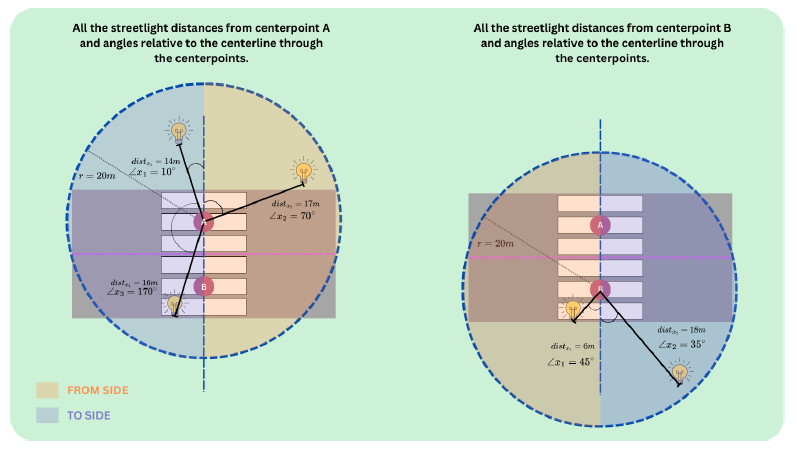
Source: John A. Volpe National Transportation Systems Center: Night Light, 2025
The team used an interactive map to visualize the results, verifying the proxy contrast crosswalk data against field-collected perceived contrast data. From the initial findings, the model accurately predicted 63 percent of the contrast conditions. While this study allows for a scalable approach to understanding contrast in the field, the results highlight limitations of proxy-based approaches and reinforce the necessity for ground-truthing and iterative refinement.
The Town of Needham conducted a town-wide safety audit in response to residents' concerns over pedestrian safety throughout town. Through the engagement process, Needham residents identified lighting as the top concern with 58 percent of residents concerned about pedestrian safety during nighttime conditions. This community feedback formed the foundation of the audit, prioritizing high-risk crossing locations across the town.
Following the MAPC-funded conversion from High Pressure Sodium (HPS) to LED, Needham assessed lighting levels along municipal roadways and identified areas needing supplemental pedestrian lighting. Needham also reviewed industry-recommended standards to establish guidance that incorporates them into new construction projects. Further, the Town mapped intensity levels from existing lighting fixtures to visualize light distribution on the roadway surface (see Figure 11). This analysis provides a representation of illuminated and dark segments, which will facilitate targeted infrastructure improvements.
Figure 11
Needham—Lighting Intensity Map
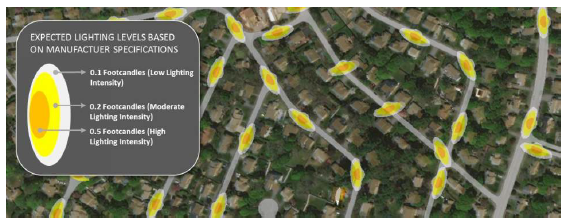
Source: Town of Needham: Town-Wide Pedestrian Safety Audit, 2019
Using the results from the analysis, Needham inventoried locations with poor lighting, performing an onsite assessment of illumination deficiencies at high-risk locations using Federal Highway Administration’s (FHWA) Informational Report on Lighting Design for Midblock Crosswalks. Of the 69 uncontrolled street crossings reviewed for lighting, 12 lacked lighting, and 54 did not meet recommendations. These findings defined a new set of orientation standards, including preferred configurations for both midblock and intersection lighting enhancements.
The Town of Needham uses a multiple step approach to identify high-risk crosswalk locations, while applying existing lighting conditions in the town-wide pedestrian safety audit process. This systematic framework identifies lighting gaps across a broad geographic scale and provides a scalable, data-driven model for future infrastructure assessments and safety studies.
Several municipalities are developing citywide pedestrian lighting plans to move away from historically fragmented, ad-hoc approaches. Brookline, Massachusetts, for example, developed its plan in response to its Complete Streets Policy, which calls for adequately lit sidewalks and crosswalks. Seattle, Washington, builds off the Pedestrian Master Plan by outlining how pedestrian lighting should be incorporated within the city-owned right-of-way. However, these approaches slightly differ in how lighting is planned and implemented.
Other cities use Master Lighting Plans (MLP) as a broader lighting infrastructure strategy. These ensure visual performance and safety of lighting, while also reinforcing a sense of place and historical character. MLPs generally adhere to a structured, five-step process to assess lighting (see Figure 12).
Figure 12
Master Lighting Plan Structure
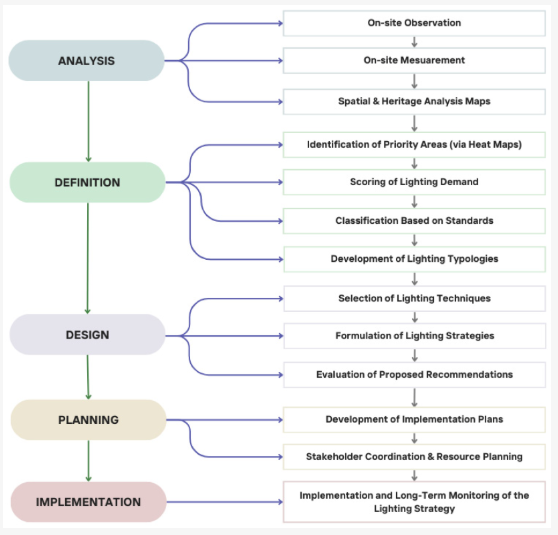
Source: Designing Lighting Master Plans in Historical City Centers: A Structured Approach and Case Study from Adana, 2026
Seattle framed the plan through a data-driven, planning-oriented approach that involved inventorying and identifying pedestrian-scale lighting locations and applying a modified version of the Seattle Pedestrian Master Plan “high-priority area” framework. This framework is based on pedestrian demand, equity indicators, and corridor function and pedestrian-scale lighting locations and crime hotspots. These factors were then integrated into the spatial analysis to produce a heat map of poorly lit conditions. The analysis ranked and categorized arterials and intersections to guide large-scale installations and targeted spot improvements, respectively (see Figure 13). Seattle also lacked standardized pedestrian lighting requirements across the city. Historically, neighborhood and design plans often provided only vague guidance, contributing to an ad hoc, project-by-project approach. The plan calls for better inter-departmental coordination and inclusion within the Right-of-Way Improvement Manual (ROWIM).
The plan successfully updated the ROWIM by introducing a dedicated section for pedestrian-scale lighting and mandating that all new designs and construction should adhere to Illuminating Engineering Society (IES) guidance. Further, within the ROWIM, pedestrian lighting implementation should be prioritized within Pedestrian Lighting High-Priority Areas outlined in the Pedestrian Lighting Citywide Plan.
The Town of Brookline transitioned from a high-level Complete Streets policy to a dedicated Pedestrian-Scale Lighting Plan by identifying the specific failures of its legacy infrastructure. Brookline’s existing lighting system was focused on vehicular travel, with utility-mounted fixtures spaced approximately 150 feet apart. While pedestrian-scale lighting exists in areas of high pedestrian demand in commercial areas (approximately two miles of streets), Brookline found a lack of uniformity with some sections of pedestrian lighting spaced improperly and existing fixtures. These existing fixtures caused unwanted light spill and glare along the commercial corridors. Finally, Brookline conducted targeted field visits to identify intersections where the absence of pedestrian-oriented lighting posed the greatest safety risks.
This plan informed a dedicated funding stream: An annual $200,000 line item within the Engineering and Transportation budget, ensuring lighting is addressed as a standalone safety priority rather than an “’add-on” to larger projects.
Figure 13
Seattle—Pedestrian Lighting Prioritization Map
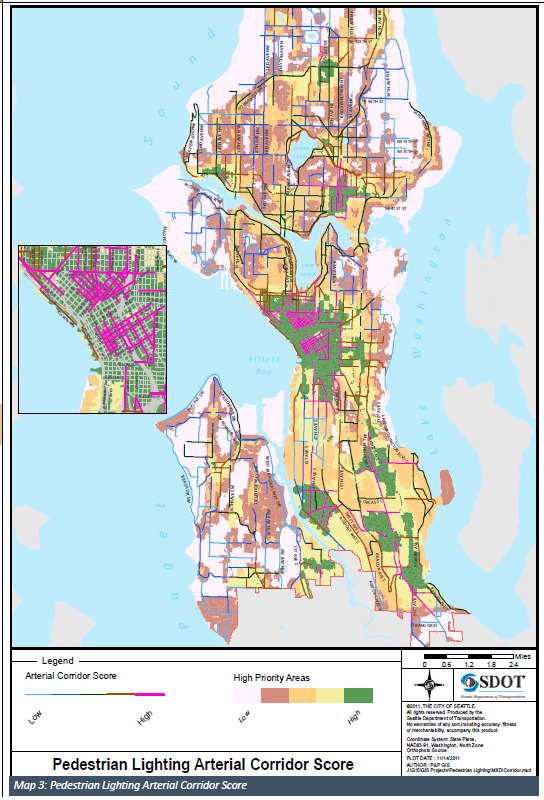
Source: Seattle Department of Transportation: Pedestrian Lighting Citywide Plan, 2012
An MLP is a formal arrangement between local governments and other entities within a regional area to coordinate and standardize the design, operation, and maintenance of public lighting (Texas Department of Transportation n.d.). This strategy provides a holistic approach to enhance lighting and contributes both to safety and aesthetics, creating a blueprint for implementation. The City of London and the City of San Antonio, Texas, for example, evaluated the entirety of its urban environments. Each city reviewed lighting in open spaces, historical districts, and building architecture, while also applying specific illumination values and spacing to its roadway.
The City of San Antonio inventoried existing lighting conditions and equipment across its functional classification network. This assessment identified corridor segments with inadequate pole spacing, high color temperatures, and non-compliance with IES illumination and uniformity standards. For example, San Antonio found minor street (mixed-use and commercial areas) segments had cobra-head style HPS lighting equipment. This causes direct glare and could benefit from LED retrofits. Further, San Antonio found intersections that were not in compliance with illumination standards set forth by the IES. San Antonio developed a comprehensive framework that applied appropriate equipment, CCT targets, and intensities to its functional classification network.
Alternatively, London established illuminance values for “main streets” and “side roads,” as well as pedestrian paths and the river walkway (see Figure 14). They then developed adaptive lighting across roadways and open spaces, adjusting levels to account for the following:
For example, the system provides higher illumination during peak traffic hours and dims during off-peak periods when vehicle and pedestrian activity subside, while also considering season variability with summer months having longer periods of daylight and winter months with less.
Figure 14
London—Citywide Illuminance Values
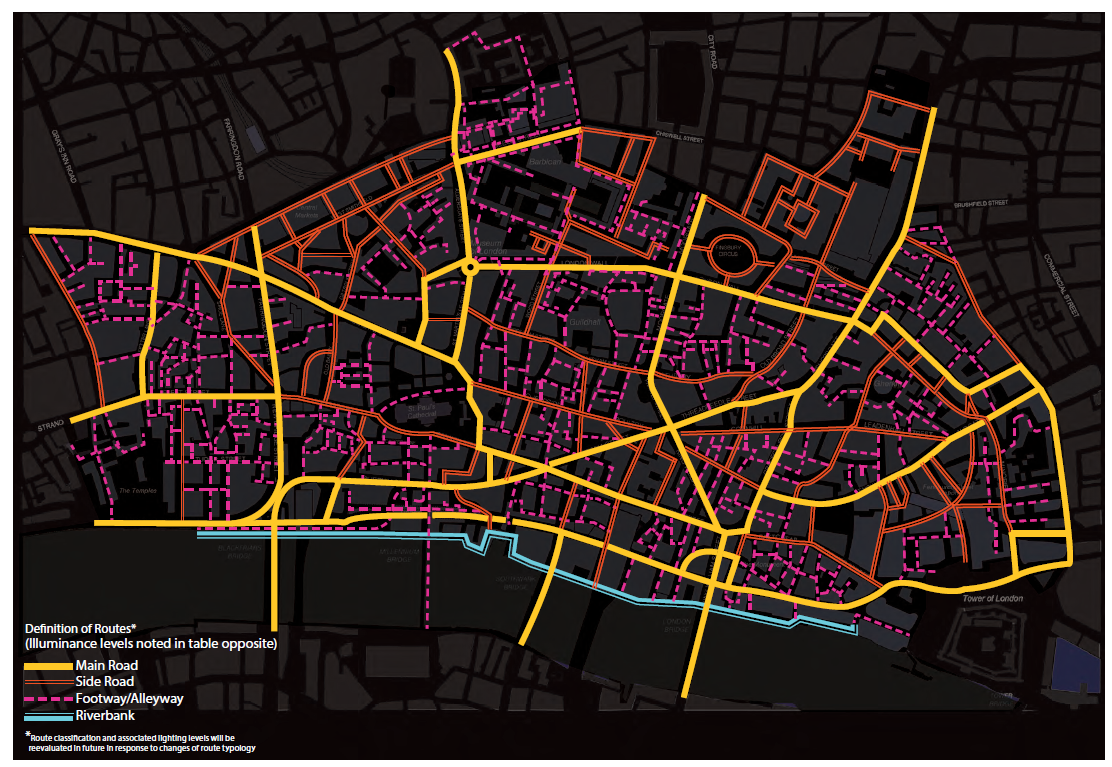
Source: City of London: City of London Lighting Strategy, 2018
Vision Zero establishes the goal of zero deaths and serious injuries. HINs use crash data to identify locations with the highest concentrations of past fatal and serious injury crashes and target areas with the greatest potential for safety improvement. Well-designed lighting, one of the “proven pedestrian safety countermeasures” identified by the FHWA, should be considered as part of a Safe System Approach, which aims to address and mitigate the risks inherent in the transportation system (Markowitz and Schwendinger 2023, 25). The Boston MPO region recorded 123 fatal or serious pedestrian crashes in dark or unlit conditions. The Boston Region MPO adopted its Vision Zero Action Plan on March 5, 2026, with a corresponding HIN.
The Boston MPO interviewed a member of the City of Milwaukee’s Public Works Department to discuss its innovative approach to large-scale LED lighting retrofits at intersections along its pedestrian HIN. Milwaukee mapped all pedestrian crashes with severe and fatal crashes receiving a higher score than non-injury related crashes, which were then totaled in half-mile segments to represent the most dangerous corridors. Using the pedestrian HIN as a catalyst, the city successfully applied for Transportation Alternatives Program (TAP) funding to address outdated HPS lighting.
TAP funds a variety of transportation-related projects that increase options for non-vehicular transportation, including construction projects. Milwaukee focused the funding on target areas along the HIN, prioritizing intersections with high nighttime crash rates and major pedestrian generators such as bus transfers, parks, and schools. Once target intersections were identified, Milwaukee overlaid its street lighting network and found that its multiple-circuit street lighting system, with individual voltage, enables fast and low-cost LED retrofits (see Figure 15).
Figure 15
Milwaukee—Prioritized Intersection for LED Retrofits
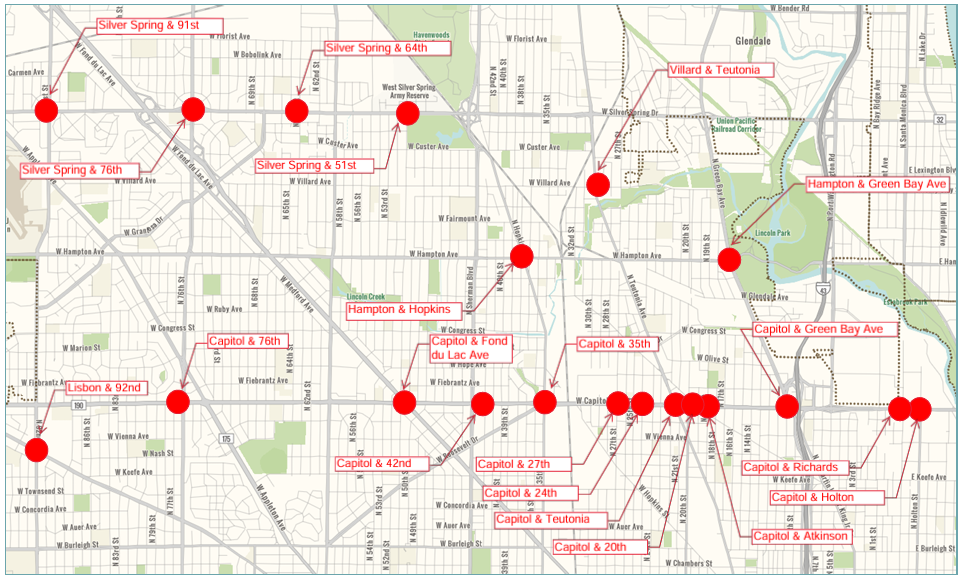
LED = Light Emitting Diodes
Source: City of Milwaukee: Street Lighting on Pedestrian High Injury Network: Project Location Maps
Milwaukee owns and maintains all lighting infrastructure, including the poles, fixtures, and cabling, which permits Milwaukee to more effectively and efficiently retrofit streetlights to LED. Milwaukee completed the federal processes necessary to obtain funding, as well as the selection of the contractor. The project has entered the implementation phase and with the installation of all designed components is expected to conclude by the end of the year.
Milwaukee successfully targeted and implemented LED lighting to improve visibility at 68 intersections with high nighttime crash rates and pedestrian demand. This shows the benefits of municipal ownership, which allows cities to target specific locations more effectively without relying on utility companies for retrofits. Finally, Milwaukee plans to expand this effort by implementing pedestrian-scale lighting along trails and converting the more expensive existing lighting, series circuit, to LEDs.
This section reviews MassDOT’s current Complete Streets framework and evaluates the various municipal policies regarding pedestrian lighting within the Boston Region MPO’s jurisdiction. It will also briefly examine the Boston MPO’s Complete Streets process as it relates to the Transportation Improvement Program (TIP), comparing it against Denver Regional Council of Governments (DRCOG) Complete Street’s Toolbox process. This comparison shows an alternative that focuses on a top-down approach with specific pedestrian lighting language and recommendations.
The MassDOT Complete Streets program partners with communities to identify and fund transportation projects that address infrastructure gaps within local networks. Under the program’s current list of eligible activities, street lighting is categorized within the ‘Environment & Streetscape’ investment section, which includes projects that incorporate streetscape amenities. Pedestrian lighting is not explicitly mentioned within other eligible activities, including intersection redesign, pedestrian crossing modification, or transit investments, highlighting an absence in integrated lighting standards.
The program was originally structured around a three-tier system designed to guide municipalities from policy adoption to physical construction:
While not a formal requirement, MassDOT recommends that communities follow this tiered approach. Most cities and towns adopt the standard Complete Streets policy language provided by MassDOT. For example, within the performance measures section, the guidance offers options ranging from linear feet of reconstructed sidewalks to economic impacts in business districts. While certain measures track the “number and type of intersection improvements,” there is no dedicated metric for pedestrian lighting. However, the Town of Brookline explicitly stated that “sidewalks and crosswalks should be adequately lit” within its design guidance section. This ultimately led to its pedestrian lighting plan.
The Boston Region MPO uses a Complete Streets Scorecard to prioritize projects within the TIP. The scorecard applies criteria aligned with the Long-Range Transportation Plan, such as achieving zero transportation-related fatalities and enhancing multimodal access. However, while the scorecard includes quantitative elements, the prioritization process has increasingly relied on qualitative staff judgment. Further, there is currently limited guidance defining the specific characteristics of a Complete Street.
The DRCOG developed a Complete Streets Toolkit to provide municipal guidance and ensure multimodal balance. By aligning with this framework, communities become more competitive for funding through the TIP. DRCOG used a combination of local and regional data to develop street typologies. These typologies prioritize different modes and their corresponding design elements. For example, the “downtown mixed-use” typology (see Figure 16) sets high priority for walking and rolling, with pedestrian lighting categorized as a high-priority design element. Further, it provides high-level policy recommendations including spacing, LED lighting, and fixtures that are in accordance with the DarkSky International Model (Denver Regional Council of Governments 2021, 48).
Figure 16
Denver Regional Council of Governments—Downtown Mixed-Use Typology
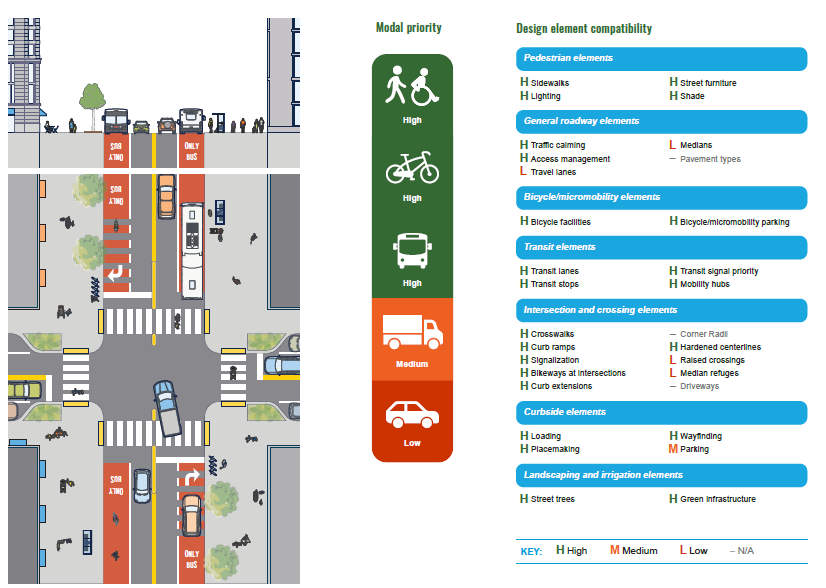
Source: Denver Regional Council of Governments: Regional Complete Streets Toolkit, 2021
DRCOG provides communities with standardized, top-down language for a Complete Streets model, embedding practical implementation guidance directly alongside high-level policy requirements. This framework establishes a uniform approach for municipalities to implement pedestrian lighting, effectively streamlining the integration of local safety projects into the regional TIP.
Pedestrian lighting is a key component of a multimodal system because it improves visibility and comfort and reduces conflict between Vulnerable Road Users (VRU) and vehicles. This section reviews two active transportation plans, highlighting actionable recommendations that lead to implementation.
The Portland Bureau of Transportation (PBOT) analyzed crash data and, similar to national trends, observed the severity of crashes that increased at nighttime with the highest rates occurring during the winter and fall months because of reduced daylight hours. Further, a “Walking While Black” public engagement initiative, which examined racial disparities in pedestrian safety, drive behavior, and infrastructure access, identified lighting as vital to pedestrian visibility and safety and the top barrier for walking within the community.
The PBOT developed a pedestrian network, based on land-use demand and public outreach, with classifications ranging from Major City Walkways to Neighborhood Walkways. Using the developed pedestrian network as a baseline, the PBOT identified and weighted segment and intersection gaps within the network by applying equity, safety, and demand metrics. This methodology yielded a tiered prioritization framework, allowing for a series of strategies and actions to address cross-cutting factors including historic underinvestment, Vision Zero, and public safety.
One strategy explicitly prioritizes pedestrian lighting with supplemental actions that translate high-level policies into attainable safety objectives:
The Connect Arlington sustainable transportation plan establishes a framework to reduce greenhouse gas emissions by integrating multimodal alternatives to single-occupancy vehicles while enhancing system-wide safety. These strategies align with the plan’s vision and goals and were developed following a synthesis analysis, policy, and public engagement. Through the public engagement process, residents identified the implementation of pedestrian-scale lighting as a top priority for enhancing safety and visibility at existing crossing locations.
Arlington integrated lighting primarily within two goal areas: completing the Minuteman Bikeway Project and enhancing pedestrian safety through targeted design improvements at intersections and crossings (see Figure 17). These goals prioritize high-visibility infrastructure where multimodal activity is most concentrated. Table 1 shows the recommended strategies to achieve these safety goals.
Figure 17
Arlington—Minuteman Bikeway Lighting Plan
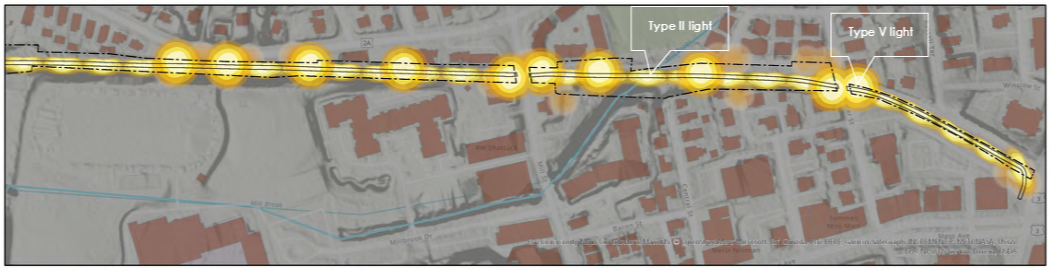
Source: Town of Arlington: Minuteman Bikeway Planning Project, 2022
Table 1
Arlington—Sustainable Transportation Plan Pedestrian Lighting Recommendation
Goal |
Strategy and Recommendations |
Outcome |
Complete the Minuteman Bikeway Project and implement recommendations that increase access to and capacity and safety on the pathway. |
Install lighting to increase visibility and safety along the pathway at night. Arlington prioritized a comprehensive lighting plan for the Minuteman Bikeway to eliminate visibility gaps and standardize illumination across the multiuse corridor. |
Through the Town of Arlington Minuteman Bikeway Planning Project Plan, an assessment of existing conditions found sparse coverage, significant light spill, and obsolete fixtures along the corridor. The town developed a high-level lighting plan with recommendations including new fixtures, illumination values at intersections, and cost. The plan specifies Type II distribution for path segments and Type V distribution for intersections and access points. |
Enhance pedestrian safety through design improvements at intersections and crossings. |
Enhance lighting at intersections and other crossings to improve pedestrian visibility. |
While the town has yet to codify a lighting design guide, it has addressed safety goals by deploying Rectangular Rapid Flashing Beacons at six unsignalized locations. |
Enhance pedestrian safety through design improvements at intersections and crossings. |
Pilot intersection lighting improvements that focus on the pedestrian, and pedestrian crossings, to improve visibility and safety. |
There has been no advancement on this strategy. |
This section reviews urban design guidelines, which serve as an advisory framework to shape streetscape enhancements, redevelopment initiatives, and improvements to the public realm, as well as a negotiation tool for designs and redesigns (McBride 2025, 12). Although certain guidelines prioritize aesthetics, other guidance integrates pedestrian lighting as a critical safety countermeasure. These guidelines can be incorporated into capital improvement projects or other development opportunities and may be referenced in municipal code.
San Francisco’s Better Streets Guidance is an interconnected policy that encourages the design and development of streetscapes to align with Complete Streets and the City’s ecological code. Under this model, developers are required to improve the public right-of-way adjacent to their projects, submitting a detailed streetscape plan for Planning Department review. Street lighting is recognized as an aesthetic enhancement and safety countermeasure. The design guidance includes recommendations such as the location and spacing of street lighting, distribution of lighting, and reduction in glare or sky glow. Further, the guidance establishes specific recommendations for illuminance levels and uniformity criteria to address both pedestrian and vehicles, incorporating lux requirements for intersections, midblock crossings, and roadways.
Similarly, the City of Newton provides illumination levels and uniformity for street types and land use context and recommended LED distribution types for continuous roadway. However, Newton distinguishes itself between San Francisco's guidelines in that it provides recommended heights for both roadway and pedestrian-scale lighting. Further, Newton establishes specific luminaires and fixtures with standardized color temperature outlined in its ordinance.
While Cambridge recommends using photometric analysis to determine appropriate spacing and references its DarkSky International ordinance, its design guidance primarily emphasizes the aesthetic of pedestrian-scale lighting. Cambridge establishes lighting as a placemaking tool, enhancing the city’s historical feel and experience. In Cambridge, the Citywide Urban Design Guidelines provide clear direction for public projects. This ensures that City departments and staff maintain a shared understanding of the design expectations for streetscapes, open spaces, and new public buildings. For private development, any project that is under public review for zoning must adhere to the guidelines. However, as-of-right projects that do not require special approval are generally not required to follow these standards.
This section outlines how municipalities utilize ordinances to govern pedestrian lighting. Many communities now embed DarkSky International principles within their municipal codes to reduce light pollution and improve the pedestrian experience. Ordinances also ensure developer compliance during the subdivision process and provide standards for safety.
According to Modernizing Outdoor Lighting Regulations, many municipalities rely on outdated standards, such as wattage and HPS-based metrics, rather than modern lumen-based measurements and recommend “semi” and “full-cutoff” fixture classifications. Further, many ordinances fail to regulate CCT. To provide a holistic update to municipal codes, planners can implement “lighting zoning” (see Figure 18). This is an overlay zoning tactic that “identifies where a particular level of ambient lighting or a particular range of light levels is both expected by residents and appropriate for the area’s use at nighttime,” (McBride 2025, 3) having brighter lighting in downtown areas and lower levels in residential areas (McBride 2025, 4).
Cambridge’s ordinance divides exterior lighting into zones to regulate light emission and direction. Cambridge applies a lower-intensity zone to residential and neighborhood areas, limiting light levels at property lines. This requires fully shielded fixtures and restricts uplight to minimize glare, light trespass, and sky glow. In commercial and industrial areas, higher intensity zones allow for increased lighting levels, maintaining shielding requirements to prevent spillover into adjacent properties. These regulations govern private site and building-mounted lighting, but public lighting is exempt from the lighting zone regulation.
The City of Flagstaff, Arizona, uses a lighting classification system based on both land use and function. Flagstaff adopts more permissive classes for safety lighting to ensure visibility, while residential areas prioritize DarkSky International regulation. Overall, Flagstaff ties allowable lighting levels directly to functional use categories, while Cambridge relies on zoning-based site controls with separate standards for public infrastructure lighting.
Figure 18
Lighting Zones
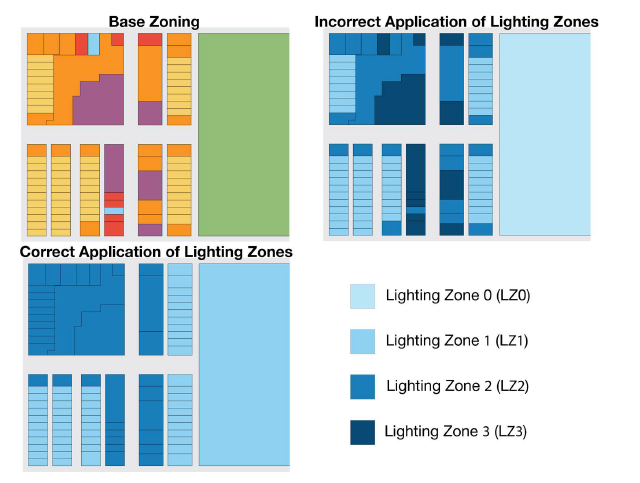
Source: American Planning Association: Modernizing Outdoor Lighting Regulations, 2025
National lighting standards are developed by three main agencies working together: IES, the American National Standards Institute, and DarkSky International (McBride 2025, 3). DarkSky International principals promote practices such as shielding lights, reducing brightness, and controlling glare and light spill with the intention of promoting environmental protection and nuisance avoidance (DarkSky International 2020). They also provide communities with a municipal ordinance template that is implementable for outdoor lighting.
According to DarkSky International, 29 towns and cities within the Boston MPO participate. Table 2 provides examples of Boston MPO towns and cities who currently have implemented DarkSky International standards.
Table 2
Boston MPO Towns Dark Sky Codification
Location |
Type |
Enforcement |
Municipal Code |
The Town of Newton |
Light Pollution and Light Trespass |
The code enforces that lighting must shine downward and not emit light in any direction above a horizontal plane (uplighting), avoiding light pollution. |
|
The Town of Winchester |
Glare and CCT |
In addition to light trespass regulation, the code enforces glare perceptibility. Lighting must not be perceptible to persons on any street or abutting lot or parcel, using fully shielded designs. |
CCT = Correlated Color Temperature. MPO = Metropolitan Planning Organization.
Municipalities require developers to submit lighting plans during the subdivision process, specifying pole locations, fixture orientations, and photometric data (Village of Tinley Park n.d., 1–7). This makes sure lighting meets established illumination standards. Municipalities also place stipulations on lighting, such as the town of Reading, mandating developers to pay lighting costs and completing at least 50 percent of the proposed lots within 300 feet of a planned street light ownership to the Town. Further, some jurisdictions have moved toward codifying specific illumination and orientation standards within their municipal ordinances to ensure safety (see Table 3).
Table 3
Illumination and Orientation of Lighting Codification
Location |
Type |
Enforcement |
Municipal Code |
City of Las Cruces, New Mexico |
Mid-Block Street Lighting |
The code recommends mid-block lighting near pedestrian generators/residential areas and enforces its concurrent installation by developers in new subdivisions. |
|
City of Boulder, Colorado |
Illumination Levels |
The code enforces uniformity ratios along pedestrian walkways in residential and commercial zoning districts. |
|
City of Flagstaff, Arizona |
Orientation and Pedestrian Scale Lighting |
The code requires four streetlights at signalized intersections (one per corner) to ensure positive contrast and maximize pedestrian visibility within the crosswalk. The code recommends placement of pedestrian lighting and requires developers to adhere to CCT, fixture, and mounting heights. |
Sec. 13-12-003 - Lighting Layouts
|
CCT = Correlated Color Temperature.
The Goldsboro, North Carolina, MPO Bicycle, Pedestrian, and Greenway Plan evaluated the existing active transportation network and facilities and relevant policies, providing recommendations for each section. In the policy review, the MPO assessed regulations for three municipalities and Wayne County, North Carolina, within the region. This evaluation included subdividing the policy recommendations into three categories as follows:
Within the Complete Streets and Greenways category, ordinances for the municipalities and Wayne County were evaluated on a three-tier rating system: Good, Needs Improvement, and Inadequate. Wayne County and the City of Goldsboro were rated as Needs Improvement. Both jurisdictions require street lights for new subdivision development in accordance with local standards and the National Electrical Safety Code; however, neither requires lighting along walkways. The Village of Walnut Creek and the Town of Pikesville do not require street lighting and were assigned an Inadequate rating.
The MPO recommends implementing pedestrian-scale lighting at key intersections, crossings, and along pedestrian and bicycle facilities with fixtures not exceeding 18 feet in height. The MPO uses the Town of Wendell’s Unified Development Ordinance as guidance for the local jurisdictions. Within the Unified Development Ordinance, pedestrian-scale lighting is required in the Downtown Mixed-Use Zone and must comply with specific fixture heights and a spacing of 75 to 85 feet between fixtures. The code also requires fixtures that limit glare and light spill. Developers may elect to have pedestrian-scale lighting installed through administrative approval in accordance with Downtown Mixed-Use regulations. Finally, the code mandates that walkways be illuminated to a level between 0.2 and 0.5 average horizontal maintained foot-candles.
This methodology establishes a scalable framework for a regional assessment of municipal codes throughout the Boston MPO town and cities.
MassDOT conducts Road Safety Audits (RSA), which are formal safety performance evaluations that examine high-crash locations for motorists, pedestrians, and cyclists. RSAs serve as a requirement for both 25 percent design plan submissions and Highway Safety Improvement Program funding eligibility. During the field assessment phase, the audit team uses a safety review prompt list to identify infrastructure deficiencies and safety risks, including the lighting conditions (see Figure 19). While this brings attention to general lighting issues, the form overlooks pedestrian lighting.
The FHWA Pedestrian and Bicyclist RSA Guide provides the framework to conduct safety-focused audits. This guide establishes a methodology for documenting safety issues and project constraints, including a section with a focus on nighttime visibility. Questions within the audit form include “can pedestrians be seen by motorists in dark conditions”, are “pedestrian crossings adequate lit”, and “is lighting adequate at all corners of the intersection?” These questions focus an auditor’s attention on the needs of VRUs, ensuring that nighttime safety issues are identified more clearly during the field assessment. While MassDOT Chapter 90 references this guide for municipal use, there is an opportunity for MassDOT to incorporate more explicit pedestrian safety and visibility criteria within its RSA forms, requiring such criteria at the state level would allow auditors to prioritize pedestrian visibility during the review of high-crash locations.
Figure 19
Road Safety Audit Lighting Questions
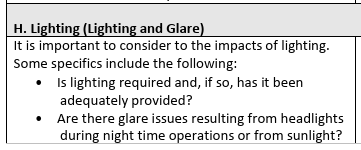
Source: Massachusetts Department of Transportation: MassDOT Road Safety
Audit Guidelines, 2024
This section examines two MPO-led processes that use a similar structure to fund and identify lighting improvements for safety. Both methodologies screen for areas with high nighttime crash rates, followed by field assessments to measure existing illumination values and fixture orientation. Though similar, they vary in scale and differ in final deliverables. The National Capital Region Transportation Planning Board (TPB) provides documentation to support the City of Alexandria’s Vision Zero efforts, while also offering lighting level and luminaire placement recommendations for a single intersection. On the other hand, North Jersey Transportation Planning Authority (NJTPA) collaborates with counties, Newark, and Jersey City to obtain two crosswalk or midblock crossing per jurisdiction and develop plans for each, furthering their respective Vision Zero goals.
In Alexandria, TPB analyzed five-year VRU nighttime crash data associated with visibility crashes within police report narratives. The TPB eliminated intersection locations with skewed geometry and obstructed sight lines, and intersections where crashes persisted after LED lighting installations or retrofits. These exclusions suggest that lighting upgrades alone did not resolve the visibility issues. Through the prioritization process, the initial list of intersections was narrowed to five priority intersections for evaluation.
To evaluate these sites, the TPB applied IES RP-8-22 lighting criteria, determining the necessary illumination levels based on each intersection’s functional classification and pedestrian activity. The TPB selected one intersection for in-depth review and found the location was measured at 1.7 lux, compared to a recommended lighting level of 20 lux. This location was also near a frequented bus stop.
The TPB discovered the light distribution patterns were oriented to illuminate the northern and southern sides of the intersection, directing light away from the crosswalk. To resolve this, the TPB recommended installing an additional light fixture to the existing utility pole or constructing a standalone pole to ensure lighting coverage, providing more vertical illuminance in the crosswalk (Maine Department of Transportation 2024., 69) (see Figure 20). The study also provided additional recommendations for the City of Alexandria, including using IES RP-8-22 as the criteria for Alexandria, assessing crash risks with pedestrian and cyclist volumes, and continuing to measure lighting levels at high-risk locations.
Figure 20
Alexandria—Crosswalk Area with Insufficient Lighting
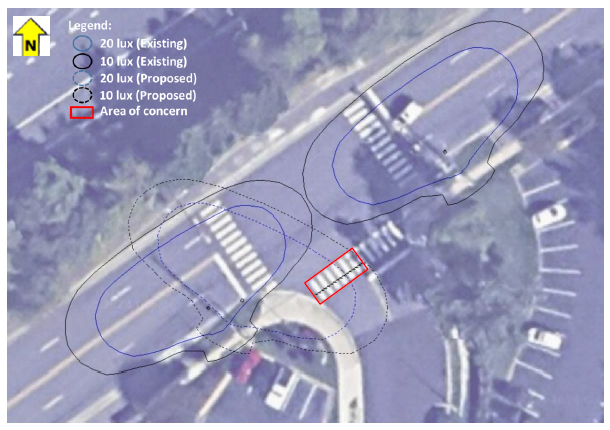
Source: National Capitol Region Transportation Planning Board: City of Alexandria Pedestrian Lighting Improvements Study, 2024
The Boston MPO interviewed a member of NJTPA staff to gain a deeper understanding from an ongoing study conducted by its Local Safety Programs group. This team provides technical assistance to 13 counties, the City of Newark, and Jersey City and ensures the transportation system is in a state of good repair while investing in safety improvements and advancing pedestrian and bicycle safety. Through its Unified Planning Work Program, NJTPA is currently overseeing pedestrian counts, intersection control evaluations, and pilot pedestrian lighting analyses. These efforts serve as a model for each subregion and as a touchpoint for coordination with utility companies, providing the initial analysis needed to implement pedestrian lighting at both rural and urban intersections. Each subregion must submit two priority intersections based on the number of pedestrian crashes from the New Jersey Department of Transportation database. This project addresses three key issues:
Using photometric modeling to generate illuminance heat maps that highlight areas of high and low visibility, the study provides two tiers of recommendations for each intersection.
These recommendations provide a replicable approach for subregions to improve pedestrian visibility and safety at high-priority locations. Further, each report is designed to provide standards that allow utility companies to easily implement pedestrian lighting improvements.
Quick-build projects use temporary materials to demonstrate new design improvements before committing funding for permanent implementation. This section highlights low-cost, high-impact lighting projects that improve safety and visibility of vulnerable road users. Further, the City of Middletown, Connecticut, and the City of Austin, Texas, case studies demonstrate how municipalities can leverage differing funding sources to test new or tested pedestrian lighting products at high demand pedestrian locations, while also involving feedback from residents.
The City of Middletown leveraged a Smart Growth Complete Streets Leadership Academy grant to support a $10,000 proof of concept pilot. This program focuses on state arterial roadways and “the safety of communities, increasing physical activity and eliminating preventable deaths” (Smart Growth America 2024, 6). By aligning this pilot with its Complete Streets Initiative Master Plan, Middletown prioritized corridors where walking and biking infrastructure improvements would most effectively enhance pedestrian visibility and safety.
The initial project reconfigured downtown parking to a back-in (reverse) angle layout. This configuration improves sightlines for drivers, allowing them to pull forward and see oncoming pedestrians or cyclists. However, public opposition to the parking reconfiguration prompted the City to pivot its strategy. The City selected an intersection along its prioritized corridor with a history of nighttime crashes and high pedestrian demand. The existing lighting configuration is designed for vehicular traffic and causes a negative contrast which silhouettes the pedestrians.
Prior to installation, the City established baseline illuminance levels at the intersection. Based on these findings, the quick-build pilot deployed supplemental flood lighting mounted directly to the arm shafts of existing traffic signal poles (see Figure 21). This automated system synchronizes with signal timing and a detection camera, providing illumination during active pedestrian crossing phases. Pedestrians and nearby business owners provided positive survey feedback, while several residents asked about making the safety improvements permanent.
This example shows the importance of building public support and testing the demonstration prior to a pilot launch. Further, Middletown used Complete Streets policy and existing crash conditions as a catalyst to establish an innovative solution for existing pedestrian visibility issues. This proof of concept provides a repeatable model that municipalities can scale through other funding opportunities or established planning and policy efforts.
Figure 21
Middletown—Quick-Build Pedestrian Lighting System
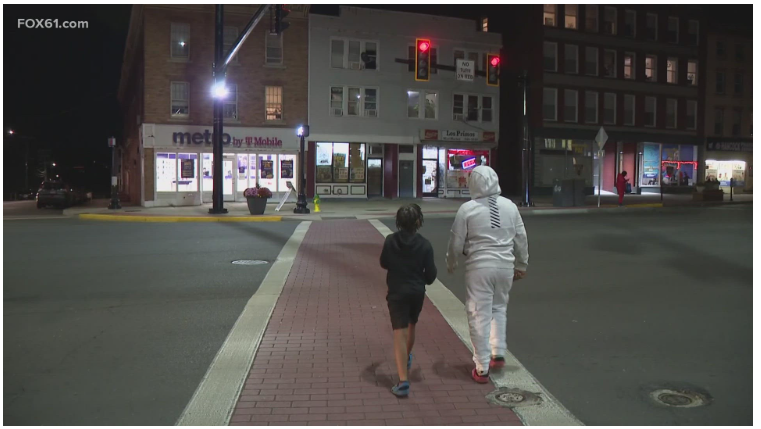
Source: New Pedestrian Safety Improvements Made at Crosswalk in Middletown, 2023
The City of Austin’s Smart Mobility Office “focused on creating a process to pilot new mobility technology with the private sector” (Austin Transportation and Public Works Department 2024, 14). Using a phased approach, the office validates private entities to demonstrate a municipal purpose and proof of concept before entering a long-term, large-scale partnership. The City sought to install new illumination technology at an intersection near an elementary school, building upon previous safety interventions.
In partnership with TAMPCO, the City tested a crosswalk illuminator system that activates solar powered flood lights directed at the center crosswalk upon push button demand. This activation triggers flashing LED lighting school-crossing signage. In conjunction with the pilot, the City engaged the community through local news coverage and surveys. Survey data revealed that the majority of residents felt safer using the intersection, rated the lighting levels as adequate, and observed a noticeable improvement in driver yielding.
Figure 22
Austin—Solar-Powered Flood Lights on RRFB
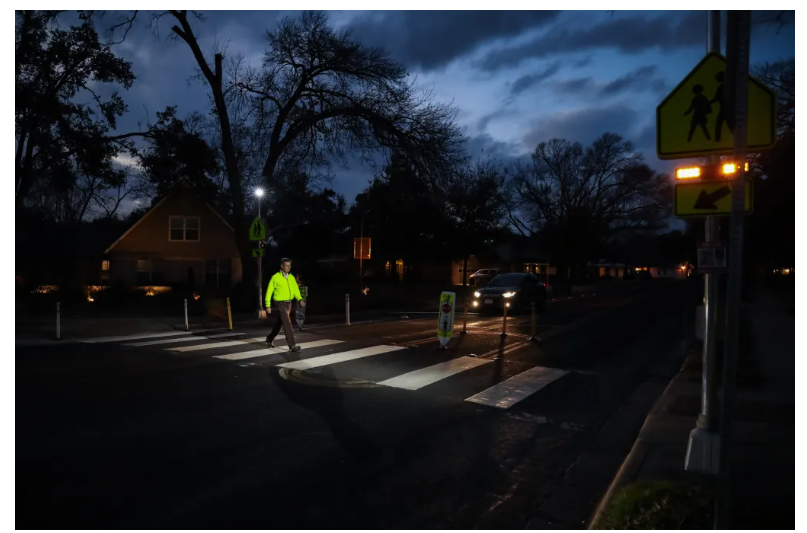
RRFB = Rectangular Rapid Flashing Beacon.
Source: Austin Illuminates Northern City Intersection in Pedestrian Safety Pilot, 2026
This section reviews current ownership models across Massachusetts and the Boston Metropolitan Planning Organization (MPO) region, evaluating the benefits of municipal ownership. This includes the ability to address high-priority crossings faster and select lighting design. While the majority of documentation was focused on Light Emitting Diode (LED) retrofits, the same logic may be applied to pedestrian lighting. The report then reviews ways towns and cities in the region identify lighting within their Capital Improvement Programs (CIP) and gives users a table to identify potential funding sources to implement large-scale, planning, and spot improvement projects.
While many towns and cities have purchased their streetlights from utilities to execute LED retrofits, some municipalities in the Boston Region MPO remain under Investor-Owned Utility (IOU) ownership and rely on the utility for ongoing maintenance and service. IOUs may purchase and own the streetlights’ physical pole structures, hardware, and fixtures. This allows the private electric company to register them as corporate assets treated as depreciable property on the company’s balance sheet (Arnold and Buckley 2015, 11). Such policies can create financial incentives to own utility infrastructure through tax benefits and the ability to seek higher regulated rates.
Although electricity distribution service rates are set by state regulatory commissions, “the utility proposes a set of new rates and a new mechanism that operates ‘automatically’ between formal regulatory review for adjusting those rates over time” (Joskow and Schmalensee 2024, 9). Electric companies operate as natural monopolies due to the scale of their infrastructure, meaning there is little economic motive to maintain duplicate streetlight systems, which creates geographic monopolies (Joskow and Schmalensee 2024, 4). Because of this lack of competition, municipalities have limited bargaining power and may have few alternatives when street lighting tariffs increase.
Municipalities may establish, own, and operate Municipal Light Plants. Operating without investor profit mandates gives Municipal Light Plants autonomy over capital investments and lighting policies, which permit them to maintain lower rates. Municipal Light Plants’ localized geographic footprints “allow for targeted, customized service to a small, finite region” (Peterson et al. 2016, 4). This model, unlike the large-scale IOU geographic footprint, allows municipalities to keep billing services exclusive to their service areas and purchase power wholesale on the open market (Peterson et al. 2016, 4). By having access to the open market without regulation set by state regulatory commissions, towns and cities may integrate local clean energy preferences to reduce greenhouse gas emissions. Ultimately, oversight and strategic governance are vested in a municipal light board composed of three or five residents (Massachusetts General Court n.d.b).
Street lighting accounts are subject to specialized cost-of-service structures that set them apart from standard municipal gas and electric billing. According to Massachusetts General Law, the payment structure is not a fixed, scheduled rate. The price is dictated by a mathematical formula that considers the sum of the plant’s operating expenses and depreciation, which is “equal to three per cent of the cost of the plant exclusive of land and any water power appurtenant thereto” (Massachusetts General Court n.d.c). This calculation also factors in interest on outstanding debt, utility losses, and recurring bond payments over time. The calculation then divides the total operating cost by the kilowatt-hours sold by the plant, including the power supplied for street lighting (Massachusetts General Court n.d.d). Finally, this is multiplied by the kilowatt-hours consumed by the town or city. The formula is transparent, establishing a cost-based approach to the plant’s actual allowable expenses and total electricity sales.
According to the Massachusetts Department of Public Utilities, 20 municipalities within the Boston Region MPO operate under or are served by the Municipal Light Plants model, granting them direct control over their local pedestrian and street lighting networks. For example, the Town of Wellesley, Massachusetts, owns the Wellesley Municipal Light Plant. A 2014 report states Wellesley converted 540 of the Town’s streetlights from metal halide to LED. In turn, this generated approximately $30,000 in annual savings without having to buy those lights back from the utility (Peterson et al. 2016, 10). Capturing funds that would otherwise be spent on IOU overhead, municipalities may keep these dollars within their local budgets and repurpose them for other community priorities.
Utilities recover most street lighting costs through electric tariffs. Under a private utility model, an S-1 tariff applies to utility-owned and maintained infrastructures, including associated maintenance costs. The LED-utility tariff rate is bundled into three components: “the energy cost, the capital cost including the cost of the LED fixture, and the maintenance cost” (Arnold and Buckley 2015, 13). If a town or city requests LED lighting retrofits on IOU-owned lighting infrastructure, the municipality must send a “written notice requesting replacement” (Massachusetts Electric Company 2019, 4) and agree to pay for the procurement, installation, and maintenance of equipment. Due to the energy savings provided by LED lighting, utility companies may front-load their capital costs to offset energy and maintenance savings, which results in a neutral or negative return on investment for municipalities (Arnold and Buckley 2015, 13).
Utility company maintenance response times vary. According to the US Department of Energy requests to repair failed luminaires or damaged infrastructure can remain in a dispatch queue for 30 or more days (US Department of Energy 2017, 4).
Massachusetts allows cities and towns to purchase lighting equipment from utility companies while still receiving power. Under an alternative tariff, the utility company continues to provide service over the distribution facilities and wires owned by the company, while towns and cities use lighting equipment owned or leased by the municipality. Towns and cities may also use space on the pole or lamp post to mount lighting equipment previously owned by the utility company. Under Section 34A(b), the municipality may acquire “all or any part of the electric company’s lighting equipment upon payment of the unamortized investment allocable to such acquired equipment.” National Grid’s S-5 Alternative Tariff allows municipalities to receive electricity service from the utility while retaining full responsibility for maintaining its street lighting infrastructure. Under this tariff, the utility charges the customer for electricity delivery.
Direct streetlight ownership affords municipalities the flexibility to bypass utility dispatch queues and contract directly for routine and emergency repairs. From a pedestrian lighting perspective, towns and cities can directly prioritize high-risk crossings, allowing public works departments or local contractors to respond faster than utility dispatch queues. This framework also gives communities full control over lighting design, fixture selection, and standardized color temperatures (Vesel 2023).
The Metropolitan Area Planning Council (MAPC) administered a rapid LED Streetlight program from 2017 through the end of 2020, acting as an aggregator on behalf of the Department of Energy. The agency funded 30 percent of procurement costs—the cost of materials and installation—for High Pressure Sodium to LED retrofits. A key requirement was that towns and cities acquire street lighting from IOUs before receiving funding. To guide municipalities through acquisition and retrofit implementation, MAPC established a structured framework:
Towns and cities must put in a formal request with the utility to purchase streetlights, initiating a 60-day window to settle on a price. The utility calculates this purchase price based on “the system’s net book value,” (Metropolitan Area Planning Council 2013, 2) which incorporates its depreciated value. Municipalities may purchase all overhead lighting outright or select a targeted subset, such as a specific neighborhood. The guidance also recommends using the cost savings allocated for utility maintenance under an S-1 tariff to purchase LED lighting equipment.
After notifying the utility of the decision to purchase, a price sheet of identified street lighting is provided to the municipality. MAPC recommends conducting an audit to ensure the accuracy of the price sheet, offering two options. The first option is a wattage check, where consultants or municipalities review 10 percent of the inventory to determine if poles or fixtures are present. The other method is a GIS survey. While this method is more cost-intensive, GIS inventory audits verify location of utility inventory and allow towns and cities to maintain the dataset for future retrofits or lighting warrants.
MAPC also recommends selecting streetlight design and fixture specifications. This includes choosing lamp technologies that achieve expected life-cycle performance, defining the appropriate Correlated Color Temperature (the prescribed color temperature in the document is not appropriate for the current 3000K standard), and using Illuminating Engineering Society guidance to evaluate Backlight, Uplight, Glare ratings (Metropolitan Area Planning Council 2014, 6–8).
There are a number of options to pay the up-front costs of retrofits, including bonds, tax exempt municipal lease-purchase agreements, or utility rebates. Per Massachusetts General Law. Chapter 141 Section 7, “streetlight replacement does not require the supervision of a licensed contractor; only a bucket truck license is needed.” MAPC recommends procuring a maintenance contract, specifying that contracts for outside consultants must include storm repair timelines, a recommended five-day turnaround, and warranties that assume risks. In addition, MAPC presented a case study focused on Somerville, Massachusetts, as an example. Somerville would continue using its 311 system and address the backlog of maintenance requests, hiring a maintenance contractor through a bidding process.
This section identifies local funding mechanisms and financing tools for pedestrian lighting projects and reviews two CIP plans that identify pedestrian lighting. Finally, the document outlines funding opportunities to implement large-scale, planning and granular, and spot and quick-build pedestrian lighting projects and plans.
Lighting maintenance and repairs must be absorbed within annual operating budgets to fund day-to-day operations. For example, the City of Somerville includes an operating budget line item for maintenance and repair services covering lighting and utility pole infrastructure. A CIP is an updated annual program that identifies major municipal infrastructure, facility, and equipment investments alongside its designated funding sources. Funding sources may include, but may not be limited to,
As previously mentioned in the Literature Review section, the Town of Brookline incorporated a dedicated $200,000 line item for pedestrian lighting within its CIP. This allocation allows for an estimated 10 pedestrian lighting poles per year, funding the most critical areas. While they have a dedicated stand-alone capital line item, Brookline also coordinates lighting installation with large-scale street reconstruction projects. The City of Newton CIP identifies transportation projects with guidance from the ongoing 10-year Transportation Network Improvement Program. The program prioritizes roadways with poor pavement conditions and aligns with Complete Street goals to determine which roads should receive improvements.
These examples highlight the differing ways communities program pedestrian lighting within local capital programs. The Town of Brookline prioritizes pedestrian lighting with a dedicated line item, while the City of Newton focuses on a broader, long-term network framework. However, since its adoption in 2023, Brookline has yet to allocate the $200,000 for pedestrian lighting construction, deferring funding to following years, which shows the potential limitations of incorporating it as a stand-alone item. This strategy may benefit from spot improvements, reviewing and selecting projects outlined in the Pedestrian-Scale Lighting Plan. Newton’s construction of new pedestrian lighting through the West Newton Square and Walnut Street projects highlights a proven strategy, demonstrating how embedding lighting into an established program ensures a clearly planned process for implementation.
Table 4 provides an overview of funding sources through federal and state grants, public and private partnerships, and municipal financing. Towns and cities may use this table to identify opportunities referenced earlier in this report, incorporating them into local CIPs or financing temporary quick-build projects to demonstrate safety improvements at poorly lit intersections. Funding opportunities are categorized into three scale categories:
Table 4
Pedestrian Lighting Funding Table
Funding Opportunity |
Scale |
Description |
Example(s) |
Alignment |
MassWorks Infrastructure Program |
Large-Scale Infrastructure |
The Massachusetts Executive Office of Economic Development provides grants to cities and towns to construct and improve publicly owned infrastructure, spurring economic development and supporting housing production and job creation. Several cities and towns received funding to install pedestrian-scale lighting, or lighting within larger transportation, Complete Streets, and streetscape projects. |
The City of Malden, Mass., received funding for 25 percent design to reconstruct the Pleasant Street corridor—a project aligned with Complete Streets guidance that includes lighting improvements. |
Pedestrian Lighting Installation |
Complete Streets |
Large-Scale Infrastructure
Planning and Granular
Spot and Quick-Build |
Funds municipal projects that address local multimodal infrastructure gaps. Street lighting is an eligible activity under the ‘Environment & Streetscape’ investment category. MassDOT offers $38,000 in Technical Assistance for the development of a Complete Streets Prioritization Plan and $1 million in construction. |
The Town of Clinton, Mass., received $225,000 for additional lighting improvements along the Walnut Street Sidewalk and Bicycle Network. |
Complete Street Prioritization Plans
Pedestrian Lighting Installation
|
Chapter 90 Local Roads |
Large-Scale Infrastructure
Planning and Granular |
Chapter 90 Funds are distributed based on local roadway mileage, population, and employment with assets ranked by a prioritization methodology. Cities and towns may use these funds for construction, preservation, and capital improvement of municipal owned roadways and public ways. Eligible spending includes civil and structural projects involving the installation of street lighting and consultant services that include plans and RSAs. |
Chapter 90 funding is included within several communities CIP. |
Pedestrian Lighting Installation
Intersection Field Reviews and Plans
RSAs |
HousingWorks |
Large-Scale Infrastructure |
The Massachusetts Executive Office of Housing and Livable Communities offers a competitive HousingWorks Infrastructure Grant. This grant awards towns and cities with funding up to $500,000 planning efforts and $5 million in construction. Monies are associated with housing development; however, this program offers funds based on the nexus with housing. The grants will be awarded in fall 2026 and must be completed by end of SFY 2027. |
In SFY 2024, the City of New Bedford was awarded a grant to improve transportation connections to recently developed housing and economic clusters in a TOD district. The project plans to reconstruct several corridors to be compliant with Complete Streets guidance, which includes pedestrian-scale lighting. |
Pedestrian Lighting Installation |
Safe Streets and Roads for All |
Planning and Granular
Spot and Quick-Build |
Safe Streets and Roads for All grants allow local, Tribal, and regional entities to secure federal funding to develop a comprehensive safety action plan, conduct supplemental planning, or execute safety demonstration activities to inform future capital priorities. USDOT permits supplemental updates to established Action Plans, ranging from RSAs on HIN to specialized sub-plans, such as lighting. While federal guidance broadly categorizes this as 'lighting,' there are examples of municipalities incorporating lighting to address safety planning goals. |
The City of Richmond, Virginia, was awarded an additional $762,400 to support Vision Safety initiatives set forth in its Action Plan. This included a Lighting Management Plan that funded a citywide plan that identified locations that enhance safety and upgrade pedestrian lighting. |
Active Transportation Plan
Lighting Plan
RSAs
Quick-Build Demonstration Projects |
Shared Streets and Spaces Program |
Spot and Quick-Build |
MassDOT allocates grant funding to towns and cities and transit agencies to support communities in an effort to improve public health and mobility through quick-build or ready-to-implement initiatives. Pedestrian lighting and lighting enhancements are included as eligible activities under the program's bicycle and pedestrian infrastructure, transit supportive infrastructure, and public space reimagining categories. |
The Town of Danvers, Mass., used funds to enhance pedestrian safety along the Danvers Rail Trail at Maple and Hobart Streets by installing pedestrian lighting. |
Pedestrian Lighting Installation
Quick-Build Demonstration Projects
|
AARP Community Challenge |
Spot and Quick-Build |
The AARP focuses on improving the lives of residents aged 50 years and older, which then betters people of all ages. Through its Livability Communities Program, the agency supports efforts to provide resources to elected officials and residents. This includes informing policy, such as helping communities adopt Complete Streets legislation and providing quick-build grants. The Community Challenge grants fund on-the-ground, physical permanent projects and pilots. |
Lighting enhancements through this program include lighting installations in Downtown Montpelier, Vermont, decorative light poles along a state highway in the City of Greeley, Colorado, and several community gathering spots, pocket parks, alleys, and trails. |
Quick-Build Demonstration Projects |
Parking Benefit Districts |
Planning and Granular
Spot and Quick-Build |
The Massachusetts Municipal Modernization Act grants cities the ability to form PBDs. The intent of a PBD is to recoup funds garnered from a metered area and implement transportation improvements and pedestrian and bicycle facilities, while also decreasing parking demand through these improvements. MAPC noted these funds may be used for public realm enhancements, which include lighting. |
The Town of Arlington adopted the ability to establish PBDs. The Parking Advisory Committee states the Town uses the net income from the meters and applies these funds to improve pedestrian lighting. |
Pedestrian Lighting Installation and Repairs |
Transportation Improvement Program |
Large Scale Projects |
The TIP is the five-year capital plan for the 97 cities and towns in the Boston Region MPO planning area. Projects within the TIP are identified as transportation projects that will receive federal funding over the next five years. Pedestrian and street lighting were integrated within multiple projects and identified within investment programs, including Complete Streets. |
For FFY 2027–31 TIP cycle, projects featuring pedestrian or street lighting construction within their primary scopes include the Westwood/Norwood Reconstruction of Canton Street to University Drive and the Wakefield Comprehensive Downtown Main Street Reconstruction. |
Pedestrian Lighting Installation |
CIP = Capital Improvement Program. FFY = Federal Fiscal Year. HIN = High Injury Networks. MAPC = Metropolitan Advisory Planning Council. MassDOT = Massachusetts Department of Transportation. MPO = Metropolitan Planning Organization. PBD = Parking Benefit District. RSA = Road Safety Audits. SFY = State Fiscal Year. TIP = Transportation Improvement Program. TOD = Transit Oriented Development. USDOT = United Stated Department of Transportation.
This section was originally scoped to select three to five high-priority crossings for small- to mid-sized municipalities requiring pedestrian-scale lighting and apply the Massachusetts Department of Transportation’s (MassDOT) guide to evaluate these locations. However, MassDOT extended its development timeline to further refine how planners use a checklist to determine if crossings need pedestrian lighting, field reviews, or targeted plans. To adapt to this change, the Boston Region Metropolitan Planning Organization (MPO) developed a prioritization methodology that identifies municipalities with the highest rate and share of dark-condition pedestrian crashes across the region. The top eight municipalities were engaged to solicit feedback on flagged crash clusters and provide insight into local planning and implementation processes.
MassDOT provided a list of prioritized crosswalks using a crosswalk feature class generated by the University of Massachusetts Amherst. The feature class included midblock and intersection crossings. MassDOT then applied scoring criteria based on the number of nighttime injury pedestrian crashes within 300 feet of the crosswalk, alongside prioritization factors such as distance from pedestrian generators and location within Environmental Justice census tracts. They defined nighttime conditions as “dark lighted or unlighted,” “dawn,” or “dusk,” among other factors. Risk scores were assigned by comparing the proportion of crashes occurring at crosswalks with a specific feature against the overall share of crosswalks containing that feature. The final output resulted in high, medium, and low rankings (see Figure 23).
Figure 23
MassDOT Prioritized Crosswalks
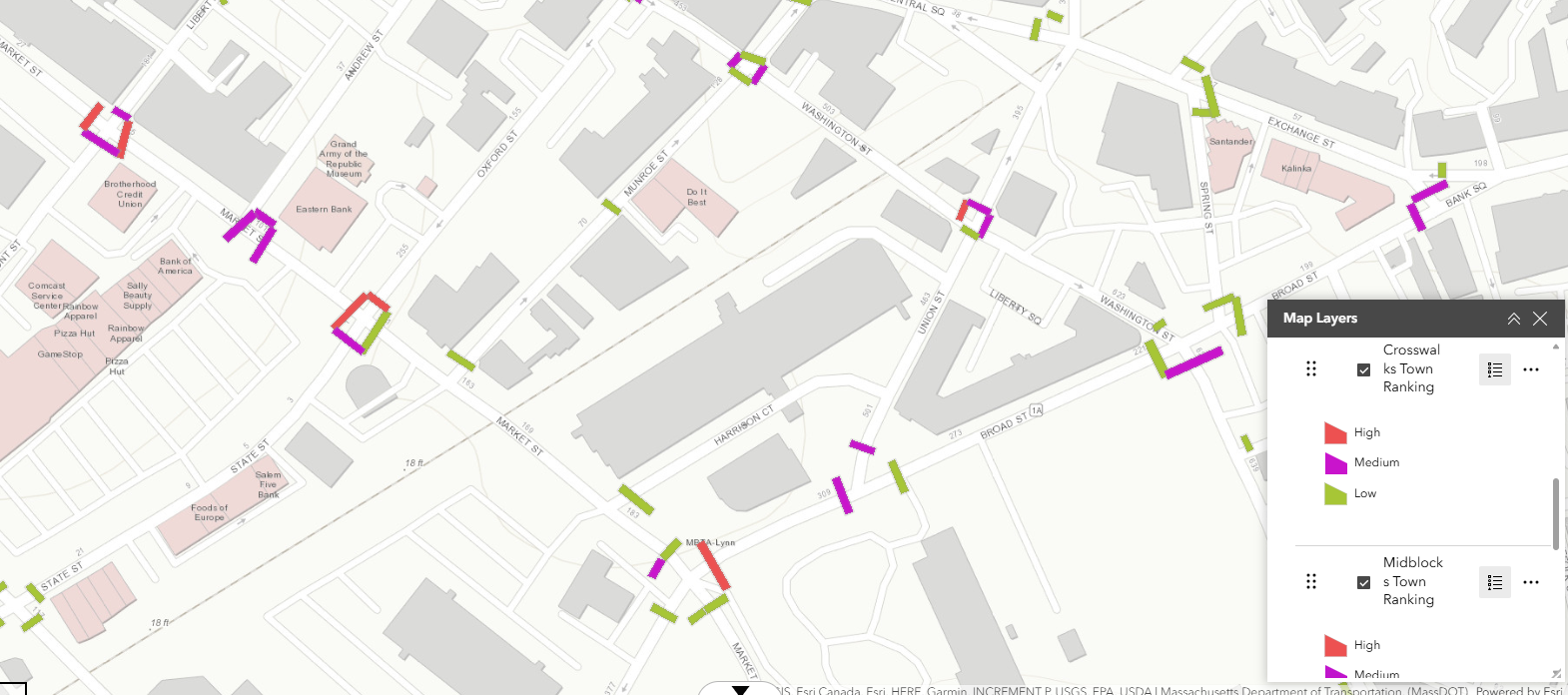
MassDOT = Massachusetts Department of Transportation
Source: MassDOT Statewide Crosswalk Prioritization, 2026.
The Boston Region MPO observed the highest share and rate of dark condition crashes across the region and calculated a priority score with HIN and Census data. This calculation uses the two metrics to determine the percentage of dark condition injuries and dark injury rate per capita. With the percentages, a percentile ranking tool was used to scale the data based on a town or cities relative position in the dataset, rather than its actual numerical value. The result was a priority score ranging from five to 95, grouping the scores into quadrants. Figure 24 and Table 5 highlight the highest ranking municipalities.
Figure 24
Boston Region MPO Town and City Prioritized Dark Condition Crashes Map
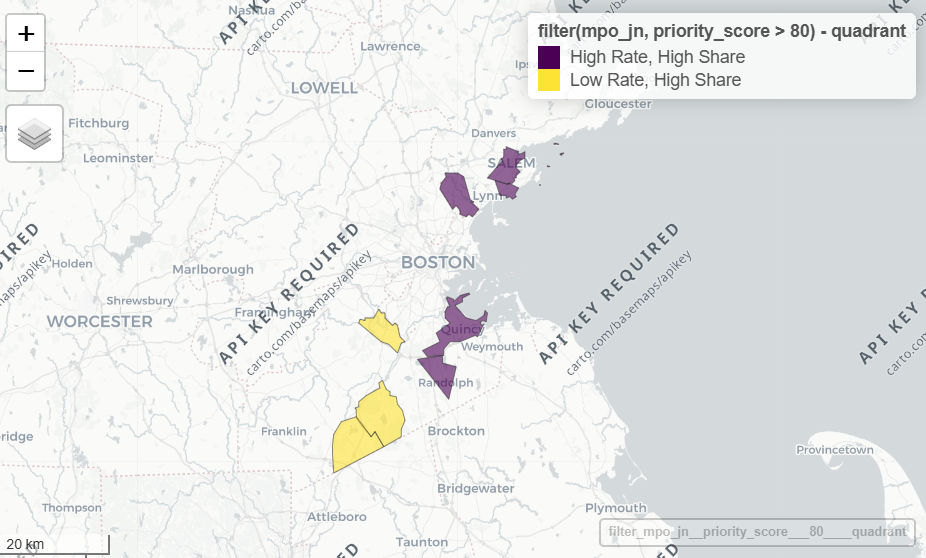
MPO = Metropolitan Planning Organization.
Table 5
Boston Region MPO Town and City Prioritized Dark Condition Crashes
Municipality |
Tier |
Priority Score |
Peds Injured in Dark Crashes |
Total Peds Injured in Crashes |
Dark Injury % |
Dark Injury Rate (per 100k) |
Swampscott |
High Rate, High Share |
92.1 |
17 |
30 |
56.7% |
112.5 |
Quincy |
High Rate, High Share |
90.5 |
191 |
377 |
50.7% |
187.9 |
Randolph |
High Rate, High Share |
90.0 |
35 |
62 |
56.5% |
100.0 |
Dedham |
Low Rate, High Share |
85.8 |
15 |
23 |
65.2% |
59.1 |
Salem |
High Rate, High Share |
85.8 |
34 |
60 |
56.7% |
76.4 |
Saugus |
High Rate, High Share |
83.7 |
22 |
42 |
52.4% |
76.9 |
Foxborough |
Low Rate, High Share |
82.1 |
12 |
22 |
54.5% |
64.5 |
Sharon |
Low Rate, High Share |
81.6 |
10 |
16 |
62.5% |
53.8 |
MPO = Metropolitan Planning Organization.
The Boston Region MPO used MassDOT’s prioritized crossings to analyze nearby injury patterns—defined in the MPO’s Vision Zero work—and select candidates for case studies. A subset of pedestrian crashes occurring in dim or dark conditions was evaluated based on the distance of each crossing. This allows closer, pedestrian-involved crashes to weigh more heavily on each crosswalk's score and gives greater weight to more severe injuries (see Figure 25). For example, a pedestrian receives half its maximum weight 100m away from the crash. Finally, crashes with scores in the top five percent of priority crosswalks in each municipality were clustered based on the proximity and severity of dim and dark pedestrian crashes.
Figure 25
Boston Region MPO Town and City Prioritized Dark Condition Crashes Map
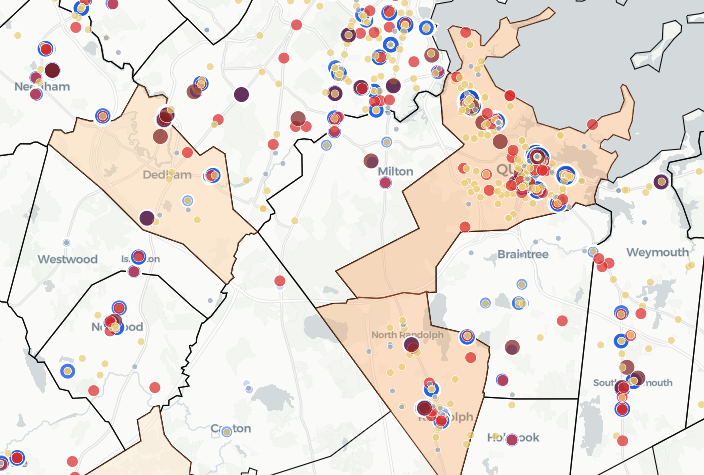
MPO = Metropolitan Planning Organization.
Swampscott, Massachusetts, and Salem, Massachusetts, served as key partners, offering perspectives on their current processes and areas of concern. Figures 26 and 27 show the identified clusters in each community, while Tables 6 and 7 present the corresponding corridors, intersections, score ranges, and crash types within each cluster.
Figure 26
Swampscott—Cluster of Five Percent of Prioritized Crosswalk Maps
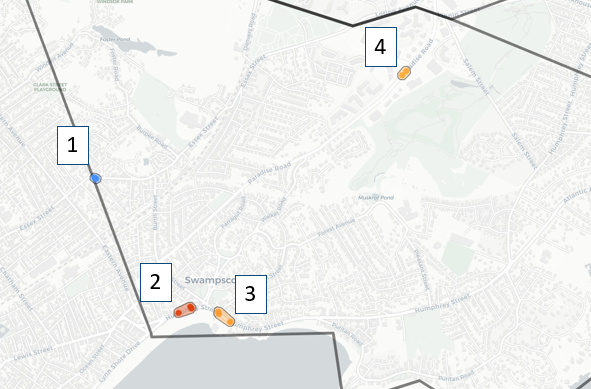
Table 6
Swampscott—Cluster of Five Percent of Prioritized Crosswalks
Cluster Number |
Number of Crossings |
Major and Minor Roadways |
Score Range |
Fatal Crashes |
Serious Injury Crashes |
Non-Serious Injury Crashes |
1 |
2 |
Essex St and Beach Ave |
1.56–1.58 |
0 |
1 |
0 |
2 |
3 |
Humphrey St and Phillips St/Midblock Crossing |
1.05–1.23 |
0 |
1 |
1 |
3 |
3 |
Humphrey St and Redington St/Midblock Crossing |
1.07–1.41 |
0 |
1 |
0 |
4 |
2 |
Paradise Rd and Shopping Center Access |
1.23–1.24 |
0 |
1 |
1 |
Figure 27
Salem—Cluster of Five Percent of Prioritized Crosswalks Map
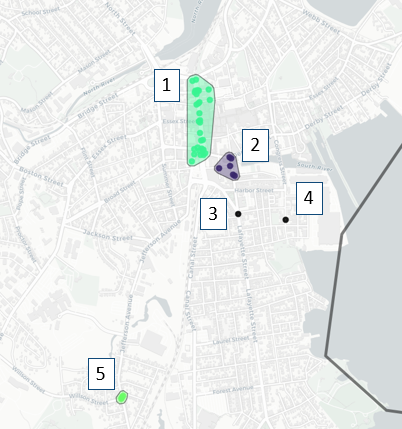
Table 7
Salem—Cluster of Five Percent of Prioritized Crosswalks
Cluster Number |
Number of Crossings |
Major and Minor Roadways |
Score Range |
Fatal Crashes |
Serious Injury Crashes |
Non-Serious Injury Crashes |
1 |
30 |
Washington St Corridor – Bridge St to Gedney St |
1.24 - 2.50 |
0 |
2 |
4 |
2 |
6 |
Lafayette St Corridor – New Derby St to Peabody St |
1.26 - 1.76 |
0 |
1 |
1 |
3 |
1 |
Lafayette St and Dow St |
1.26 |
0 |
0 |
1 |
4 |
1 |
Congress St and Palmer St |
1.45 |
0 |
0 |
1 |
5 |
3 |
Jefferson Ave and Wilson St/Cloutman St |
1.65–1.66 |
1 |
0 |
1 |
Each municipality interviewed received four questions focused on the community's current pedestrian lighting implementation strategies and the results of the Boston MPO’s prioritized crossing list. The interview results provide a series of common themes and issues that each town or city faces when installing and funding pedestrian lighting as a safety countermeasure. Three key themes were identified: prioritized crosswalk safety issues, streetlighting ownership and replacement workflows, and funding and installation obstacles.
The four interview questions are as follows:
Municipalities noted several prioritized locations in high pedestrian activity areas. Staff identified crossing locations along commercial corridors with pedestrian malls and retail space seeing thousands of crossings during peak tourist seasons, as well as near waterfront access that residents and visitors heavily utilize. Planners also flagged pedestrian facilities in high-growth areas, including new multifamily housing developments. Finally, community input addressed pedestrian lighting needs near a high school in coordination with other safety countermeasures.
One prioritized crossing observed a crash involving a fatality. The planner stated this location recently implemented safety countermeasures including signal timing improvements and cobrahead lighting to increase illuminance. They also highlighted an opportunity to reevaluate lighting along an adjacent corridor undergoing safety improvements, where an upcoming project plans to redesign the roadway to include traffic calming measures. Further redevelopment is occurring along the corridor, which may spur additional pedestrian activity, and the site was identified as a location for a future case study.
A bifurcation between municipal and utility ownership of streetlighting applies an additional layer of complexity when requesting luminaire replacements or repairing street lighting infrastructure. When street lighting is owned by the town or city, the project is added to an annual warrant for capital improvements. On the other hand, when the utility owns the infrastructure, replacement requests join the utility's maintenance queue. The municipality plans to engage with its Department of Public Works and understand asset ownership before the following fiscal year.
Another municipality interviewed owns its streetlighting, allowing it to coordinate directly with its electrical department to make upgrades or replacements. Within its internal process, documentation and studies are required prior to installations. City Council involvement is generally not required for these replacements. However, large scale reconstruction projects require on-call consultants, which can introduce additional delays and funding challenges.
Planners identified budgets and funding as potential obstacles for upgrades, replacements, and construction, which affect the ability to implement large-scale lighting projects. One interviewee identified lighting as a long-term, high-cost solution classified as a capital improvement project, potentially spanning a 10-year timeline with costs exceeding $20,000. Budget constraints also force planners to seek grants for pedestrian lighting projects. A planner noted the limitations of Chapter 90 funding due to a set annual allocation, instead pursuing grant funding or splitting the cost over two fiscal years. Other obstacles documented include
Through the research identified above, the Boston Region Metropolitan Planning Organization (MPO) developed a series of next steps to advance over the multi-year planning horizon. Although municipal contexts are unique and rely on different funding sources or strategies for implementation, this section offers towns and cities a flexible framework to guide pedestrian lighting improvements. Even where municipalities already own their streetlight infrastructure, they may consider incorporating a more comprehensive strategy to integrate pedestrian lighting within the planning process or incorporating Massachusetts Department of Transportation (MassDOT) guidance when identifying areas at prioritized crossings.
The Boston MPO will continue its Vision Zero initiative through a recent Safe Streets for All grant, which will focus on local safety planning and infrastructure demonstration projects. Both efforts provide an opportunity to develop quick-build lighting projects or pedestrian lighting plans in partnership with municipalities identified through the prioritization process, as well as other communities.
The Boston MPO will provide insight and recommendations for MassDOT’s pedestrian-scale lighting guidance. Once implemented, the agency will continue working to identify prioritized crossings, collaborating with municipalities to better understand these intersections and midblock locations and why high pedestrian crash rates occur under nighttime conditions. The MPO will review these locations and perform initial analyses using MassDOT guidance. This will lead to a series of case studies, which may be added to the upcoming update to the Managing the Curb Guidebook or completed upon request through our technical assistance program.
This section outlines a potential roadmap for municipalities to use when considering pedestrian lighting in the planning, funding, and implementation processes. Strategies incorporate the documented findings and regional case studies presented above.
AARP. 2022. “2022 AARP Community Challenge Grantees.” Livable Communities. AARP. Accessed September 11, 2026. https://www.aarp.org/livable-communities/community-challenge/info-2022/2022-grantees.html.
Access Fixtures. 2026. “Massachusetts Senate Passes the Dark Skies Bill S.3145: What It Means for Publicly Funded Outdoor Lighting Statewide.” Access Fixtures Lighting Solutions Blog. July 5, 2026. https://www.accessfixtures.com/massachusetts-senate-bill-3145-dark-sky-lighting-standards/.
Arnold, Gabe, and Brian Buckley. 2015. LED Street Lighting Assessment and Strategies for the Northeast and Mid-Atlantic. Lexington, MA: Northeast Energy Efficiency Partnerships. https://neep.org/sites/default/files/resources/DOE_LED%20Street%20Lighting%20Assessment%20and%20Strategies%20for%20the%20Northeast%20and%20Mid-Atlantic_1-27-15.pdf.
Asahi Optics. 2026. “Solving Three Common Street Lighting Issues Through Optical Lenses and Simulation.” Asahi Optics. February 10, 2026. https://www.asahi-optics.com/news/blog/solving-three-common-street-lighting-issues-through-optical-lenses-and-simulation.html.
Austin Transportation and Public Works Department. 2024. Smart Mobility Office Pilot Evaluation Report. Austin, TX: City of Austin.
Aydin, Nursel, and Kasım Çelik. 2026. “Designing Lighting Master Plans in Historical City Centers: A Structured Approach and Case Study from Adana.” Buildings 16 (5): 1030. https://doi.org/10.3390/buildings16051030.
Bhagavathula, Rajaram, Ronald Gibbons, and Andrew Kassing. 2021. Roadway Lighting's Effect on Pedestrian Safety at Intersection and Midblock Crosswalks. Research Report No. FHWA-ICT-21-023. Urbana, IL: Illinois Center for Transportation. https://doi.org/10.36501/0197-9191/21-028.
Brightlx. 2024. “What Is IES Light Distribution Type I, Type II, Type III, Type IV, Type V?” Brightlx. July 9, 2024. https://www.lensblx.com/What-Is-IES-Light-Distribution-Type-I-Type-II-Type-III-Type-IV-Type-V-id42870276.html.
Cammalleri, Anthony. 2026. “Mass. Legislature sheds light on light pollution with ‘Dark Skies’ bill.” Daily Hampshire Gazette, August 9, 2026. https://gazettenet.com/2026/08/09/mass-legislature-sheds-light-on-light-pollution-with-dark-skies-bill/.
City of Alexandria. 2024. City of Alexandria Pedestrian Lighting Improvements Study (Final Report). Funded by the National Capitol Region Transportation Planning Board. Alexandria, VA: City of Alexandria. https://www.alexandriava.gov/sites/default/files/2024-09/Task%204%20-%20City%20of%20Alexandria%20Pedestrian%20Lighting%20Improvements%20Study%20%28Final%20Report%29%20%281%29.pdf.
City of Cambridge. 2016. “Chapter 15.22: Outdoor Lighting.” Cambridge Municipal Code. Cambridge, MA: City of Cambridge. https://www.cambridgema.gov/cdd/projects/econdev/~/media/5E03320375454D3EAFE5DC513345D497.ashx.
City of Cambridge. 2025. Shaping Our City: Citywide Urban Design Guidelines for Cambridge. Cambridge, MA: Community Development Department, City of Cambridge. https://www.cambridgema.gov/-/media/files/cdd/planning/studies/citywideurbandesign/cudg_final_20250908.pdf.
City of Flagstaff. n.d. “Division 10-50.70: Outdoor Lighting Standards.” In Flagstaff Zoning Code. Flagstaff, AZ: City of Flagstaff. https://www.codepublishing.com/AZ/Flagstaff/html/Flagstaff10/Flagstaff1050070.html#10.50.70.
City of London. 2018. City of London Lighting Strategy. London: City of London Corporation. https://www.cityoflondon.gov.uk/assets/Services-Environment/city-of-london-lighting-strategy.pdf.
City of Milwaukee. n.d. 2984-27-02; Street Lighting on Pedestrian High Injury Network: Project Location Maps Overview. Milwaukee, WI: City of Milwaukee. https://city.milwaukee.gov/ImageLibrary/Public/DPW/PDFs/Project-Maps.pdf.
City of Newton. 2017. Newton-in-Motion: A Transportation Strategy for Newton. Newton, MA: City of Newton Planning Department. https://www.newtonma.gov/government/planning/plans-policies-strategies/transportation-strategy.
City of Newton. 2018. Newton Street Design Guide. Newton, MA: City of Newton. Funded by the Commonwealth of Massachusetts Executive Office of Energy and Environmental Affairs. June 2018.
City of Newton. 2020. Mayor Ruthanne Fuller’s Supplemental Capital Improvement Plan FY2021-FY2025. Newton, MA: City of Newton. May 11, 2020.
City of Portland. 2019. PedPDX: Portland's Citywide Pedestrian Plan. Portland, OR: Portland Bureau of Transportation. https://www.portland.gov/transportation/planning/pedpdx.
City of Portland. 2023. Vision Zero Action Plan Update 2023-25. Portland, OR: Portland Bureau of Transportation. https://www.portland.gov/transportation/vision-zero/documents/vision-zero-action-plan-update-2023-25/download.
City of Richmond. 2023. “City Awarded $762,400 Safe Streets and Roads for All Grant.” Richmond, VA: City of Richmond Department of Public Works. February 10, 2023. https://www.rva.gov/press-releases-and-announcements-public-works/news/city-awarded-762400-safe-streets-and-roads-all.
City of San Antonio. 2019. Urban Lighting Master Plan. San Antonio, TX: City of San Antonio Transportation & Capital Improvements. https://www.sanantonio.gov/Portals/0/Files/TCI/ULMP-Urban-Lighting-Master-Plan.pdf.
City of San Francisco. n.d.a. “Developer Requirements.” SF Better Streets. City of San Francisco. Accessed September 11, 2026. https://sfbetterstreets.org/learn-the-process/developer-requirements/index.html.
City of San Francisco. n.d.b. “San Francisco's Guiding Policies.” SF Better Streets. City of San Francisco. Accessed September 11, 2026. https://sfbetterstreets.org/why-better-streets/san-franciscos-guiding-policies/index.html.
City of San Francisco. n.d.c. “Street Lighting.” SF Better Streets. City of San Francisco. Accessed September 11, 2026. https://sfbetterstreets.org/find-project-types/streetscape-elements/street-lighting/index.html.
Cranor, Maya, Rucha Dave, Allyson Hur, Daeyoung Kim, and Natsuki Sacks. 2025. Night Light. Santos Volpe SCOPE Final Report, Report No. DOT-VNTSC-OLIN-25-01. Cambridge, MA: John A. Volpe National Transportation Systems Center. https://rosap.ntl.bts.gov/view/dot/84532.
CT Insider. 2023. “Middletown to Rework Downtown Parking to Back-in Spaces.” CT Insider. Accessed September 11, 2026. https://www.ctinsider.com/news/article/middletown-rework-downtown-parking-back-in-spaces-17741291.php.
DarkSky International. 2020. “Five Principles for Responsible Outdoor Lighting.” DarkSky International. Updated June 11, 2024. https://darksky.org/resources/guides-and-how-tos/lighting-principles/.
DarkSky Massachusetts. 2026. “Senate Passes Dark-Sky Bill!” DarkSky Massachusetts. July 3, 2026. https://darkskymass.org/2026/07/03/senate-passes-dark-sky-bill/.
Denver Regional Council of Governments. 2021. Regional Complete Streets Toolkit. Denver, CO: Denver Regional Council of Governments. https://drcog.org/sites/default/files/acc/TPO-RP-COMPLETESTREETS-EN-ACC-24-05-16-V1.pdf.
Federal Highway Administration. n.d. “Lighting.” Proven Safety Countermeasures. Washington, DC: Federal Highway Administration. Accessed September 11, 2026. https://highways.dot.gov/safety/proven-safety-countermeasures/lighting.
Federal Highway Administration. 2020. Pedestrian and Bicyclist Road Safety Audit (RSA) Guide and Prompt List. Report No. FHWA-SA-20-042. Washington, DC: Federal Highway Administration. https://highways.dot.gov/sites/fhwa.dot.gov/files/2022-08/fhwasa20042.pdf.
Federal Highway Administration. 2022. Pedestrian Lighting Primer. Report No. FHWA-SA-21-087. Washington, DC: Federal Highway Administration. https://highways.dot.gov/sites/fhwa.dot.gov/files/2022-09/Pedestrian_Lighting_Primer_Final.pdf.
Gibbons, Ronald, Don McLean, Paul J. Lutkevich, Rajaram Bhagavathula, and David Keith. 2023. 2023 FHWA Lighting Handbook. Report No. FHWA-SA-23-004. Washington, DC: Federal Highway Administration. https://highways.dot.gov/sites/fhwa.dot.gov/files/2023-05/FHWA-Lighting-Handbook_0.pdf.
Goldsboro MPO. n.d. Document preview. City of Goldsboro, North Carolina. Accessed September 11, 2026. https://www.goldsboronc.gov/api/DocumentLibrary/d5c1d11a-7b2d-41ed-9b66-6014b2be1057/versions/1/preview.
Greaney, Dara. 2025. “Understanding Type II Light Pattern LED Street Lights: A Complete Guide.” LED Light Expert. February 27, 2025. https://www.ledlightexpert.com/type-ii-light-pattern-street-light-guide.
Green, Marc. 2024. “Seeing Pedestrians At Night.” Visual Expert. Accessed September 11, 2026. https://www.visualexpert.com/Resources/pedestrian.html.
Greenman-Pedersen, Inc. 2019. Town-Wide Pedestrian Safety Audit. Prepared for the Town of Needham. Needham, MA: Town of Needham. https://www.needhamma.gov/DocumentCenter/View/20316/2019-10-31_FinalPedAudit?bidId=.
Illuminating Engineering Society. n.d.a. “Disability Glare.” Illuminating Engineering Society. https://ies.org/definitions/disability-glare/.
Illuminating Engineering Society. n.d.b. “Equivalent Veiling Luminance.” Illuminating Engineering Society. Accessed September 11, 2026. https://ies.org/definitions/equivalent-veiling-luminance/.
Illuminating Engineering Society. n.d.c. “Luminaire.” Illuminating Engineering Society. https://ies.org/definitions/luminaire/.
Illuminating Engineering Society and International Dark-Sky Association. 2011. Joint IDA-IES Model Lighting Ordinance (MLO) with User's Guide. Illuminating Engineering Society and International Dark-Sky Association. https://www.usgbc.org/sites/default/files/mlo_final_june2011.pdf.
International Dark-Sky Association. 2022. LED Practical Guide. Tucson, AZ: International Dark-Sky Association. https://darksky.org/app/uploads/bsk-pdf-manager/2022/08/LED-Practical-Guide-8.3.22.pdf.
Iowa Statewide Urban Design and Specifications. 2020. “Luminaires.” Section 11B-1 in SUDAS Design Manual. Ames, IA: Institute for Transportation, Iowa State University. https://www.iowasudas.org/wp-content/uploads/sites/15/2020/03/11B-1.pdf.
Jo, Hyunjin, Hea Ree Park, Su Jung Choi, Soo-Youn Lee, Seog Ju Kim, and Eun Yeon Joo. 2021. “Effects of Organic Light-Emitting Diodes on Circadian Rhythm and Sleep.” Psychiatry Investigation 18 (5): 471–477. https://doi.org/10.30773/pi.2020.0348.
Jones, Carolyn. 2024. “A Bright Finish for Witherspoon Street Leaves Princeton Asking New Questions.” TAPinto Princeton. https://www.tapinto.net/towns/princeton/sections/planning-and-zoning/articles/a-bright-finish-for-witherspoon-street-leaves-princeton-asking-new-questions.
Joskow, Paul L., and Richard Schmalensee. 2024. “Chapter 3: Cost of Service Regulation of Electricity Distribution Services in the U.S.” Pre-publication draft for Handbook on Electricity Regulation (eds. Jan-Michel Glachant, Micheal Pollitt, and Paul Joskow). Massachusetts Institute of Technology. March 26, 2024. https://economics.mit.edu/sites/default/files/inline-files/Chapter%203%20Joskow-Schmalensee%20March%2026%202024.pdf.
KXAN. 2026. “Austin Illuminates Northern City Intersection in Pedestrian Safety Pilot.” KXAN. Accessed September 11, 2026. https://www.kxan.com/news/local/austin/austin-illuminates-northern-city-intersection-in-pedestrian-safety-pilot/.
Lutkevich, Paul, Don McLean, and Joseph Cheung. 2012a. “4 Analysis for Lighting Needs.” In FHWA Lighting Handbook. Washington, DC: Federal Highway Administration. https://highways.dot.gov/safety/other/visibility/fhwa-lighting-handbook-august-2012/4-analysis-lighting-needs.
Lutkevich, Paul, Don McLean, and Joseph Cheung. 2012b. “5 Considerations Concerning Lighting Systems.” In FHWA Lighting Handbook. Washington, DC: Federal Highway Administration. https://highways.dot.gov/safety/other/visibility/fhwa-lighting-handbook-august-2012/5-considerations-concerning-lighting.
Maine Department of Transportation. 2024. Maine DOT Crosswalk Lighting Guidelines. Augusta, ME: Maine Department of Transportation. August 2024. https://www.maine.gov/dot/sites/maine.gov.dot/files/inline-files/Maine%20DOT%20Crosswalk%20Lighting%20Guidelines_0.pdf.
Markowitz, Frank, and Leni Schwendinger. 2023. “Lighting for Pedestrians: Essential Considerations for Complete Streets Planning and Design.” ITE Journal 93 (9): 24–29.
Massachusetts Department of Public Utilities. n.d. “Find My Electric, Gas, and Water Company.” Mass.gov. Commonwealth of Massachusetts. Accessed September 11, 2026. https://www.mass.gov/info-details/find-my-electric-gas-and-water-company.
Massachusetts Department of Transportation. 2021. Chapter 90 Program Guidance. Boston, MA: Massachusetts Department of Transportation. https://www.mma.org/wp-content/uploads/2021/08/dot-c90-Program-Guidance-August-2021.pdf.
Massachusetts Department of Transportation. 2022. “Shared Streets & Spaces: 2022 Round 4 Project Narratives.” Mass.gov. Commonwealth of Massachusetts. https://www.mass.gov/info-details/shared-streets-spaces-2022-round-4-project-narratives.
Massachusetts Department of Transportation. 2024. MassDOT Road Safety Audit Guidelines. Boston, MA: Massachusetts Department of Transportation. https://www.mass.gov/doc/massdot-road-safety-audit-guidelines/download.
Massachusetts Department of Transportation. n.d. “Complete Streets Funding Program.” MassDOT Grant Central. Commonwealth of Massachusetts. Accessed September 11, 2026. https://transportationgrantcentral.mass.gov/s/program/a3Ics000001U0GZEA0/complete-streets-funding-program.
Massachusetts Electric Company. 2019. Street and Area Lighting - Company Owned Equipment S-1. M.D.P.U. No. 1429. National Grid. Effective October 1, 2019. https://www.nationalgridus.com/media/pdfs/billing-payments/tariffs/mae/meco_s-1_10.18.pdf.
Massachusetts Electric Company. 2024. Street and Area Lighting - Customer Owned Equipment S-5. M.D.P.U. No. 1217. National Grid. https://www.nationalgridus.com/media/pdfs/billing-payments/tariffs/mae/meco_s5.pdf.
Massachusetts Executive Office of Economic Development. 2025. “MassWorks 2025 Awards.” Mass.gov. Commonwealth of Massachusetts. Accessed September 11, 2026. https://www.mass.gov/info-details/massworks-2025-awards.
Massachusetts Executive Office of Housing and Livable Communities. 2025. HousingWorks Infrastructure Program 2024-2025 Report to the Massachusetts General Court. Boston, MA: Commonwealth of Massachusetts.
Massachusetts General Court. 2026. “Bill S.3145: An Act to Improve Outdoor Lighting, Conserve Energy, and Increase Dark-Sky Visibility.” The 194th General Court of the Commonwealth of Massachusetts. Accessed September 11, 2026. https://malegislature.gov/Bills/194/S3145/BillHistory.
Massachusetts General Court. n.d.a. “Chapter 164, Section 34A: Municipal street lighting service.” Massachusetts General Laws. Commonwealth of Massachusetts. Accessed September 11, 2026. https://malegislature.gov/Laws/GeneralLaws/PartI/TitleXXII/Chapter164/Section34a.
Massachusetts General Court. n.d.b. “Chapter 164, Section 55: Municipal Light Board.” Massachusetts General Laws. Commonwealth of Massachusetts. Accessed September 11, 2026. https://malegislature.gov/Laws/GeneralLaws/PartI/TitleXXII/Chapter164/Section55.
Massachusetts General Court. n.d.c. “Chapter 164, Section 57: Manager's annual financial report; tax levy; expenditure of income.” Massachusetts General Laws. Commonwealth of Massachusetts. Accessed September 11, 2026. https://malegislature.gov/Laws/GeneralLaws/PartI/TitleXXII/Chapter164/Section57.
Massachusetts General Court. n.d.d. “Chapter 164, Section 58: Price for gas and electricity; regulation.” Massachusetts General Laws. Commonwealth of Massachusetts. Accessed September 11, 2026. https://malegislature.gov/Laws/GeneralLaws/PartI/TitleXXII/Chapter164/Section58.
McBride, Kaitlin. 2025. “Modernizing Outdoor Lighting Regulations.” Zoning Practice, February 2025. American Planning Association. https://planning-org-uploaded-media.s3.amazonaws.com/publication/download_pdf/Zoning-Practice-2025-02.pdf.
Metropolitan Area Planning Council. 2013. “Buy Back Streetlights from Utility.” Clean Energy Toolkit. Boston, MA: Metropolitan Area Planning Council. September 11, 2013. https://www.mapc.org/wp-content/uploads/2017/09/Buy-Back-Streetlights-from-Utility.pdf.
Metropolitan Area Planning Council. 2014. “Retrofit Streetlights with LEDs.” Clean Energy Toolkit. Boston, MA: Metropolitan Area Planning Council. https://www.mapc.org/wp-content/uploads/2017/09/Retrofit-Streetlights-with-LEDs.pdf.
Patterson, Theodore, and Ryan Gillespie. 2011. Pedestrian-Lighting Options and Roles of Responsibility Within Unincorporated Delaware Communities. Newark, DE: Institute for Public Administration, University of Delaware. https://www.ipa.udel.edu/.
Peterson, Cammy, Neal Duffy, Alison Henry, and Kate Ito. 2016. Municipal Light Plants in Massachusetts: Spotlight on Clean Energy Initiatives. Boston, MA: Metropolitan Area Planning Council (MAPC). https://www.mapc.org/wp-content/uploads/2017/10/MAPC_MLPWhitePaper_Jul2016-1.pdf.
Molina, Gaby. 2023. “New Pedestrian Safety Improvements Made at Crosswalk in Middletown.” FOX61, October 23, 2023 (updated October 24, 2023). https://www.fox61.com/article/news/local/middlesex-county/middletown/new-pedestrian-safety-improvements-made-crosswalk-in-middletown/520-e0fd04a2-bf8a-409e-a13d-f8528c421b50.
National Highway Traffic Safety Administration. 2007. Nighttime Glare and Driving Performance. Report to Congress. Washington, DC: National Highway Traffic Safety Administration. https://www.nhtsa.gov/sites/nhtsa.gov/files/glare_congressional_report.pdf.
New Jersey Bicycle and Pedestrian Resource Center. 2019. Pedestrian-Scale Lighting Brochure. New Brunswick, NJ: Alan M. Voorhees Transportation Center, Rutgers University. https://njbikeped.org/wp-content/uploads/Ped-Scale-Lighting-Brochure-2019.10.22.pdf.
Northeast Energy Efficiency Partnerships. 2015. LED Street Lighting Assessment and Strategies for the Northeast and Mid-Atlantic. Lexington, MA: Northeast Energy Efficiency Partnerships. https://neep.org/sites/default/files/resources/DOE_LED%20Street%20Lighting%20Assessment%20and%20Strategies%20for%20the%20Northeast%20and%20Mid-Atlantic_1-27-15.pdf.
Pattison, Morgan, Kyung Lee, and Sean Donnelly. 2022. DOE Solid-State Lighting Program and Federal Highway Administration: Roadway Lighting R&D Meeting. Washington, DC: U.S. Department of Energy. https://www.energy.gov/cmei/ssl/articles/doe-solid-state-lighting-program-federal-highway-administration-roadway-lighting.
Schréder. n.d. “How to light pedestrian crossings.” Schréder Group. Accessed September 11, 2026. https://www.schreder.com/en/solutions/how-light-pedestrian-crossings.
Seattle Department of Transportation. 2012. Pedestrian Lighting Citywide Plan. Seattle, WA: Seattle Department of Transportation. https://www.seattle.gov/Assets/Documents/Departments/SDOT/About/DocumentLibrary/PedMasterPlan/PedLightingFINAL.pdf.
Seattle Department of Transportation. 2017 “3.6 Street and Pedestrian Lighting.” Streets Illustrated. Seattle, WA: Seattle Department of Transportation. Accessed September 11, 2026. https://streetsillustrated.seattle.gov/design-standards/lighting/.
Smart Growth America. 2024. Complete Streets Leadership Academies Report. Washington, DC: Smart Growth America. https://wordpress.smartgrowthamerica.org/wp-content/uploads/2024/03/Complete-Streets-Leadership-Academies-Report_Final.pdf.
Streetsblog Massachusetts. 2026. “MassDOT Awards $6.6 Million for Municipal 'Complete Streets' Projects.” Streetsblog Massachusetts. February 23, 2026. https://mass.streetsblog.org/2026/02/23/massdot-awards-6-6-million-for-municipal-complete-streets-projects.
Terry, T., Ronald Gibbons, Andrew Kassing, Rajaram Bhagavathula, and Paul Lutkevich. 2020. Research Report: Street Lighting for Pedestrian Safety. Report No. FHWA-SA-20-062. Washington, DC: Federal Highway Administration. https://highways.dot.gov/sites/fhwa.dot.gov/files/2022-09/StreetLightingPedestrianSafety.pdf.
Texas Department of Transportation. n.d. “Master Lighting Plans.” In Highway Illumination Manual. Austin, TX: Texas Department of Transportation. https://www.txdot.gov/manuals/trf/hwi/master_lighting_plans.html.
Tomczuk, Piotr, Kazimierz Jamroz, Tomasz Mackun, and Marcin Chrzanowicz. 2019. “Lighting Requirements for Pedestrian Crossings – Positive Contrast.” MATEC Web of Conferences 262: 05015. https://doi.org/10.1051/matecconf/201926205015.
Town of Arlington. 2021. Connect Arlington: Sustainable Transportation Plan. Arlington, MA: Town of Arlington. https://www.arlingtonma.gov/home/showpublisheddocument/56982/637641174457130000.
Town of Arlington. 2022. Minuteman Bikeway Planning Project. Arlington, MA: Town of Arlington. https://www.arlingtonma.gov/home/showpublisheddocument/61876/637937576422000000.
Town of Arlington. n.d.a. “Parking Advisory Committee.” Town Governance: Boards and Committees. Town of Arlington, MA. Accessed September 11, 2026. https://www.arlingtonma.gov/town-governance/boards-and-committees/parking-advisory-committee.
Town of Brookline. 2021. Pedestrian-Friendly Street Lighting. Committee Report (Amended August 13, 2021). Brookline, MA: Town of Brookline. https://www.brooklinema.gov/DocumentCenter/View/25840/Ped-Friendly-Lighting-Report-Amended-Aug-13--2021.
Town of Brookline. 2026. CIP summary 2027-2032 Prelim 020326. Brookline, MA: Town of Brookline. https://www.brooklinema.gov/DocumentCenter/View/60844/CIP-summary-2027-2032.
Town of Reading. n.d. “Street Lighting.” Highway Division, Department of Public Works. Town of Reading, MA. Accessed September 11, 2026. https://www.readingma.gov/242/Street-Lighting.
U.S. Department of Energy. 2017 The Outdoor Lighting Accelerator: Lighting the Way Forward. Washington, DC: U.S. Department of Energy. https://minextcities.org/wp-content/uploads/2022/11/The-Outdoor-Lighting-Accelerator.pdf.
U.S. Department of Energy. 2014. Outdoor Area Lighting. Washington, DC: U.S. Department of Energy. https://www.energy.gov/sites/prod/files/2014/05/f16/outdoor_area_lighting.pdf.
Van Houten, Ron, Valerian Kwigizile, Jun-Seok Oh, Sia Mwende, and Jacob Engle. 2025. Examination of Lighting Practices at Crosswalks. Report No. SPR-1744. Lansing, MI: Michigan Department of Transportation. https://www.michigan.gov/mdot/-/media/Project/Websites/MDOT/Programs/Research-Administration/Final-Reports/SPR-1744-Report.pdf.
Vesel, Paul. 2023. “Streetlight Municipalization: 5 Enlightening Benefits of Municipally-Owned Streetlights.” RTE Energy Solutions. February 17, 2023. https://www.rte-es.com/streetlight-municipalization-benefits/.
Village of Tinley Park. n.d. Street Lighting Construction Standards and Specifications. Tinley Park, IL: Village of Tinley Park. https://cms6.revize.com/revize/tinleypark/document_center/Public%20works/Village%20Specifications%20and%20Standards/Construction%20Standards%20for%20Street%20Lights.pdf.