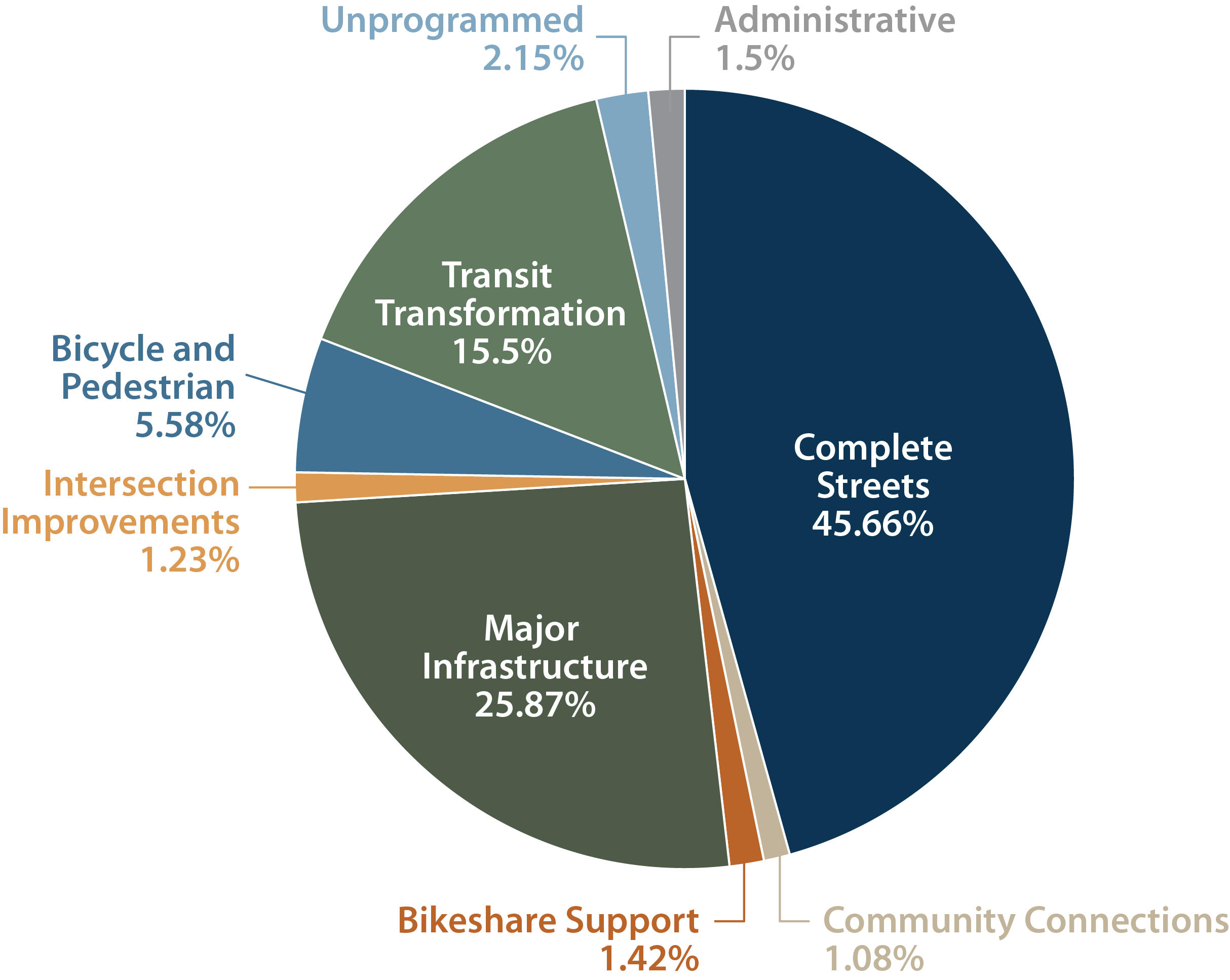
The Boston Region MPO is responsible for allocating approximately $150,000,000 in Regional Target funds to transportation projects annually. Generally, these funds are invested in capital projects, such as the reconstruction of a roadway into a multimodal corridor, the conversion of a former railbed into a shared-use path, or expanding a regional bikeshare program. The MPO establishes investment programs in its Long-Range Transportation Plan (LRTP) to prioritize the types of transportation projects that it funds through its Transportation Improvement Program (TIP). The TIP is the MPO’s rolling five-year capital investment plan. The latest TIP, for Federal Fiscal Years (FFYs) 2027–31, allocates $781,230,252 of Regional Target funds to 41 projects.
The MPO’s investment programs direct funding to priority areas over the 20-year LRTP planning timeframe. Projects funded through each investment program may vary by type, scale, transportation mode (such as the roadway network or transit network), funding source, or other factors. These programs are developed to ensure MPO investments support the vision and goals outlined in its LRTP. They also communicate to potential project proponents—such as municipalities or regional transit authorities (RTAs)—the types of projects the MPO believes will support that vision and set of goals.
Investment programs are reevaluated and updated every five years as part of the LRTP development process. MPO staff review federal statute, regional and state plans, and regional transportation needs; consult MPO members; collect stakeholder input; and consult project proponents and implementing agencies. As part of the development of the LRTP, staff present recommendations to the board. In Destination 2050, the MPO’s current LRTP, the MPO adopted the following investment programs:
Figure 1 depicts the breakdown of MPO investments through the FFYs 2027–31 TIP across these seven investment programs.
Figure 1
MPO Investments through the FFYs 2027–31 TIP
Source: Boston Region MPO staff.
Projects funded through the Bicycle Network and Pedestrian Connections program expand the region’s bicycle and pedestrian network and support safe bicycle and pedestrian access to key destinations. Improvements can include multiuse paths, improved bicycle and pedestrian crossings, new or expanded sidewalks, enhanced signage and lighting, and traffic calming.
Table 1
Bicycle Network and Pedestrian Connections Program Targets
LRTP Investment Program Target |
5 percent |
FFYs 2027–31 TIP Actual |
5.58 percent ($43.6 million) |
Average of FFYs 2025–29 through FFYs 2027–31 TIP Actuals |
8.32 percent |
Source: Boston Region MPO staff.
The majority of projects developed and funded through this investment program are new urban trail and greenway connections. MPO staff proactively engage communities that neighbor MPO-funded trail projects to advance subsequent phases through the funding process.
Municipalities have indicated growing interest in a larger funding source for trail resurfacing and rehabilitation beyond what the Commonwealth’s MassTrails grant program can support.
The Bikeshare Support program was created in the Destination 2050 LRTP to support the expansion of the bikeshare system and to replace or upgrade existing stations. Currently, the program is focused on supporting the Bluebikes system.
Table 2
Bikeshare Support Program Targets
LRTP Investment Program Target |
1 percent |
FFYs 2027–31 TIP Actual |
1.42 percent ($3.12 million) |
Average of FFYs 2025–29 through FFYs 2027–31 TIP Actuals |
1.3 percent |
Source: Boston Region MPO staff.
The Bikeshare Support program continues to represent the majority of “quick-build” projects funded by the MPO. It consistently draws strong interest in funding application cycles from municipalities for both the expansion of the Bluebikes system and replacement of older bikes and equipment. MPO investment in Bluebikes has outpaced the investment program target, enabled in large part due to declining interest in the Community Connections program. MPO staff are considering ways to further support the expansion of the Bluebikes system while also exploring the feasibility of supporting other bikeshare systems across the region.
The Community Connections program is the MPO’s funding program for first- and last-mile solutions, community transportation, and other small, non-traditional transportation projects such as those that update transit technology.
Table 3
Community Connections Program Targets
LRTP Investment Program Target |
2 percent |
FFYs 2027–31 TIP Actual |
1.08 percent ($8.46 million) |
Average of FFYs 2025–29 through FFYs 2027–31 TIP Actuals |
2 percent |
Source: Boston Region MPO staff.
The Community Connections program, as envisioned, has struggled to generate interest among project proponents. The majority of funded projects can be categorized as bikeshare, bike rack purchases, and community transit service pilots. Bikeshare now falls under a separate program, and community transit service projects have generally seen low ridership. Proponents have struggled to generate funding to keep service going after the pilot periods.
Given the ongoing decline in interest in this program, MPO staff are considering ways to make better use of these funds to support small-scale projects that meet the needs for first-and-last mile connectivity for people who walk, bike, and take transit. One potential approach is to consolidate this investment program with Intersection Improvements to create a dedicated, long-term funding program for quick-build projects.
The Complete Streets program modernizes roadway corridors to achieve a variety of MPO goals, such as improving safety, infrastructure condition, and multimodal mobility and access. The projects are initiated through the MassDOT Highway Division Project Development Process, and designs are reviewed by MassDOT.
Table 4
Complete Streets Program Targets
LRTP Investment Program Target |
45 percent |
FFYs 2027–31 TIP Actual |
45.66 percent ($356.74 million) |
Average of FFYs 2025–29 through FFYs 2027–31 TIP Actuals |
46.01 percent |
Source: Boston Region MPO staff.
The Complete Streets program consistently maintains the largest list of projects within the portfolio of MPO-funded projects. Project size typically ranges from $10 to $30 million, though recent project cost trends are driving project budgets well beyond that $30 million figure. These increases continue to constrain the MPO’s ability to fund new roadway projects.
The Complete Streets program encompasses the broadest variety of projects, ranging from those that support full multimodal corridors to ones that focus more on the condition of pavement or bridges, or even resiliency-oriented efforts. The Complete Streets program is traditionally pursued by municipalities that are uncertain about the suitability of a project for a different, more specialized investment program (e.g., Bicycle and Pedestrian). The MPO could consider better defining the role of the Complete Streets program, or potentially reorienting applications to other programs.
The Intersection Improvements program supports projects that enhance intersections in ways that improve safety and mobility for all modes. Projects are initiated through the MassDOT Highway Division Project Development Process, and designs are reviewed by MassDOT. They are distinct from Complete Streets projects in that they are focused on one intersection or multiple intersections spread out in an area (as opposed to those aligned in a corridor).
Table 5
Intersection Improvements Program Targets
LRTP Investment Program Target |
12 percent |
FFYs 2027–31 TIP Actual |
1.23 percent ($9.63 million) |
Average of FFYs 2025–29 through FFYs 2027–31 TIP Actuals |
4.61 percent |
Source: Boston Region MPO staff.
Despite increasing emphasis in MPO and MassDOT work on prioritizing investments in safety, the Intersection Improvements program has seen a consistent decline in interest. As with other investment programs, the Intersection Improvements program has substantial overlap in scope with other programs, particularly Complete Streets and Major Infrastructure. As the project development process has lengthened and design costs have increased, municipalities are electing to bundle more improvements into their projects.
The Major Infrastructure program invests in large-scale, regionally significant roadway projects that improve expressways and major arterials to reduce congestion and improve safety, or transit projects that expand the fixed-guideway network. Generally, projects must be listed in the MPO’s LRTP to be eligible for inclusion in this investment program.
Table 6
Major Infrastructure Program Targets
LRTP Investment Program Target |
30 percent |
FFYs 2027–31 TIP Actual |
25.87 percent ($202.08 million) |
Average of FFYs 2025–29 through FFYs 2027–31 TIP Actuals |
24 percent |
Source: Boston Region MPO staff.
The Major Infrastructure program is primarily shaped through development of the MPO’s LRTP. Due to project delays and cost increases across current Major Infrastructure projects, it is unlikely the MPO will be able to fund additional projects in this category for the foreseeable future. In FFY 2026, the MPO began providing early-stage planning and design funding for two projects in Framingham and Lexington that were programmed in the MPO’s LRTP in order to expedite project development.
The MPO includes transit projects within the eligibility criteria for this program, though historically it has largely funded roadway projects. The increasingly multimodal nature of projects has meant that large-scale roadway projects that include transit elements are often eligible for funding under multiple MPO programs. For example, the construction of dedicated bus lanes along Tremont Street and Columbus Avenue in Boston, which utilizes $34 million in MPO Transit Transformation funding, also meets the criteria of a Major Infrastructure project.
The Transit Transformation program supports multimodal access, state of good repair, and infrastructure upgrades. Other investment programs, such as Complete Streets and Major Infrastructure, often incorporate substantial transit improvements, but the Transit Transformation designation is traditionally reserved for projects proposed by transit authorities.
Table 7
Transit Transportation Program Targets
LRTP Investment Program Target |
5 percent |
FFYs 2027–31 TIP Actual |
15.50 percent* ($121.07 million) |
Average of FFYs 2025–29 through FFYs 2027–31 TIP Actuals |
10.07 percent |
*The Transit Transformation Program typically solicits projects only for the first or second year of a five-year TIP cycle. Therefore, this methodology understates the annual proportion of investment by the MPO in transit. Table 8 shows annual programmed amounts for transit projects using MPO Regional Target dollars between FFYs 2023 and 2027.
Source: Boston Region MPO staff.
Table 8
Transit Transportation Program Targets between FFYs 2023–27
|
FFY 2023 |
FFY 2024 |
FFY 2025 |
FFY 2026 |
FFY 2027* |
Average |
Dollars Programmed |
$34,500,000 |
$60,171,495 |
$67,173,096 |
$31,431,589 |
$50,968,883 |
$48,849,013 |
Available TIP Budget |
$128,950,081 |
$130,647,095 |
$128,427,689 |
$125,285,688 |
$153,053,705 |
$133,272,852 |
Percent of Allocation |
26.75% |
46.06% |
52.30% |
25.09% |
33.30% |
36.70% |
* This figure is a projection and may be subject to change based on TIP amendments throughout FFY 2027.
Source: Boston Region MPO staff.
As evidenced by Table 8 above, MPO investment in Transit Transformation projects often greatly exceeds the program targets set through the LRTP. This pattern is the result of a lack of shovel-ready projects in other investment programs. Delays on projects in other investment programs have led the MPO to redirect money earmarked for those delayed projects to support additional Transit Transformation projects. Given the existence of substantial transit investments in other MPO investment programs, there may be an opportunity to broaden the scope and scale of this program to capture more municipal-priority projects that improve transit.
Civil Rights Notice to the Public
Welcome. Bem Vinda. Bienvenido. Akeyi. 欢迎. 歡迎
You are invited to participate in our transportation planning process, free from discrimination. The Boston Region Metropolitan Planning Organization (MPO) is committed to nondiscrimination in all activities and complies with Title VI of the Civil Rights Act of 1964, which prohibits discrimination on the basis of race, color, or national origin (including limited English proficiency). Related federal and state nondiscrimination laws prohibit discrimination on the basis of age, sex, disability, and additional protected characteristics.
For additional information or to file a civil rights complaint, visit www.bostonmpo.org/mpo_non_discrimination.
To request this information in a different language or format, please contact:
Boston Region MPO Title VI Specialist
10 Park Plaza, Suite 2150
Boston, MA 02116
Phone: 857.702.3700
Email: civilrights@ctps.org
For people with hearing or speaking difficulties, connect through the state MassRelay service, www.mass.gov/massrelay. Please allow at least five business days for your request to be fulfilled.