Percentage of Chapter 90 Projects by Type
August 2026
The Central Transportation Planning Staff is directed by the Boston Region Metropolitan Planning Organization (MPO). The MPO is composed of state and regional agencies and authorities, and local governments.
Central Transportation Planning Staff
Boston Region Metropolitan Planning Organization
State Transportation Building
Ten Park Plaza, Suite 2150
Boston, Massachusetts 02116
857.702.3700 | ctps@ctps.org | bostonmpo.org
Section 1—Introduction and Project Overview
1.2...... Chapter 90 Program Overview
1.4...... Methodology and Limitations
1.4.2 Department of Public Works Interviews
1.5...... Recent Research on Chapter 90
1.5.1 Comparable State Programs
Section 2—Balance Sheet Analysis
2.1...... Project Type Distribution
2.2...... Uncommitted Balances
Section 3—Department of Public Works Interviews
3.1...... Project Types and Project Delivery Timelines
3.2...... Project Prioritization Processes
3.3...... Funding Levels and “Banking” Funds
3.4...... Multi-Year Authorizations.
3.5...... Program Administration and Departmental Collaboration
Section 5—MPO’s Relevance and Recommendations
Figure 1 Percentage of Chapter 90 Projects by Type
Figure 2 Number of Chapter 90 Projects by Type
Figure 3 Number of Municipalities by Uncommitted Balance Level
Table 1 Comparison of State Local Aid Programs
Table 2 Median Income and Population by Community Type
This briefing provides an overview of how municipalities in the Boston MPO region make use of the Chapter 90 municipal funding program to maintain and improve their roadways. Chapter 90 has provided funding for municipalities for decades, but there has not been a recent evaluation of the program in the Boston region. The Boston Region Metropolitan Planning Organization (MPO) has conducted this review, as the MPO is responsible for creating a regional vision for transportation in 97 municipalities in eastern Massachusetts and coordinating across institutions and local governments to align priorities for capital investments in the region.
This briefing documents the findings from an inventory of Chapter 90 reimbursement requests from calendar year (CY) 2018 to 2024 and interviews with municipal Public Works Departments conducted by MPO staff. Through this research staff sought to better understand the utilization of the program—particularly focusing on design projects—to evaluate potential overlaps with the MPO’s own capital program, explore opportunities for the MPO to raise awareness of design as an eligible Chapter 90 use, and provide information about the program to decision-makers.
The key findings were that program funding utilization is highly variable between municipalities, municipal size and median household income were not strong predictors of program funding utilization, and municipal staff had consistent desires for more predictable and robust funding in the Chapter 90 authorization bills.
The MPO can act on these findings by highlighting the potential use of Chapter 90 for design projects, both for the MPO’s required 25 percent design submission for Transportation Improvement Program (TIP) projects and as match funding to the MPO’s recently established design pilot program, and by continuing to provide decision-makers informative research on transportation policy that affects the MPO region.
The Chapter 90 Program is the primary source of state funding for municipal road maintenance. The program was created by the state legislature more than 50 years ago to help municipalities maintain their roadways and complete small capital projects that improve their transportation systems.1 The program is reimbursement-based, meaning municipalities pay the upfront cost and apply for reimbursement from the program via the Massachusetts Department of Transportation’s (MassDOT) six district offices; within the Boston Region MPO’s boundaries, these are MassDOT Districts 3 through 6.
Chapter 90 is known for being a flexible, reliable funding stream for municipalities. The funding can be used for paving, design services, equipment purchases, sidewalk improvements, and more. It is formula funded, meaning municipalities do not need to apply to access the funding (although they must submit a project request to MassDOT before any work is undertaken). The formula relies on road mileage, jobs, and population; in recent years, there has been additional funding based on road miles alone. This flexibility and ease of use is why the Chapter 90 Program is a favored spending program for municipalities.
As the regional metropolitan planning organization for 97 cities and towns, the Boston Region MPO is responsible for projecting a long-term vision for the region through the Long-Range Transportation Plan (LRTP) and programming about three-quarters of a billion dollars of capital investments through the Transportation Improvement Program (TIP). The MPO board is composed of state agencies, regional agencies, and municipalities that are responsible for stewarding federal funding into the capital projects most effective for realizing the vision for the Boston region.
To make the most efficient use of federal and state dollars, it is important for the MPO to better understand the broader municipal financing landscape. Municipalities are project proponents for many TIP projects, and understanding their constraints and challenges allows the MPO to determine ways to better support its municipal partners. Further, because design is an eligible use of Chapter 90 dollars, there are potential avenues for municipalities to use the funding toward design services for projects that can be funded through the MPO’s TIP or to provide supplemental design funding to projects whose designs are already being funded via the MPO’s recently established design pilot program.
As well as this, one of the top priorities in the current LRTP, Destination 2050, is to improve roadway quality and support investments that keep roadways and bridges in a state of good repair. While the MPO does not directly administer roadway maintenance funds, conducting research that can inform these programs’ operations is one way that the MPO can help achieve its stated goals for the region.
Although the Chapter 90 Program directs about 40 percent of its base funding ($80.3 million out of $200 million for state fiscal year 2025) to the Boston region, there has not been a comprehensive evaluation of the program’s current conditions, strengths, and challenges in the region. In 2024, MassDOT convened an advisory group made up of municipalities from all six MassDOT districts for a term of one year.2 This geographically diverse advisory group was focused on the challenges of, and potential changes to, the Chapter 90 Program. However, because it was statewide, not every finding could be applicable to the Boston region. Further, by nature of being an advisory body, the group was focused on making suggestions to the state legislature and MassDOT for potential changes to funding levels and the formula used to allocate those funds.
In contrast, this MPO research on Chapter 90 focuses on a more in-depth review of how municipalities in the region use the funding and does not make recommendations for changes to the program. The Chapter 90 Program is the largest source of state investment in municipal roadways. Because project selection for the program is typically done by Public Works Departments (DPWs), researching Chapter 90 usage also presents the opportunity for the MPO to foster relationships with municipal DPW departments that may not be the typical target of MPO outreach.
This analysis drew on two related sources: balance sheet analyses and interviews with municipal staff.
MPO staff contacted each of the 97 municipalities in the region to request their most recent Chapter 90 balance sheet and project list, as well as to inform them about this MPO research project. Staff also reached out to MassDOT state aid engineers to request the standardized MassDOT copies of the municipal balance sheets. When staff received different versions from a municipality and MassDOT, the more recent version was used. Staff looked at reimbursement requests from CY 2018 to December 2024/January 2025, when the balance sheets were collected. Staff selected 2018 as the cutoff year to help account for 2020 pandemic-related irregularities. The calendar year period was used because reimbursement requests are not typically made in alignment with fiscal years.
Once the sheets were compiled, staff categorized projects into six categories:
The Other category encompassed projects such as drainage improvements, berms, or projects where the category was unclear. When staff categorized sidewalk projects, they marked whether they were exclusively sidewalk projects or included within other resurfacing or reconstruction projects. Finally, staff also noted the uncommitted balance (sometimes called “current available funds”) on each municipal balance sheet at the time of collection.
With the number and type of projects accounted for, staff analyzed the project data and uncommitted balances to identify trends. For example, staff looked to see if any MassDOT districts had substantially different project types than others, or if median household income was a predictor of uncommitted balances. These trends are discussed more in the following sections of this document.
The second stage of the project involved discussions with municipal staff, primarily DPW directors, about how their municipalities utilize the program and how Chapter 90 funding fits into the bigger picture of their municipal transportation budgets. Discussions with DPW directors were subject to their availability. Staff met with eight directors in three meetings. The municipalities represented were Needham, Lincoln, Melrose, Newton, Peabody, Littleton, Hingham, and Brookline. While these municipalities had a higher median household income than the region overall, they were geographically diverse, representing six of the eight MPO subregions. The meetings were conducted from late April to mid-May 2025.
The limitations to the methodology and research data are as follows:
As previously mentioned, MassDOT convened an advisory group that served one year to discuss challenges municipalities face with the Chapter 90 Program and potential changes to the program. The Chapter 90 Program Advisory Group’s report also detailed the legislative history of Chapter 90, including recent year funding levels.
Some of the group’s key findings were as follows:
To better understand the legislative context for the Chapter 90 Program, staff reviewed programs in surrounding and peer states to learn how these states conduct their own municipal road local aid. All the selected states have a program that is similar to Chapter 90 but with significant variation across formula specifications, match requirements, and other factors. A summary of the state programs, including Massachusetts, is shown in Table 1.
Comparison of State Local Aid Programs
|
|
|
|
|
|
|
|
|
|
|
|
|
|
|
|
|
|
|
|
|
|
|
|
|
|
|
|
|
|
|
|
|
|
|
|
|
|
|
|
Table 1 Sources:
1 New Hampshire Department of Transportation (website), “Highway Block Grant Aid,” State of New Hampshire, accessed July 14, 2026. https://www.dot.nh.gov/projects-plans-and-programs/programs/highway-block-grant-aid .
2 Connecticut Department of Transportation (website), “Town Aid Road Program,” State of Connecticut, accessed July 14, 2026. https://portal.ct.gov/dot/programs/town-aid-road-grants?language=en_US .
3 Utah Department of Transportation (website), “Local Government Program Assistance,” State of Utah, accessed July 14, 2026. https://www.udot.utah.gov/connect/business/public-entities/local-government-program-assistance/ .
4 Commonwealth of Pennsylvania Department of Transportation (website), “Learn About How to Request Funding from the Municipal Liquid Fuels Program”, Commonwealth of Pennsylvania, accessed July 14, 2026. https://www.pa.gov/services/penndot/learn-ho .
5 New York Department of Transportation (website), “Consolidated Local Street and Highway Improvement Program (CHIPS),” State of New York, accessed July 14, 2026. https://www.dot.ny.gov/programs/chips .
6 Georgia Department of Transportation (website), “Local Maintenance and Improvement Grant (LMIG),” State of Georgia, accessed March 20, 2026. https://www.dot.ga.gov/GDOT/pages/LMIG.aspx .
7 Massachusetts Department of Transportation (website), “Chapter 90 Program,” Commonwealth of Massachusetts, accessed July 14, 2026. https://www.mass.gov/chapter-90-program .
When comparing the Chapter 90 Program to other states’ municipal road aid programs, it appears that the Chapter 90 Program may be easier for municipalities to access. Other states’ programs include match requirements, lengthy certification documents, complex funding formulas, or revenue-dependent allocations that create uncertainty. In contrast, the Chapter 90 Program requires no match, has a straightforward reimbursement process, and few application or reporting requirements. This sentiment was echoed by the municipal staff interviewed for this project (this is elaborated on in Section 3). Lastly, because it is a bond program, Chapter 90 could be more insulated from year-over-year revenue variations than state programs that require the state to have cash-on-hand.
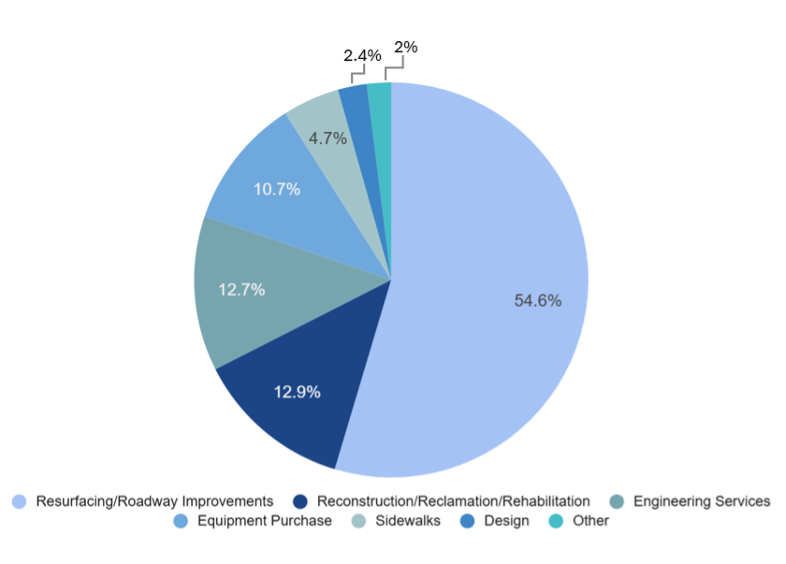
The analysis of the 97 municipal balance sheets resulted in a tally of 1,007 projects categorized into six categories:
The proportion of projects of each type and the raw number of each project type are shown in Figures 1 and 2, respectively.
Figure 1
Percentage of Chapter 90 Projects by Type
Figure 2
Number of Chapter 90 Projects by Type
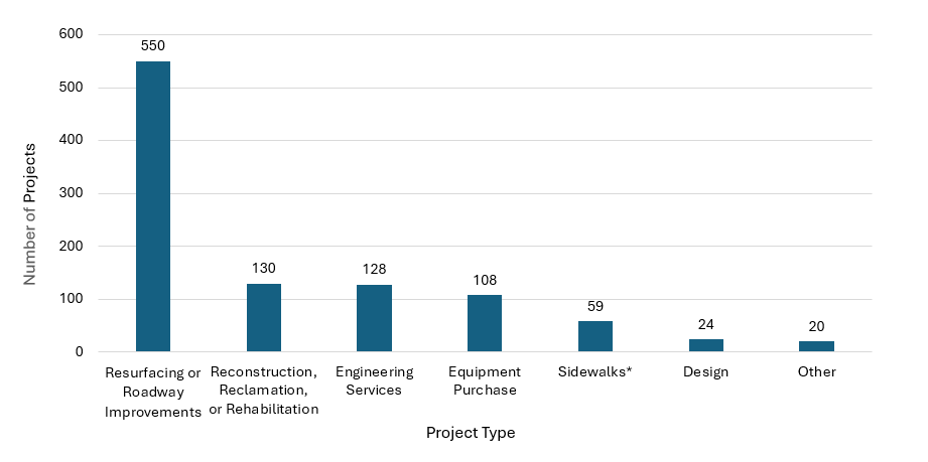
*Note: The Sidewalks category may contain double-counted projects if a sidewalk project was part of a larger project. The number of independent sidewalk projects is 47. The total number of projects excluding double-counted sidewalk projects is 1,007. Project type percentages are based on the total project counts excluding double-counted sidewalks.
This project type distribution is aligned with the intent of the Chapter 90 Program, which is for municipalities to use the funding to maintain their existing roadway network, with the flexibility to use it for other expenditures as needed. At the same time, this distribution illustrates that while Chapter 90 is most often used for paving projects, there are additional ways in which municipalities use the program funds. The wide discretion municipalities have for using Chapter 90 funds allows them the flexibility to prioritize different purchases at different times. For example, the Town of Sharon submitted 29 reimbursement requests for equipment purchases during the data period, while many municipalities submitted none. Similarly, the Town of Marshfield used Chapter 90 funds 11 times for engineering services, while the City of Newton used it for these services eight times, the Town of Holbrook used it four times, and several dozen municipalities did not use the funds for engineering services.
There was also wide variability in the number of reimbursements municipalities submitted. As stated in Section 1 where the limitations of the study are discussed, some of this can be explained by the fact that some municipalities submit one reimbursement for their whole paving program, while some municipalities submit reimbursements for individual streets and paving projects. However, this is not entirely the case as indicated by the number of reimbursements submitted by similarly sized suburbs. The Town of Sharon submitted 111 reimbursement requests during the data period, including 52 resurfacing projects, but the remaining 59 projects were a mix of equipment purchases (29), reconstruction/reclamation (10), engineering services (9), and 11 independent sidewalk projects not part of other resurfacing or reconstruction projects. On the other hand, the suburbs of Sudbury and Canton both submitted 15 requests total.
There was some variation in project type totals between MassDOT districts. All districts’ reimbursement requests were between 50 percent and 59 percent for resurfacing/roadway improvements. However, among other categories, some trends emerged. District 6 had the highest percentage of sidewalk projects at 10.96 percent, while District 3 had only 0.31 percent. This could be explained by the fact that District 6 includes largely urban inner core communities while District 3 is much more suburban and partially rural. District 4 had a markedly higher percentage of reimbursement requests for engineering services, at 19.27 percent, while only 9.32 percent of reimbursement requests in District 5 were for this purpose. Overall, there was wide variation in how municipalities spent their Chapter 90 allocations excluding pavement improvements.
Similarly, there was significant variation in uncommitted balances for municipalities. At the time of data collection (winter 2024–25), there was about $80 million in uncommitted funds, meaning funds that were not utilized for projects, are not pending reimbursement approval, and are not committed otherwise to a project. While this would normally represent 40 percent of the annual Chapter 90 allocation, the state allocated $45 million of Fair Share funding to the Chapter 90 Program in fiscal year (FY) 2024, so it is difficult to discern an accurate ratio of funds spent to funds allocated.
Municipalities can “bank” their Chapter 90 funds from year to year, often to save for larger projects. On average, municipalities had about one year’s worth of their Chapter 90 allocation banked in uncommitted balances (1.08 years). However, there was wide variation. Five municipalities had zeroed out their accounts, while one municipality had over seven years’ worth of allocations banked.
Municipalities were grouped into the following categories based on their balances:
The number and proportion of municipalities falling into each cohort is shown in Figure 3.
Figure 3
Number of Municipalities by Uncommitted Balance Level
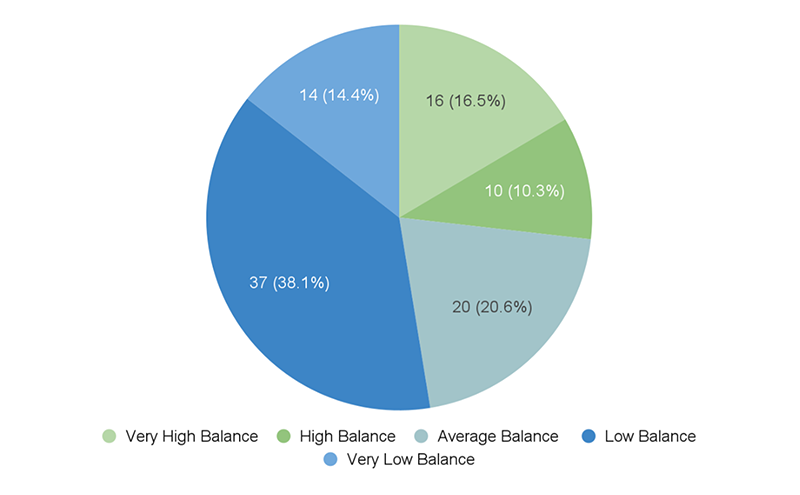
There were 10 municipalities with a high balance and 16 with a very high balance. Communities with a very high balance were concentrated geographically, with District 3 and District 4 most represented. Of the 16 communities with very high balances, nine were in District 4. However, District 4’s average uncommitted balance was barely higher than the region as a whole (1.10 years vs. 1.08 years), so this overrepresentation in the data may be because District 4 covers the largest number of municipalities in the region.
There were 37 municipalities with a low balance, and 14 with a very low balance. Five of the communities with very low balances (Milton, Hopkinton, Quincy, Westwood, and Winthrop) had a zero-dollar balance. The communities with low and very low balances were not concentrated geographically, but were spread throughout each district.
Population size and wealth may contribute to a municipality’s ability or need to expend its total Chapter 90 allotment. It may be easier for wealthy, larger municipalities to successfully spend their allotment because they have greater staff capacity. Or, it may be that smaller, less wealthy communities will spend more of their allotment because they are unable to supplement their annual paving budgets with municipal funds.
Neither of these scenarios were borne out in the data on Chapter 90 uncommitted balances. Communities with very high balances (with more than two years of allotments banked) had an average median household income of $155,360 and an average population size of 24,546. Municipalities with very low balances (less than 0.1 years of allotments banked) had an average median household income of $160,030 and an average population size of 26,839.3
Median Income and Population by Community Type
Community Type |
Household Median Income |
Population |
Very High Balance |
$155,360 |
24,546 |
Very Low Balance |
$160,030 |
26,839 |
Communities with very low balances were slightly more affluent and have higher populations than communities with very high balances, by 3 percent and 9.4 percent, respectively. To determine if this difference was statistically significant, a two-sample t-test was performed and it was found that neither median income nor population were predictive of Chapter 90 uncommitted balances (p = .39). This does not mean the challenges that smaller or less-resourced communities face are any less impactful, but it does indicate that any issues the program faces within the Boston area are not a result of systemic capacity issues.
However, it is possible this trend—or lack thereof—is only apparent in the Boston region. This is because the majority of municipalities in the Boston region have a much higher median household income than Massachusetts writ large. In the Boston region, the median household income is $151,643, while the state median is $104,828.4 Therefore, while it is true that relative wealth within the Boston region is not predictive of municipal Chapter 90 utilization, this may not remain true when comparing the Boston region with other, less wealthy regions of the state.
Similarly, while the Boston region includes some very small municipalities, there are few with fewer than 5,000 residents. Municipalities in the Boston region also typically have more employment opportunities than other regions of the state. This means that Boston region municipalities receive, on average, more Chapter 90 funding per year than towns in Central and Western Massachusetts. Therefore, they may not need to bank funding for multiple years in order to make an equipment purchase or complete roadway projects.
In line with the analysis of balance sheets, the interviews illustrated that the Chapter 90 Program’s implementation is highly variable from place to place. Each municipality used Chapter 90 money in different ways and with different goals in mind. Below, staff have summarized the conversations about key topics.
As seen in the balance sheet analysis, most municipalities utilized Chapter 90 funding for their annual paving programs. Five municipalities reported that they supplemented their paving budgets with town funds to varying degrees. Two municipalities, however, mentioned that Chapter 90 funds were the only reliable funding streams for routine repaving and maintenance. Most municipalities said that with both Chapter 90 and any municipal funding available, they were able to pave between one and three miles of roadway a year depending on several factors, including the timing of when the project is put out to bid, whether or not sidewalks need to be installed or updated, and the fluctuating price of labor and materials.
Because all the municipalities interviewed are Complete Streets communities, sidewalks were always considered in project prioritization processes. Two municipalities also had procedures that required the municipality to consider adding on-street bike lanes or crosswalks whenever a road was undergoing resurfacing.
Only one interviewed municipality reported prioritizing the use of Chapter 90 funds for design projects. Representatives of Needham discussed how their annual paving budget was typically made up of town funds and only occasionally supplemented by the Chapter 90 Program, so they were able to be more flexible with the types of projects they funded using their Chapter 90 allocation. Needham funded five design projects via the program in the years examined, including one design project that resulted in a capital project funded through the Boston Region MPO’s TIP.
All municipalities agreed that the timing of the annual bill’s passage was a determining factor for project cost. One municipality estimated that projects put out to bid earlier in the season were about 25 percent less expensive. Two municipalities said that they were required to complete their paving programs during the school summer break to avoid school bus detours. This meant that, in years where the bill’s passage was over the summer, they had to rush to get projects in the pipeline before their construction window closed.
While some municipalities said they were allowed to contract projects and spend town funds with the implicit understanding that the Chapter 90 money would become available, other municipalities said they were not able to do so and had to wait until the bill’s passage to start contracting projects. This was more likely to be the case for municipalities that cannot supplement their Chapter 90 funds with municipal funds.
Several municipalities used a Pavement Condition Index (PCI) to prioritize roads for the upcoming paving season. Some municipalities used their Chapter 90 allotment to pay for the PCI. Those that did not have PCIs had their own prioritization process; for example, one municipality utilized a “neighborhood” approach where they would conduct assessments in a different neighborhood each year and determine which roads within that neighborhood were in need of repair.
However, multiple municipalities noted that there are “political” elements. Residents want to see work getting done year-to-year, so sometimes main arterials that are in need of repairs are highly prioritized even if they are not necessarily the roads most in need of repair. Similarly, a road may be prioritized if it is associated with a high number of complaints from residents. One municipality noted that they try to distribute annual repaving projects across the entire municipality so all elected officials can show their constituents that public resources are being used effectively. The same municipality noted that they usually opted for resurfacing instead of full-depth reclamation in order to maximize the lane miles they can repair every year. This was a common theme throughout the conversations. With limited funding, patch repairs or mill and overlay projects are used to keep roadways functional, even when full-depth reclamation or reconstruction would be preferable.
The prioritization process for other uses, such as engineering services or equipment purchases, was more ad hoc. Any equipment purchases made were typically to replace existing equipment, as opposed to purchasing new types of equipment, and engineering services were mostly used as part of a roadway improvement that had already been prioritized.
As mentioned in the introduction of this briefing and in MassDOT’s Chapter 90 Program Advisory Group report, the base funding level for Chapter 90 had not been increased for nearly a decade from FY 2016 to FY 2025. At the time of the interviews, there had been additional dollars directed toward the program, including $45 million in 2024 and $80 million in 2025, both using revenue from the Fair Share surtax to finance the Chapter 90 bonds. However, these additional funds have been presented as one-time additions to the formula program or written into different bills entirely. (Note: In August 2025 and June 2026, the State Legislature approved a 50 percent increase in base funding for the Chapter 90 Program for state fiscal years (SFY) 2026 and 2027, from $200 million to $300 million).5
The supplemental revenue in FY 2024 and FY 2025 was welcomed by the interviewed municipalities; however, they noted that sporadically receiving extra revenue can result in multiple short-term roadway improvement projects, instead of a longer-term project that is more needed. The uncertainty of future funding levels prevents municipalities from planning ahead. A municipality that knows it will be receiving $800,000 may plan for a full-depth reclamation project on a section of road. A municipality that originally planned for its standard $400,000 allocation, and then receives supplemental funding later in the year, may be more likely to choose to resurface two sections instead.
While most municipalities interviewed had uncommitted balances, only one municipality said it was intentional. In other words, most municipalities were not saving uncommitted balances for a larger capital project. The balances were the result of construction delays, lack of staff capacity to plan projects, a delay in funding availability (resulting in being unable to use the prior year’s funding before the end of construction season), or a delay in project reimbursement requests. The municipality that was banking funding is doing so to pay for a full reconstruction of a longer stretch of prioritized roadway.
Currently, the Chapter 90 bill is reauthorized annually. Governor Healey has filed versions of the bill that contain multi-year authorizations (two to five years), but the Legislature has continued to support the historical one-year authorization bill. Historically, municipalities, MassDOT, and lobbying organizations such as the Massachusetts Municipal Association have requested multi-year authorizations as a way to give municipalities stability and allow for longer-term planning.6
When asked about multi-year authorization bills, the municipalities that MPO staff spoke with largely agreed, with one caveat: multiple municipalities noted that they would appreciate the certainty of a multi-year authorization but did not want a multi-year authorization to be a way of “kicking the can down the road” for funding increases. If a five-year authorization was signed at current funding levels, that could be less desirable than a two-year authorization that provides the opportunity for more funding in the near future.
Multi-year authorizations were particularly appealing to municipalities that do not have access to supplemental municipal funding for their pavement programs. This is because a multi-year authorization would allow these municipalities to begin construction earlier in the season, rather than wait for the single-year authorization to pass the Legislature. This aligns with the earlier findings about municipalities’ challenges with the timing of the annual Chapter 90 bill passage.
All municipalities interviewed agreed that Chapter 90 funding was easier to access and utilize than other state funding programs. This is likely because the program is formula-based and municipalities do not need to formally apply. Municipalities reported that they received reimbursements promptly and that the reimbursement request process was straightforward, even with the recent migration to an online reimbursement system.
Within municipalities, Chapter 90 administration is a largely siloed effort. All municipal representatives interviewed said they do not typically involve other departments, such as the planning department, in their initial prioritization processes unless the project was substantial enough to require a planning board review. However, there is interdepartmental communication to ensure that paving schedules and other Chapter 90 projects do not create unnecessarily complicated construction detours and to prevent duplicative work, i.e., to ensure that the DPW is not repaving a road that will be under construction in coming years.
There are several key takeaways from this analysis.
Within the Boston region, the ways that municipalities utilize and program Chapter 90 funding is highly variable. Each municipality has its own prioritization process, method of reimbursement submission, strategy for utilizing or supplementing their allocation, and project delivery capabilities. While this makes comprehensive analyses of utilization difficult, it also represents one of the key strengths of the program: its flexibility for municipalities to program the funds as they see fit.
In the Boston region, there are no clear predictive factors for determining how easily municipalities can expend Chapter 90 funding. Neither median household income nor population size were correlated with uncommitted balances. This, again, illustrates that the program’s implementation on the municipal level is subject to each municipality’s specific characteristics and preferences. A statewide analysis could help inform policymakers on future program changes or municipal assistance programs for municipalities that lack the capacity to spend their allocation.
The Chapter 90 Program has insufficient funds to repair municipal roads and maintain them in a state of good repair. All municipalities agreed that more funding would be necessary to get all their roads to a state of good repair. This was true even for municipalities that have access to supplemental municipal funding for a paving program. This has also been found in surveys completed by the Massachusetts Municipal Association and within the MassDOT Chapter 90 Program Advisory Group’s report. Whether the Chapter 90 Program should be expanded, or if municipalities should be expected to fund the remaining cost of repairing and maintaining their roadways, is an area of debate within and outside of the state Legislature.
Many Boston region municipalities would like to see stability and predictability in program funding. While every municipality welcomed more funding, there was a clear preference for a predictable increase, rather than one-time windfalls from supplemental budgets. Increasing funding levels within the core program, along with multi-year authorizations, would help municipalities plan longer-term improvements. Multi-year authorizations could also resolve the issue many municipalities have of needing to wait until the annual bill is passed to begin their construction season. However, there were hesitations that multi-year authorizations could be a way to preclude funding increases for long periods of time.
Design projects represent a small portion of reimbursement requests, but there is room for growth. The MPO can and should encourage municipalities that have unused Chapter 90 money to consider utilizing their funding for initial design costs.
Although the Boston Region MPO does not directly administer the Chapter 90 Program, there are intersections between Chapter 90 and the MPO’s work and mission. The MPO can utilize the findings of this research to take the following actions.
Educate municipalities about design as an eligible Chapter 90 use: An eligible use of Chapter 90 funding is design, which includes work toward the 25 percent design requirement for projects applying for the TIP. However, for the analyzed years, design projects represented just 2.4 percent of project reimbursement requests.
The MPO should ensure municipalities are aware that preliminary project design is an eligible use of Chapter 90 funds. These outreach efforts could focus on municipalities with a large amount of uncommitted funds or municipalities that have expressed difficulty obtaining municipal funding for the 25 percent design requirement. Further, through the MPO’s recently established design funding program, a municipality would only need to cover a small portion of the total cost of design, which would make Chapter 90 use more feasible. Any information communicated to municipalities regarding the TIP design requirement or design funding should include information about all eligible funding sources, including Chapter 90.
Inform policymakers of the Chapter 90 Program’s current utilization patterns: In Joint Transportation Committee hearings, state policymakers have previously mentioned that one of the issues with permanently expanding Chapter 90, or creating multi-year authorizations, is that they do not have a good understanding of where the Chapter 90 allotments go.
This research can fill some of that knowledge gap and provide policymakers with the information they need when discussing and evaluating the administration and outcomes of the program. The MPO should ensure that this research about the Chapter 90 Program is elevated through the proper channels to reach policymakers.
The Boston region consists of 97 municipalities representing almost half of the state’s population. While not representative of the whole state, transportation research conducted in the region can provide insights on a larger scale than focusing on individual municipalities or smaller MPO regions.
Utilize research to move forward the Boston Region MPO’s long-range goals: One of the objectives within the MPO’s Long-Range Transportation Plan is to increase the percentage of assets in the transportation system that are in a state of good repair. Many goals, like this one, are partially outside of the MPO’s direct scope because the MPO does not own transportation assets.
However, the MPO can push forward the LRTP’s vision and encourage collaboration among local and state stakeholders through research that raises awareness of transportation issues and provides potential solutions. In this case, providing insights regarding the Chapter 90 Program could result in an increased percentage of municipal assets in a state of good repair.
The MPO should continue to contribute to research on transportation funding programs (both extant and potential) on the municipal and state level, including examining the barriers that project proponents face when trying to secure and expend funding. Through researching the roadblocks and challenges of infrastructure programs, the MPO can help the region move towards the vision laid out in Destination 2050 to create a more reliable, accessible, and connected transportation system.
Civil Rights Notice to the PublicWelcome. Bem Vinda. Bienvenido. Akeyi. 欢迎. 歡迎
You are invited to participate in our transportation planning process, free from discrimination. The Boston Region Metropolitan Planning Organization (MPO) is committed to nondiscrimination in all activities and complies with Title VI of the Civil Rights Act of 1964, which prohibits discrimination on the basis of race, color, or national origin (including limited English proficiency). Related federal and state nondiscrimination laws prohibit discrimination on the basis of age, sex, disability, and additional protected characteristics. For additional information or to file a civil rights complaint, visit www.bostonmpo.org/mpo_non_discrimination. To request this information in a different language or format, please contact:
Boston Region MPO Title VI Specialist Phone: 857.702.3700
For people with hearing or speaking difficulties, connect through the state MassRelay service, www.mass.gov/massrelay. Please allow at least five business days for your request to be fulfilled. |
1 Massachusetts Department of Transportation (website), “Chapter 90 Program,” Commonwealth of Massachusetts, accessed July 21, 2025. https://www.mass.gov/chapter-90-program.
2 Massachusetts Department of Transportation, Chapter 90 Program Advisory Group (January 2025), accessed July 21, 2025. https://www.mass.gov/doc/chapter-90-advisory-report/download.
3 United States Census Bureau (website), “QuickFacts: United States” (2025). https://www.census.gov/quickfacts/fact/table/US/PST045225.
4 United States Census Bureau (website), "Median Household Income in the Past 12 Months (in 2024 Inflation-Adjusted Dollars) by Age of Householder," American Community Survey, ACS 5-Year Estimates Detailed Tables, Table B19049, accessed March 22, 2026. https://data.census.gov/table/ACSDT5Y2024.B19049.
5 Office of Governor Maura Healy and Lt. Governor Kim Driscoll, “Governor Healey Signs Chapter 90 Bill, Unlocking Over $1 Billion in Infrastructure Funding for Communities Across Massachusetts,” August 8, 2025.https://www.mass.gov/news/governor-healey-signs-chapter-90-bill-unlocking-over-1-billion-in-infrastructure-funding-for-communities-across-massachusetts; Office of Governor Maura Healey and Lt. Governor Kim Driscoll, “Governor Healey Signs Transportation Funding Bill, for Local Roads, Highways, Bridges and Infrastructure to Unlock Housing,” June 11, 2026. https://www.mass.gov/news/governor-healey-signs-transportation-funding-bill-for-local-roads-highways-bridges-and-infrastructure-to-unlock-housing.
6 Adam Chapdelaine, “MMA expresses strong support for $300M per year for Chapter 90 and multi-year authorization in testimony to Transportation Committee,” Massachusetts Municipal Association, March 4, 2026. https://www.mma.org/advocacy/mma-expresses-strong-support-for-300m-per-year-for-chapter-90-and-multi-year-authorization-in-testimony-to-transportation-committee/.