

Prepared by
The Central Transportation Planning Staff:
Staff to the Boston Region Metropolitan Planning Organization
Directed by the Boston Region Metropolitan Planning Organization,
which is composed of the
[map]
Notice of Nondiscrimination Rights and Protections
Contact MPO staff:
Executive Summary
The Boston Region MPO
Metropolitan planning organizations (MPO) are responsible for providing forums for coordination on regional transportation goals and decision-making about how to allocate federal transportation funds for capital projects and planning studies through a continuing, comprehensive, and cooperative (3C) planning process. Each metropolitan area in the United States with a population of 50,000 or more—also known as an urbanized area—is required by federal legislation to establish an MPO and conduct a 3C planning process.
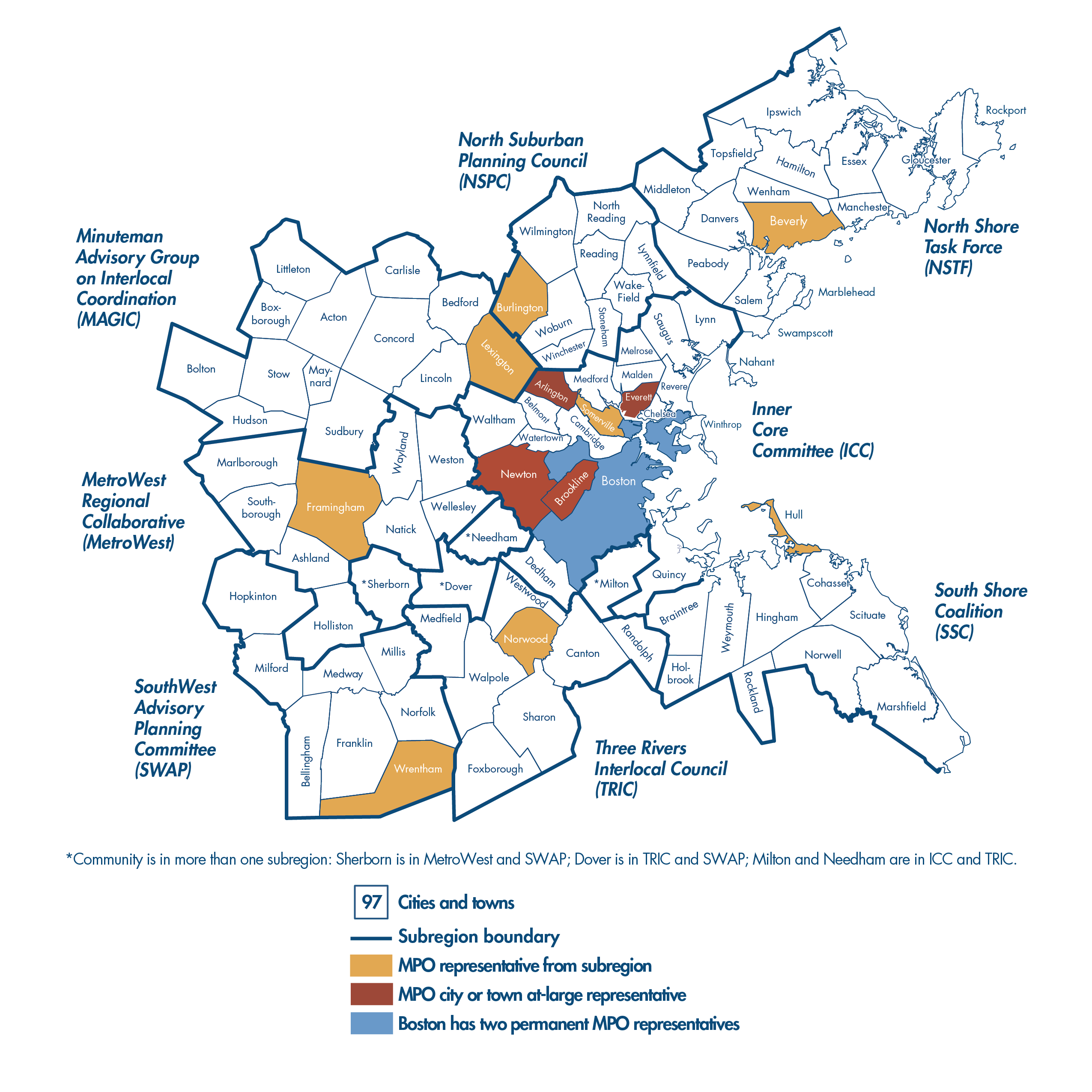
The Boston Region MPO’s planning area encompasses 97 cities and towns, stretching from Boston north to Ipswich, south to Marshfield, and west to Interstate 495. Figure ES-1 shows the map of the Boston Region MPO’s member municipalities.
The MPO’s board has 23 voting members. Several state and regional agencies, advisory organizations, and the City of Boston are permanent voting members, while 12 municipalities are elected as voting members for three-year terms. Eight of these municipal members represent each of the eight subregions of the Boston region, and four represent at-large municipal seats. The Federal Highway Administration (FHWA) and Federal Transit Administration (FTA) participate on the MPO board as advisory, nonvoting members. The MPO board makes transparent and collaborative decisions about transportation planning and funding in the Boston region, informed by data, analysis, and public input.
The MPO is supported by a staff of planners, data analysts, engineers, and other professionals.
Figure ES-1
Municipalities in the Boston Region
The Unified Planning Work Program (UPWP)
The MPO’s work is guided by a 20-year vision for a modern, safe, reliable, robust, and well-connected multimodal transportation system for the region. This vision is described in the MPO’s current Long-Range Transportation Plan (LRTP), Destination 2050. The transportation planning work funded through the UPWP is integral to achieving this regional vision.
The UPWP is a one-year planning document and financial plan that outlines how the Boston region will allocate its federal transportation planning funds for a given federal fiscal year (FFY) in alignment with its long-term vision, goals, and objectives. Overall, it describes the 3C metropolitan planning process for the Boston Region.
The development of the UPWP involves the prioritization of federal funding for transportation planning work, including MPO programs, studies, and technical analyses, to be implemented in a given year to support the region’s goals. The scopes and budgets of the prioritized work are documented in the UPWP.
In addition to MPO-funded work, staff carry out work funded by external grant programs and conduct planning analyses and studies funded by state transportation agencies, such as the Massachusetts Department of Transportation (MassDOT) and the Massachusetts Bay Transportation Authority (MBTA).
UPWP Programs and Studies
The total amount of funding (inclusive of federal funding and matching funds) programmed in this UPWP is $7,852,348. These funds are provided by both the FHWA and FTA, with MassDOT supplying the required matching funds. Federal funds originating from FHWA, known as FHWA 3C Planning (PL) funds, are distributed across MPO regions using a formula developed by the Massachusetts Association of Regional Planning Agencies. Federal funds originating from the FTA are known as FTA 3C Planning (Section 5303) funds, and since 2019, MassDOT has transferred Section 5303 funds from the FTA to the FHWA for administration as a Consolidated Planning Grant. The MPO uses this funding to conduct the following programs and plans:
MPO Programs and 3C Planning
Long-Range Transportation Plan (LRTP)
The LRTP guides decision-making on transportation investments in the Boston region over the next two decades. It serves as the MPO’s guiding document, establishing the regional transportation vision, goals, objectives, and investment approaches under which the MPO operates. The MPO adopted the current LRTP, Destination 2050, in 2023 and anticipates adopting the next LRTP in 2028.
Schedule: ongoing
FFY 2027 budget: $421,362
FFY 2027 anticipated outcomes and deliverables:
- Memorandum detailing the process for establishing performance measures associated with MPO goal areas and pilot, including constraints such as feasibility and deliberations from MPO board and Community Advisory Council discussions
- Memorandum detailing the process to establish a set of strategies that the MPO could pursue to advance priority goal areas
- Memorandum detailing preliminary results from scenario planning explorations
- Board and staff deliberations on content of the in-progress plan, documented through meeting minutes
Transportation Improvement Program (TIP)
The TIP is a financially constrained program of planned multimodal investments in the region’s transportation system over a five-year period. The TIP is guided by the goals and objectives established in the LRTP and is updated annually.
Schedule: ongoing
FFY 2027 budget: $344,760
FFY 2027 anticipated outcomes and deliverables:
- The FFYs 2028–32 TIP
- Documentation of progress made on performance measures through the programming of TIP projects
- Procedure for delivering and monitoring design contracts for TIP projects, including identification of design process outcomes and improvements
- Development of a formal process for utilizing regionally prioritized TIP funding to support early stage planning efforts that align with existing design funding offerings
- Monitoring the success of and iterating upon the MPO’s project programming and cost-change policies with policy updates as needed
- Additional analysis to help pinpoint needs for targeted municipal outreach
- Amendments and administrative modifications to the FFYs 2027–31 TIP
Unified Planning Work Program
The UPWP is developed annually and includes descriptions and budgets for work that MPO staff will conduct to support the MPO’s goals and objectives during the upcoming FFY.
Schedule: ongoing
FFY 2027 budget: $143,820
FFY 2027 anticipated outcomes and deliverables:
- FFY 2028 UPWP
- Engagement in the development of the FFY 2028 UPWP from the public and MPO board
- Improvements to the UPWP document and development process
- Support for the MPO’s UPWP Committee
- Regular reporting on FFY 2027 UPWP implementation
- Amendments and administrative modifications to the FFY 2027 UPWP
Public Engagement Program
The MPO engages the public in the transportation planning process to enhance decision-making by highlighting the transportation needs and priorities of communities throughout the region, as well as the local impacts of transportation planning decisions. The Public Engagement Program ensures that the MPO’s planning and decision-making processes are transparent and responsive to public input, providing members of the public with meaningful opportunities to participate.
Schedule: ongoing
FFY 2027 budget: $400,860
FFY 2027 anticipated outcomes and deliverables:
- Fulfill federally required engagement activities, such as public review periods, to support the 3C planning process in accordance with the Public Engagement Plan.
- Host approximately 10 Community Advisory Council meetings and facilitate connections to MPO staff and the board
- Draft a municipal engagement strategy
- Implement a stakeholder tracking database
- Publish public engagement dashboard updates
- Develop engagement resources and guidance for MPO staff
- Host the Community Planning Lab
Performance-Based Planning and Programming (PBPP)
The MPO’s PBPP work involves using data to develop and evaluate progress toward performance targets for roadway and transit safety, highway and transit assets, congestion management, travel time reliability, and air quality and emissions, in annual, two-year, and four-year horizons for the region's transportation system. PBPP helps ensure that the MPO’s planning and investments are yielding progress toward the MPO’s goals.
Schedule: ongoing
FFY 2027 budget: $121,380
FFY 2027 anticipated outcomes and deliverables:
- Federally required reporting on performance target setting
- Improvements to the content and functions of the Performance Dashboard
- Performance analysis of the projects funded in the FFYs 2028–32 TIP in relation to how they will support improvements in various performance areas and make progress toward performance targets
- Proposal of MPO region-specific safety targets
- Plan for launching project-specific air quality performance monitoring
- Methodologies and performance metrics that can be used to evaluate the impact of investments and inform future evaluation criteria
Community Transportation Access (CTA) Program
The CTA Program supports the MPO’s investment in a transportation system that meets the needs of the Boston region's residents by assessing the impacts of MPO investments on their economic well-being and quality of life. The CTA Program also ensures that the MPO complies with Title VI and other existing federal and state civil rights regulations throughout its work.
Schedule: ongoing
FFY 2027 budget: $202,000
FFY 2027 anticipated outcomes and deliverables:
- Title VI Report, if requested by MassDOT
- Plain language documents for technical CTA Program work products
- Development of metrics to assess the impacts of projects, in the aggregate, in the 2028 LRTP
- Analyses of the expected impacts of TIP projects, in the aggregate, in the FFYs 2028–32 TIP
- Updated Language Assistance Plan
Congestion Management Process (CMP) Program
The CMP program is responsible for monitoring and making recommendations to address congestion, mobility, and safety needs within the region’s transportation system.
Schedule: ongoing
FFY 2027 budget: $121,380
FFY 2027 anticipated outcomes and deliverables:
- Streamlined process for communicating and delegating data storage, analysis, and review with relevant MPO staff
- Publication of CMP network integrated with roadway reliability performance measures
- Draft of multimodal performance measure dashboard including measures encouraging mode shift in addition to cross-program performance measures overlapping with the Freight Planning and Transportation Impact Mitigation programs
- Increased collaboration with the Multimodal Mobility Infrastructure Program by providing CMP- or mobility-related technical assistance where possible
Transportation Impact Mitigation (TIM) Program
The TIM program assesses potential threats from natural hazards to the region and addresses risks to transportation assets posed by severe weather. This program also ensures that the MPO complies with the Clean Air Act and the Environmental Protection Agency’s transportation conformity regulations.
Schedule: ongoing
FFY 2027 budget: $149,940
FFY 2027 anticipated outcomes and deliverables:
- Initiation of the Regional Vulnerability Assessment with adopted framework
- Inventory of Evacuation Routes for the North Shore Task Force subregion
- Project application scoring for the TIP for risk mitigation and adaptive capacity
- Processed air quality data
- Identification of additional air quality-related studies or initiatives
- Assistance with resiliency- or air quality-related technical assistance projects
- Environmental stakeholder engagement
- Required air quality analyses and reporting
Freight Planning Program
The freight program plans for the policies and infrastructure that enable the movement of freight and goods by road, rail, water, and air.
Schedule: ongoing
FFY 2027 budget: $126,480
FFY 2027 anticipated outcomes and deliverables:
- Draft Regional Freight Decarbonization Plan Framework
- Publish, promote, and monitor progress of the Regional Freight Action Plan
- Update Freight data visualizations with relevant datasets from the Freight Action Plan and Critical Urban Freight Corridors
Regional Model Enhancement
This program supports the research and development of improvements to the regional travel demand model maintained by the MPO. The model is programmed to represent projections of population and employment in the region, which informs the development of the MPO’s LRTP. It is also used for statewide emissions estimates and to support specific planning and policy analyses by the MPO, municipalities, and state agencies.
Schedule: ongoing
FFY 2027 budget: $945,540
FFY 2027 anticipated outcomes and deliverables:
- TDM23 (travel demand model) maintenance updates to incorporate fixes, performance improvements, and new capabilities for project analysis
- TDM23 enhancements to support LRTP scenarios
- TDM28 development and calibration for the 2028 LRTP
- Initial version of TDMX exploratory platform
- Regional FTA Simplified Trips-on-Project Software updates and maintenance
- Model utility improvements and expansion
Data Program
The data program leads strategic efforts to improve how data are used, developed, and shared in support of the MPO and its stakeholders.
Schedule: ongoing
FFY 2027 budget: $586,500
FFY 2027 anticipated outcomes and deliverables:
- Data maturity assessment results
- Updated data strategy and roadmap
- Data needs assessment results and recommendations for central data repository, reference data, and public-facing data catalogue.
- Expanded use of Documentation Platform to three or more programs.
- Data request responses and updated data request handling guidelines
- Assessments and recommendations for up to three existing or emerging datasets
- Curated, enhanced reference data, tools, and distribution for FFY 2028 TIP scoring cycle.
- Standardized and centralized data repository for use internally on most or all agency work, with guidelines on data management, querying, and use, including foundational reference datasets.
Active Transportation Planning Program
This program uses data collection, analysis, and technical assistance to improve safety and comfort for people walking, bicycling, and rolling in the Boston region.
Schedule: ongoing
FFY 2027 budget: $187,680
FFY 2027 anticipated outcomes and deliverables:
- Summary of key insights and feedback from the Active Transportation Steering Committee
- Needs assessment for active modes in the region and report documenting research, methods, and results of the regional gap analysis.
- Bicycle and pedestrian volume counts and high-level trends such as the impact of weather, seasonality, facility types, and other roadway characteristics.
- Performance metrics and baseline figures for the safety, usage, and connectivity of the active transportation network in the region.
Multimodal Mobility Infrastructure Program
This program conducts studies of roadways, corridors, and intersections to address regional and community transportation needs.
Schedule: ongoing
FFY 2027 budget: $382,500
FFY 2027 anticipated outcomes and deliverables:
- Updated corridor and intersection selection process to include the data from the Vision Zero and Neutralizing Onerous Heat Effects on Active Transportation (NO-HEAT) planning efforts
- Selection of corridor and intersection study locations
- Updated methodology and steps for site-specific studies to support the project pipeline
- Recommendations for selected corridor improvements
- Recommendations for selected intersection improvements
- White paper with key findings from land use and transportation exploration
- Recommendations for incorporating findings from mode shift research into planning work
- Existing conditions analysis for the Mobility Action Plan
- Updated Managing the Curb Space Guidebook
Support to the MPO and its 3C Process
Under this program, staff implement MPO policies, plan and coordinate the delivery of information for MPO decision-making, and support the operation of the MPO and its committees. It also involves providing support for MPO meeting management.
Schedule: ongoing
FFY 2027 budget: $1,065,716
FFY 2027 anticipated outcomes and deliverables:
- Hosted MPO meetings, subcommittee meetings, and Transit Working Group meetings
- Coordination with state and federal partners
- Coordination with neighboring MPOs, including participating in coordination meetings with northern, southern, and western neighboring MPOs
- Editorial and graphics support
- Participation in the federal recertification process
Technical Assistance
In addition to the above programs and studies, the MPO funds and conducts technical assistance work through the Road Safety Audits and Community Transportation Technical Assistance programs. The Road Safety Audits program funds staff’s participation in road safety audits led by MassDOT at high-risk crash locations. Through the Community Transportation Technical Assistance Program, staff provide municipalities with advice on addressing multimodal concerns in their communities.
Schedule: ongoing
FFY 2027 Road Safety Audits budget: $10,000
FFY 2027 Community Transportation Technical Assistance budget: $137,700
FFY 2027 anticipated outcomes and deliverables:
- Participation in Road Safety Audits as requested by MassDOT
- Documentation of Road Safety Audit recommendations
- Technical assistance consultations to municipalities, Metropolitan Area Planning Council (MAPC) subregions, Regional Transit Authorities, and Transportation Management Associations
- Technical memos documenting the work, recommendations, and outcomes of technical assistance consultations
FFY 2027 Discrete Studies
Roadway Pricing Technical Evaluation: Iterative Scenario Analysis
In FFY 2025, MPO staff completed the first phase of a roadway pricing study that analyzed a conceptual roadway pricing scenario and assessed how available data and tools could be applied to measure potential impacts this scenario would have on congestion, revenue, and equity in the region. In FFY 2027, staff will build upon this initial study by using travel demand models, Replica (a large mobility data provider), and other available data to evaluate different variations on the conceptual roadway pricing framework. This iterative approach will reveal the tradeoffs between different roadway pricing scenarios and evaluate the equity impacts of the status quo of free road access.
Schedule: October 2026–September 2027
Budget: $75,000
Anticipated outcomes and deliverables:
- A white paper describing the scenarios evaluated and the impacts of roadway pricing scenarios on vehicle miles traveled, transit ridership, air quality, and revenue generation
- Evaluation of the geographic and demographic impacts of roadway pricing across the Boston region
Impact of Parking Supply on Property Values
Reducing parking supply is a key strategy for managing travel demand; however, developers often express concern that reducing parking supply will make a project appear less financially viable to lenders. This study aims to evaluate the relationship between parking supply and property values to provide insight into this concern. MPO staff will use available data to analyze the interaction between parking spaces per square foot and sale price for particular properties. The analysis would control for a number of variables that influence property value and establish separate conclusions for commercial and residential properties.
Schedule: October 2026–September 2027
Budget: $40,000
Anticipated outcomes and deliverables:
- A report detailing the data, methods, and analysis results that highlights the key findings of how parking supply relates to residential and commercial property values and how those insights can inform parking policy decisions
Opportunities for the Boston Region MPO to Support Transit-Oriented Development
Regional planning agencies can support transit-oriented development (TOD) by aligning transportation investments with emerging growth patterns and addressing areas of existing density that have low connectivity, while considering planned growth, transportation network capacity, and regional employment and demographic trends. This study will use peer research, including a literature review and interviews with peer MPOs and agencies, to identify effective strategies for the Boston Region MPO to support the objectives of TOD.
Schedule: October 2026–September 2027
Budget: $35,000
Anticipated outcomes and deliverables:
- A brief explanation of the research findings on how the MPO can support TOD through planning, programming, and policy work
FFY 2027 Budget
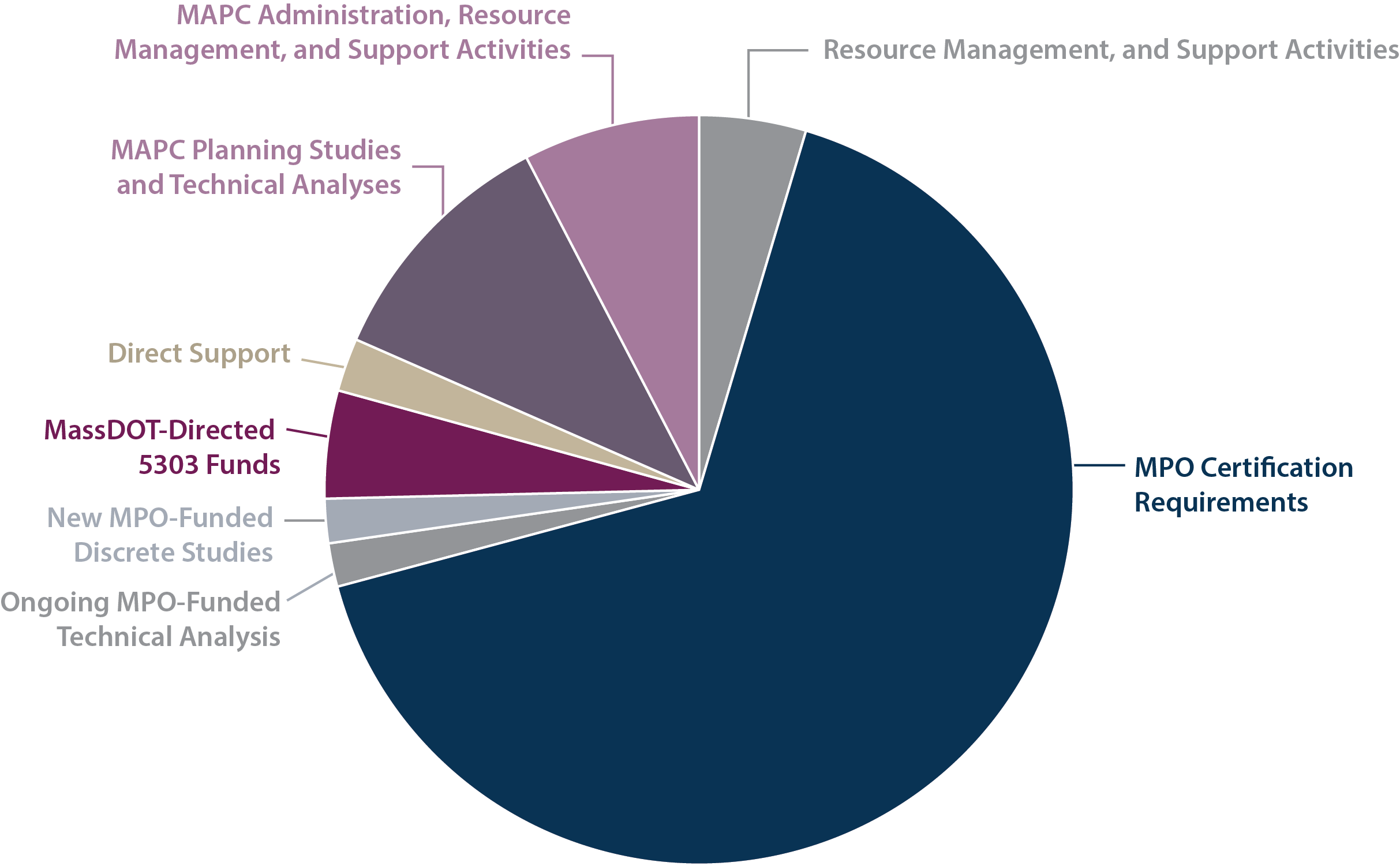
Table ES-1 contains the budget allocated for the MPO’s 3C planning activities in FFY 2027. The table reflects the FHWA PL funds and FTA Section 5303 funds, which the Boston Region MPO and MAPC expect to spend in FFY 2027. This information is also shown in the chart (Figure ES-2) below.
Table ES-1
Unified Planning Work Program Budget for FFY 2027
| 3C Studies and Programs by Budget Categories | Proposed FFY 2027 Boston Region MPO Budget |
| Resource Management and Support Activities | $362,120 |
| MPO Certification Requirements | $5,199,918 |
| Ongoing MPO-Funded Technical Analyses | $147,700 |
| New MPO-Funded Discrete Studies | $150,000 |
| MassDOT-Directed 5303 Funds | $365,412 |
| Direct Support | $180,000 |
| Total FFY 2027 Boston Region MPO Budget | $6,405,150 |
| 3C Studies and Programs by MAPC Budget Categories | Proposed FFY 2027 MAPC Budget |
| MAPC Planning Studies and Technical Analyses | $848,000 |
| MAPC Administration, Resource Management, and Support Activities | $599,198 |
| Total MAPC FFY 2027 UPWP Programmed Funds | $1,447,198 |
| Agency Supporting MPO/3C Work | Proposed FFY 2027 Budget |
| Boston Region MPO | $6,405,150 |
| MAPC | $1,447,198 |
| 3C Budget Subtotal | $7,852,348 |
| FFY 2027 UPWP Budget | $7,852,348 |
| Note: This budget includes salary, overhead, and direct support costs. |
Note: This budget includes salary, overhead, and direct support costs.
Figure ES-2
Unified Planning Work Program Budget for FFY 2027
- Resource Management and Support Activities
- MPO Certification Requirements
- Ongoing MPO-Funded Technical Analyses
- New MPO-Funded Discrete Studies
- Direct Support
- MAPC Planning Studies and Technical Analyses
- MAPC Administration, Resource Management, and Support Activities
Alt text: pie chart showing the FFY 2027 UPWP budget information.
Developing the UPWP
Updates to Ongoing Programs and Continuing Activities
The annual process of creating the UPWP includes updating the scopes and anticipated deliverables for ongoing programs, technical analysis activities, certification requirements, and administrative support activities, as well as evaluating ideas for discrete studies.
Ideas for ongoing program activities, technical analysis activities, and studies come from the following sources:
- Guidance issued by FHWA and FTA
- Input gathered from the MPO’s UPWP Committee, which oversees the development of the UPWP document
- Feedback gathered from the Community Advisory Council
- Existing planning documents, such as the MPO’s LRTP Needs Assessment and MAPC’s long-range plan for smart growth in the Boston region
- MPO staff-identified needs that emerge from continual interactions between the MPO staff, state and local agencies, organizations, and community groups
- Input gathered through ongoing public engagement
Public Engagement
MPO staff conduct public engagement throughout the development of the UPWP. Engagement includes meetings with MAPC subregional groups, community-based organizations, and other interested stakeholders, as well as attendance at community meetings and events. Input from members of the public and other stakeholders is summarized in the UPWP document and used by staff to inform future scoping, planning, and engagement work.
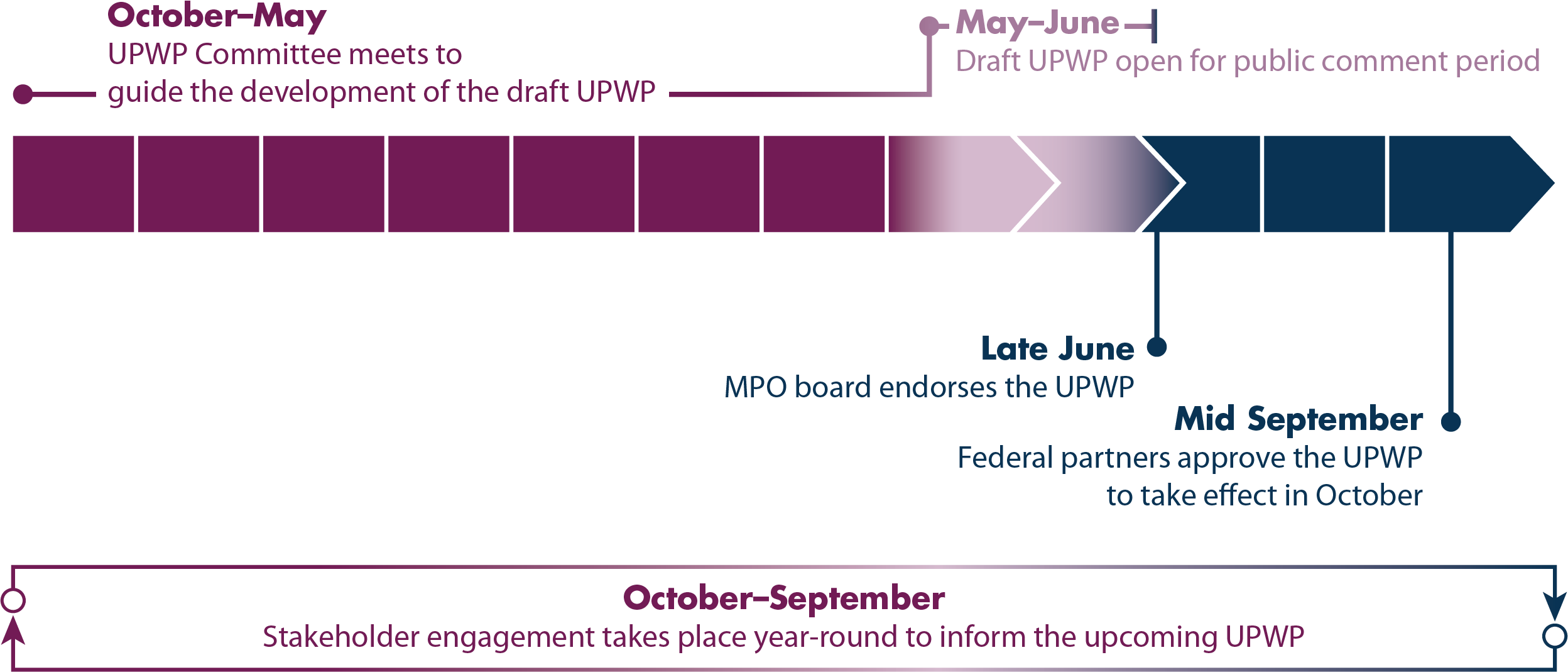
Toward the end of the document development process, the MPO board votes to release a draft UPWP for public review. MPO staff post the document on the MPO’s website (bostonmpo.org) and publicize its release via an email distribution list that includes municipal contacts, interested members of the public, and other regional stakeholders, as well as through social media. Comments received during the public review period are presented to the MPO board to review and consider. The public review period for the FFY 2027 UPWP began on May 8 and ended on May 29.
Figure ES-3 illustrates the annual UPWP development timeline.
Figure ES-3
UPWP Development Timeline
Measuring Progress
The MPO monitors the progress of programs and studies by performing the following tasks:
- Approving detailed work programs and scopes
- Reviewing monthly progress reports
- Tracking program and study budgets and spending via quarterly reports
- Approving the release of deliverables based on whether the objectives stated in the work program or scope were met and whether the stated deliverables were produced
Chapter 1: Continuing, Comprehensive, and Cooperative Transportation Planning in the Boston Region
Metropolitan Planning Organizations (MPO) were first given the authority to approve the use of federal funds for transportation planning and capital projects in a region through the Federal Highway Act of 1973. MPOs are established based on an agreement between the governor of a state and at least 75 percent of the local representation in a metropolitan area (typically representation through local elected officials) to provide a forum that engages state, regional, and local stakeholders in the transportation planning process. Each metropolitan area in the United States with a population of 50,000 or more is required by federal legislation to have an MPO.
MPOs establish regional transportation visions that are the overarching framework for decision-making about how to allocate federal transportation funds in a metropolitan area. This vision is informed by the input and needs of the full range of stakeholders in a region, including elected officials, municipal planners and engineers, transportation advocates, and residents.
The Boston Region MPO is the designated MPO for the 97 municipalities in eastern Massachusetts that comprise the MPO’s planning area. The Boston Region MPO develops plans for funding transportation projects and programs; maintains transportation models and data resources to support studies, system performance monitoring, and air quality determinations; and conducts an ongoing public engagement process.
The Transportation Planning Process
The federal government regulates the funding, planning, and operation of the surface transportation system through the federal transportation program, which was enacted into law through Titles 23 and 49 of the United States Code— Section 134 of Title 23 of the Federal Aid Highway Act, as amended, and Section 5303 of Title 49 of the Federal Transit Act, as amended.
The most recent reauthorization of the federal surface transportation law is the Infrastructure Investment and Jobs Act (IIJA). The IIJA sets policies related to metropolitan transportation planning and requires that all MPOs carry out a continuing, comprehensive, and cooperative (3C) transportation planning process. This process must result in plans and programs that support metropolitan community development and social goals and lead to the development and operation of an integrated, intermodal transportation system that facilitates the efficient, economic movement of people and goods.
The Boston Region MPO has established the following objectives for the process:
- A 3C transportation planning process resulting in plans, programs, and operations consistent with the planning objectives of the metropolitan area.
- Continuing, affirming the necessity to plan for the short- and long-range needs of the regional transportation system, emphasizing the iterative character of the progression from systems planning to project planning, programming, operations, and implementation. Frequent updating and reevaluation of data and plans is necessary.
- Comprehensive, including the effective integration of the various stages and levels of transportation planning and programming for the entire region and examining all modes to ensure a balanced planning effort. There are simultaneous analyses of various related non-transportation elements, such as land use, economic and residential development, demographics, sustainability, and community impact within an integrated planning and programming process.
- Cooperative, requiring effective coordination among public officials at all levels of government, and inviting the wide participation of all parties, public or private, at all stages of the transportation planning process. A key objective of the process is to resolve issues and controversies by providing a forum for negotiation and consensus building. At the same time, the process is not intended to operate, and cannot operate, to dilute the ultimate authority or responsibility of those state, regional, or local public officials who, pursuant to statute or under contract, review and/or implement transportation plans, programs, and projects.
- Compliance with the requirements of the IIJA, the Americans with Disabilities Act of 1990, the Clean Air Act of 1990, the Civil Rights Act of 1964, and Executive Order 13330 (regarding the coordination of human-services transportation)
More information about the federal, state, and regional guidance governing the transportation planning process, and about the regulatory framework in which the MPO operates can be found in Appendix E.
The Boston Region MPO
Planning Area
The Boston Region MPO’s planning area extends across 97 cities and towns. Figure 1-1 shows the map of the Boston Region MPO’s member municipalities.
Figure 1-1
Municipalities in the Boston Region
MPO Board Members and Staff
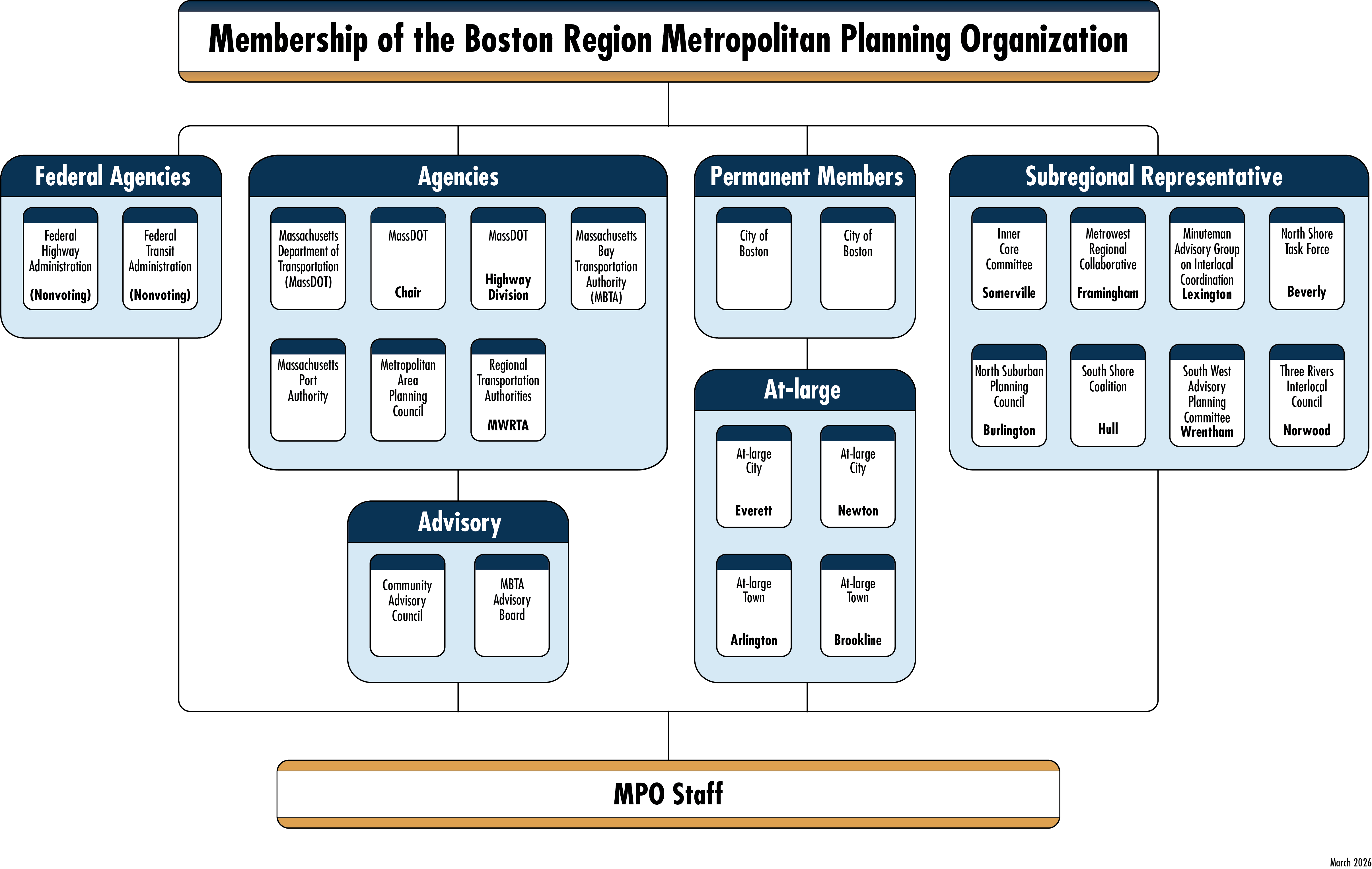
MPO decision-making is carried out by a board comprising 23 voting members, with comprehensive support from the MPO staff. Several state agencies, regional organizations, and the City of Boston are permanent voting members, while 12 municipalities are elected as voting members for three-year terms. Eight municipal members represent each of the eight subregions of the Boston region, and there are four at-large municipal seats. The Federal Highway Administration (FHWA) and Federal Transit Administration (FTA) participate on the MPO board as advisory (nonvoting) members. More details about the MPO’s permanent members can be found in Appendix F.
Figure 1-2 shows Boston Region MPO membership.
Figure 1-2
Boston Region MPO Membership
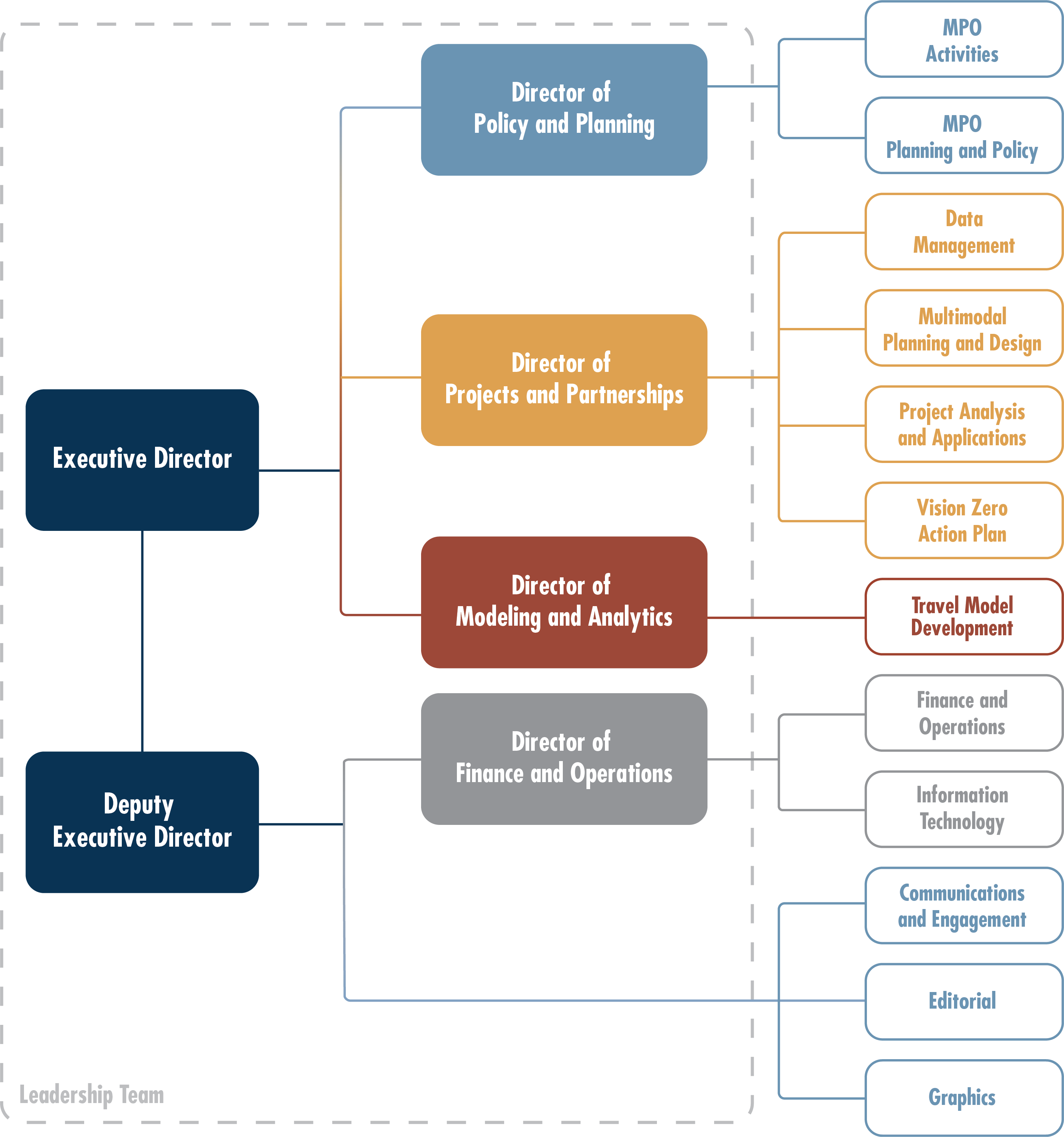
The Boston Region MPO staff is composed of transportation planners, data analysts, data scientists, engagement and communications experts, graphic designers, editors, and administrative support staff. The MPO also employs part-time data collectors to support its planning work.
Figure 1-3 shows the organization of the Boston Region MPO staff.
Figure 1-3
Boston Region MPO Organizational Chart
A Vision for the Region
Destination 2050, the MPO’s current Long-Range Transportation Plan (LRTP), was adopted in July 2023 and took effect October 1, 2023. The LRTP outlines the vision, goals, and objectives for the Boston region’s transportation system. More information about the LRTP can be found on the MPO’s website at https://www.bostonmpo.org/lrtp.
Certification Documents
As part of its 3C process, the Boston Region MPO produces the Transportation Improvement Program (TIP) and the Unified Planning Work Program (UPWP) annually, and the LRTP every four to five years. These documents, referred to as certification documents, are required for the federal government to certify the MPO’s planning process. Federal certification is a prerequisite for the MPO to receive federal transportation funds. A robust public engagement process accompanies the development of each certification document.
The Long-Range Transportation Plan
The LRTP guides decision-making on investments that will be made in the Boston region’s transportation system over the next two decades. It defines an overarching vision of the future of transportation in the region, establishes goals and objectives that will lead to achieving that vision, and allocates projected revenue to transportation projects and programs consistent with the established goals and objectives.
The Transportation Improvement Program
The TIP is a capital investment program of multimodal transportation improvements, consistent with the LRTP, that describes and prioritizes transportation projects that are expected to be implemented during a five-year period. TIP projects include major highway reconstruction and maintenance, arterial and intersection improvements, public transit expansion and maintenance, paths and other facilities designated for people walking, biking, and rolling, and bikeshare capital improvements.
The TIP contains a financial plan that shows the current or proposed revenue sources for each project.
An MPO-endorsed TIP is incorporated into the State Transportation Improvement Program (STIP) for submission to the FHWA, FTA, United States Environmental Protection Agency, and the Massachusetts Department of Environmental Protection for approval. Investments programmed in the TIP and STIP are also reflected in Massachusetts Department of Transportation’s (MassDOT) Capital Investment Plan, which shows capital expenditures in the state over a five-year period.
The Unified Planning Work Program
The UPWP describes the transportation planning work that will be conducted by MPO staff during the course of a federal fiscal year, which runs from October 1 through September 30. The document includes ongoing planning work as it will be advanced in the federal fiscal year, supportive activities undertaken by MPO staff to enable that work, such as information technology, graphics, and editorial support, and single-year planning initiatives as approved by the MPO Board. It also describes activities carried out by MPO staff that are funded through partner agencies or grant programs.
The UPWP documents the collaborative metropolitan transportation planning process by describing all regionally significant, federally funded transportation planning work in the region that will occur over the next year. This information, incorporated into the appendix of the document, includes work carried out by Metropolitan Area Planning Council, MassDOT, Massachusetts Bay Transportation Authority (MBTA), MetroWest Regional Transit Authority (MWRTA), Cape Ann Transportation Authority (CATA), and municipalities and other partners in the Boston Region.
Performance-Based Planning
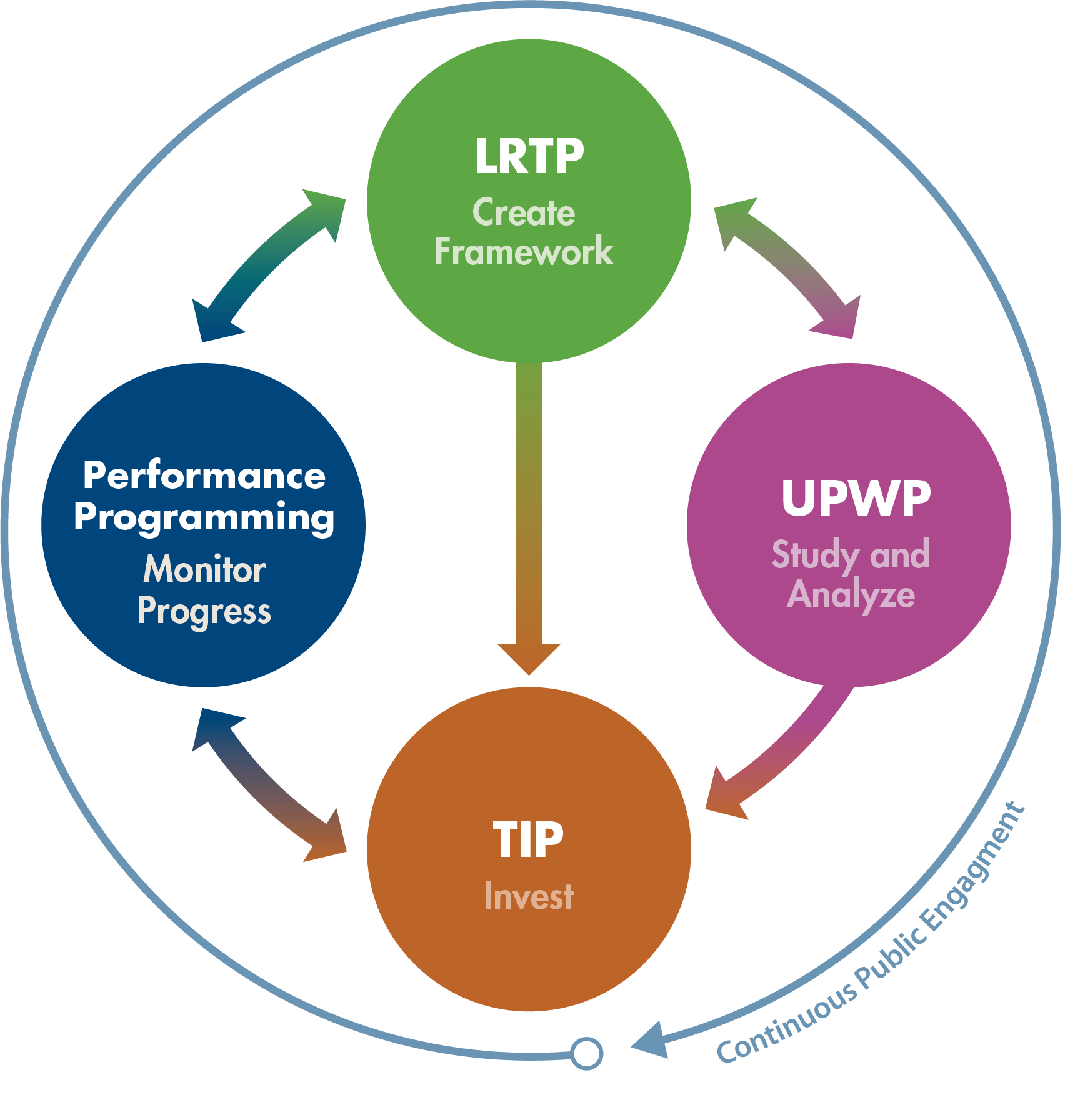
The three certification documents are intrinsically interconnected. The LRTP sets the vision, goals, and objectives framework to guide the ongoing work of the MPO captured in the UPWP and the investment decisions programmed in the TIP. Much of the planning work included in the UPWP is a means to study transportation issues and alternatives before advancing to further design, construction, and possible future programming through the TIP. Finally, performance-based planning processes ensure that the MPO’s planning and capital investments are driving progress towards the MPO’s goals.
Figure 1-4 depicts the relationship between the three certification documents and the MPO’s performance-based planning and programming process.
Figure 1-4
Relationship between the LRTP, TIP, UPWP, and
Performance-Based Planning Process
Chapter 2: About the Unified Planning Work Program
The Unified Planning Work Program (UPWP) plays an integral role in helping the MPO achieve its transportation vision for the region established in the Long-Range Transportation Plan (LRTP). This chapter provides more information about what is included in the UPWP, how it connects to the LRTP, and the annual process for developing the work plan.
What Does the UPWP Do?
As the foundation for transportation planning at the Boston Region Metropolitan Planning Organization (MPO), the UPWP prioritizes federal funding for transportation planning work that will be implemented in the 97-municipality area of the Boston region. It does this by describing the preliminary work scopes and budgets for the MPO initiatives that will be carried out in the next federal fiscal year (FFY). This work is conducted annually in compliance with the federally mandated continuing, cooperative, and comprehensive (3C) metropolitan planning process described in Chapter 1.
These initiatives, carried out either by MPO staff or Metropolitan Area Planning Council (MAPC) staff, can be classified into one of the following four categories.
- Certification Requirements and Other MPO Support Activities. The UPWP includes federally required activities that the MPO must do to remain certified as an MPO and to be eligible to receive and distribute federal transportation dollars. Work in this category includes the following:
- Preparing federally required documents, such as the LRTP, Transportation Improvement Program (TIP), and the UPWP and their associated planning activities.
- Public engagement activities, such as organizing and supporting meetings of the Community Advisory Council, MPO Board, and MPO Committees.
- Support activities, including graphics, editorial, data management, and computer resources, and maintaining the MPO’s regional travel demand model.
- Technical Analysis and Support. The MPO also provides planning, design, and analysis services to municipalities, regional transit authorities, and transportation management association in the region. These services support the implementation of multimodal transportation projects that enhance accessibility, safety, connectivity, mode shift, and economic development in the region. For more information about the MPO’s Road Safety Audits and Community Transportation Technical Assistance program, see Chapter 4.
- Discrete Studies. While the majority of the MPO’s annual planning budget supports ongoing and evolving core and programmatic work, a small but important portion is reserved for discrete studies. These studies allow the MPO to explore timely, relevant topics that align with the MPO’s goals and priorities but are not already embedded in existing program work. Discrete studies are designed to have defined outcomes and be completed within a single federal fiscal year. Information about the new FFY 2027 discrete studies can be found in Chapter 4.
- Agency Studies and Grant-Funded Work. In addition to federally funded MPO work, staff also conduct work funded by state transportation agencies, including the Massachusetts Department of Transportation (MassDOT) and the Massachusetts Bay Transportation Authority (MBTA), and through grant programs. See Chapter 5 for more details on these agency- and grant-funded studies.
The Process of Creating and Monitoring the UPWP
The Boston Region MPO develops the UPWP on an annual basis and follows a similar development timeline each year, illustrated by Figure 2-1.
Figure 2-1
UPWP Development Timeline
The UPWP Committee
Staff produce the UPWP under the supervision and guidance of the MPO’s UPWP Committee. The committee, comprising a subset of MPO board members, convened six meetings in FFY 2026 to consider and provide input on the FFY 2027 UPWP development process. Their discussions included the following topics:
- MPO and MAPC ongoing work programs
- proposed budgets for ongoing and continuing activities
- discrete study ideas and how to prioritize them
These meetings resulted in the committee’s recommendation for the Draft FFY 2027 UPWP, which the MPO approved for public review on May 7, 2026. Staff will continue to meet with the committee after the document is approved to gather ideas for improvements to future UPWP outreach and development processes.
Developing the New FFY 2027 UPWP
The UPWP development process begins with scoping ongoing program work and other continuing activities to meet federal requirements and support the MPO’s vision, goals, and objectives for transportation in the region. These ongoing activities and programs are inherently flexible, enabling staff to respond to unforeseen changes and to capitalize on opportunities to address emerging issues.
Updates to Ongoing Programs and Continuing Activities
The majority of staff time is allocated to working on the MPO’s ongoing initiatives–the core, sustained work efforts that help the MPO comply with federal requirements and achieve the goals established in the LRTP. MPO staff develop annual work plans and budgets for their programs, which outline the new and continuing activities that will be carried out in the upcoming year. Program budgets may vary from year to year based on planned activities, agency priorities, and available resources.
Examples of the MPO’s ongoing work include tasks required for the MPO to uphold its certification by fulfilling the 3C transportation planning process (Chapter 3), ongoing technical assistance to municipalities (Chapter 4), and resource management and support activities (Chapter 6).
These ongoing activities are funded through federal 3C planning funds, and after completing the annual budget development process for these tasks, the remaining funding is allocated to discrete studies.
Discrete Studies
For the FFY 2027 UPWP development cycle, staff evaluated discrete study proposals that were gathered over the past three years. These proposals were submitted by staff, board members, and members of the public through surveys that the MPO administered to solicit UPWP study ideas.
Each discrete study proposal was assessed based on several factors, such as how it helps the region accomplish the MPO’s goals as laid out in the LRTP; whether staff have the capacity to conduct the study in the upcoming federal fiscal year; how well it aligns with ongoing MPO initiatives; and whether it has the potential to inform future MPO work. Based on these criteria, staff then developed a subset of proposals (see Appendix C) for the UPWP Committee to consider for potential funding in the next work plan.
Table 2-1 shows the discrete studies that were selected to be funded in FFY 2027. Chapter 4 provides detailed descriptions of these studies.
Table 2-1
FFY 2027 New Discrete Studies
| Universe ID | Study or Program | FFY 2027 Federal Share* | FFY 2027 Local/State Match | Total Proposed FFY 2027 Budget |
| M-18 | Roadway Pricing Technical Evaluation: Iterative Scenario Analysis | $60,000 | $15,000 | $75,000 |
| L-2 | Impact of Parking Supply on Property Values | $32,000 | $8,000 | $40,000 |
| L-5 | Opportunities for the Boston Region MPO to Support Transit-Oriented Development | $28,000 | $7,000 | $35,000 |
| Total for New Discrete Studies | blank | $150,000 | ||
| *Includes FHWA PL and FTA 5303 funds | ||||
Inputs that Shape the UPWP
To develop the planned work initiatives described in the FFY 2027 UPWP, MPO staff consulted a variety of sources. These include the following:
- Federal guidance: Staff followed the guidance provided by the Federal Highway Administration (FHWA), Federal Transit Administration (FTA), and MassDOT on addressing planning emphasis areas.
- UPWP Committee: Staff regularly convened the UPWP Committee throughout the development of the FFY 2027 UPWP. The committee oversaw the document development process and contributed to generating, analyzing, and prioritizing activities planned for the MPO’s ongoing work programs and discrete studies.
- Community Advisory Council: The Community Advisory Council, established in the fall of 2025, is an independent body made of 18 community organizations whose mission is to discuss regional transportation issues and ensure MPO planning and policy decisions are responsive to public priorities. Staff met several times with the Community Advisory Council throughout the UPWP development cycle to gain its input and make suggestions on the MPO’s planned work initiatives and discrete study proposals. The Community Advisory Council also holds a permanent seat on the UPWP Committee.
- Existing planning documents: A variety of resources were reviewed to inform the development of the FFY 2027 UPWP. These include the regional Congestion Management Process, which monitors the transportation network to identify locations and sources of congestion; Focus40, the MBTA’s long-range capital plan; the MPO’s long-range planning documents, including the current LRTP, Destination 2050; MetroCommon, MAPC’s long-range plan for the region; MassDOT’s statewide modal plans; MassDOT’s Statewide Long-Range Transportation Plan, Beyond Mobility; and other recent studies.
- Ongoing Public Engagement: MPO staff continuously gather public input on transportation priorities to help inform the MPO’s planned work through various engagement activities, such as subregional group meetings with municipal planners and in-person or virtual events focused on specific transportation topics or issues. The MPO maintains a Public Engagement Dashboard, which documents the priorities identified through the MPO’s ongoing public engagement efforts and is updated on a quarterly basis. The dashboard ultimately enables decision-makers to more easily consider public input in the transportation planning process.
MPO staff work continuously to enhance public engagement in the development of the UPWP and other MPO activities and strive to achieve continued improvements in the volume, diversity, and quality of public input. More information about the MPO’s public engagement process is available in Chapter 3 and at https://www.bostonmpo.org/public-engagement.
Public Review of the Draft UPWP
Once the draft UPWP is complete, the document is presented to the MPO Board who vote to release the draft for public review. It is then posted online to the MPO’s website (www.bostonmpo.org).
Public engagement is a significant part of the UPWP development process each year. During the 21-day public comment period, staff solicit public feedback through various communication outlets, like the MPO email list, website, and social media channels. All public comments received during this process are compiled into a list and presented to the MPO Board. Information about the public review process for the Draft FFY 2027 UPWP is available in Appendix B.
Other Regionally Significant Transportation Planning Studies
The UPWP also includes a list of other federally funded and/or regionally significant transportation planning activities that will be active in the region during the relevant FFY. These studies–undertaken by MPO staff (see Chapter 5) or partners (see Appendix A)–are not funded with the MPO’s planning funds. Rather, they are funded and implemented by individual transportation agencies, municipalities, or academic institutions and often make use of the expertise and tools that MPO staff are uniquely able to provide.
Monitoring Progress of UPWP Studies
The MPO approved the following procedures for monitoring the implementation of the FFY 2027 UPWP:
- Work activities that are funded through federal 3C planning funds but not part of one of the MPO’s ongoing activities or programs must be approved by the MPO prior to execution of work.
- MPO work supported by other funding sources (for example, other governmental entities) should be approved by the MPO with the assurance that the new work will not interfere with other MPO-funded work.
- Monthly progress reports on all active studies and work programs must be submitted to the respective funding agency (FHWA or FTA) by the entity conducting the work (Boston Region MPO and/or MAPC). The reports must include the following information for each study or work program:
- brief narrative describing the work accomplished
- key personnel attendance at meeting(s) held during the reporting month
- objectives and planned activities for the next month
- percent of work completed
- some measure of actual resources (for example, hours and funds) charged to the contract over the past month
- comparison of actual cumulative resources expended to the contract budget
- MPO approval for release of a 3C-funded study’s work products is based on whether the objectives stated in the work program were met and whether the stated deliverables were produced.
Amendments, Adjustments, and Administrative Modifications to the UPWP
If necessary, MPO staff can make amendments, adjustments, and administrative modifications to the UPWP throughout the year. All 3C documents endorsed by MPOs must follow standardized procedures regarding proposed changes. If an amendment is under consideration, MPO staff will notify all interested parties and follow the procedures specified in the MPO’s Public Engagement Plan. The following guidelines explain the conditions that constitute an amendment, adjustment, or administrative modification to the UPWP, as received from the FHWA by MassDOT.
Amendments
Amendments to the UPWP, defined as significant changes to the overall UPWP that require federal approval, include the following:
- addition or deletion of a UPWP task or sub-task
- major changes to UPWP task descriptions, activities, and other information
- funding increase above the originally approved UPWP overall budget
- funding transfers between tasks equal to or greater than 25 percent of the UPWP task budget
- funding increase or decrease equal to or greater than 25 percent of the UPWP task budget
Staff must present all proposed amendments to the MPO for consultation prior to endorsement. When submitting the standard Budget Reallocation Request form to MassDOT’s Office of Transportation Planning (OTP), staff must fill out all fields with clear indication that the MPO board was consulted prior to submission. Staff must submit back-up documentation, including the UPWP description of task(s) affected, original budget, revised budget, and justification for the request.
The UPWP Committee reviews amendments before forwarding them to the MPO Board for a vote of approval. UPWP amendments are not federally required to undergo a 21-day public comment period after being approved by the board; however, MPO staff and the UPWP Committee may still elect to hold a public comment period for certain amendments that reflect considerable changes to work activities or budgets. Members of the public may attend and provide comments at UPWP committee meetings and MPO meetings at which amendments are discussed. Amendments go into effect after their approval by FHWA.
Adjustments
Adjustments to the UPWP, defined as minor revisions to the overall UPWP, include the following:
- minor changes to UPWP task descriptions, activities, and other information
- funding transfers between UPWP tasks less than 25 percent of the UPWP task budget
- funding increase or decrease less than 25 percent of the UPWP task budget
UPWP adjustments must be presented to the UPWP Committee and forwarded to the MPO Board for a vote of endorsement. Adjustments do not require federal approval or a public review period, and they go into effect on the day of endorsement by the MPO board.
Administrative Modifications
Administrative modifications are made for minor changes to the UPWP, such as updates to task descriptions, project phasing, or anticipated project deliverables and adding federal discretionary planning grants (competitive grants) won by partner agencies or municipalities into the appendix. These changes do not require a vote of approval or a public comment period. The MPO may make administrative modifications at the MPO’s discretion, and in these circumstances, information is shared with MassDOT OTP. Administrative modifications go into effect after OTP’s approval and the MPO board is informed thereafter.
These procedures are aligned with the MPO’s Public Engagement Plan and serve to complement it.
Funding the 3C Planning Work
The total federal funding programmed in this UPWP is $7,852,348. All federal funds programmed in the UPWP are allocated to the Boston Region MPO by MassDOT as 3C planning funds. These federal funds initially come from two sources, the FHWA and the FTA, and are then supplemented by a state match provided by MassDOT.
FHWA 3C Planning (PL) funds: FHWA planning funds are distributed to MassDOT OTP to carry out the 3C planning process. MassDOT allocates these funds to all MPOs in the state according to a formula that is primarily based on the region’s road mileage and population. This formula is developed by the Massachusetts Association of Regional Planning Agencies and approved by the state FHWA Division office. The FFY 2027 3C PL funding provided to the Boston region, including state matching funds, is $4,849,116. The total Boston region 3C PL allocation is split between the Boston Region MPO, which receives $3,927,784, and MAPC, which receives $921,332.
FTA 3C Planning funds (Section 5303): FTA provides 3C planning funds for transit projects to MPOs and Departments of Transportation under Section 5303 of the Federal Transit Act. These funds are distributed according to an allocation formula, require a state match, and are administered by MassDOT. MassDOT converts these funds into PL planning funds prior to distribution. The FFY 2027 FTA allocation for the Boston region, including a total local match, is $3,003,232. This amount is split into two categories:
- MPO and MassDOT FTA 3C Planning funds (Section 5303): The total amount of FTA funds, including the state match, programmed in this UPWP for work conducted by MPO staff is $2,477,366.
- MAPC FTA 3C Planning funds (Section 5303): A portion of the Boston region’s FTA allocation is provided to MAPC, and MAPC uses these funds to conduct its transit-planning studies programmed through the UPWP. The total amount of FTA-derived funds, including the state match, allocated to MAPC is $525,866.
Other Funding Sources
There is additional work included in the UPWP that is funded through partner agencies, such as MassDOT and the MBTA, and from various grant programs. More detail about these agency- and grant-funded studies can be found in Chapter 5 and Appendix A.
Chapter 3: MPO Support and 3C Planning
Introduction
The activities described in this chapter broadly cover work that the Boston Region Metropolitan Planning Organization (MPO) completes to fulfill the continuous, comprehensive, and cooperative (3C) transportation planning process and to maintain its certification by the Federal Highway Administration (FHWA) and the Federal Transit Administration (FTA). Activities are grouped into three areas: (1) those that support the core MPO planning and programming functions, (2) those that supplement and enhance the MPO’s core 3C planning and programming activities, and (3) those that support the MPO board and committee operations and their decision-making processes. Together, this body of work represents the agency’s priorities in allocating resources to advance a sustainable and robust multimodal regional transportation system that gets people to their destinations safely, easily, and reliably, and that supports a resilient, healthy, and economically vibrant Boston region.
Table 3-1 presents the funding in federal fiscal year (FFY) 2026 and FFY 2027 for each of these activities and includes a brief description of their work, progress, and products. Although many of these activities may generally comprise similar tasks from year to year, often there are variations in budgets that reflect greater or lesser emphasis in certain tasks or incorporation of new tasks. For example, MPO staff may undertake new analyses under specific line items; expand or change the form of public engagement; fold tasks undertaken in one year into an ongoing activity in a subsequent year; take on a new initiative of the MPO; or experience fluctuations in staffing levels that account for budget changes. Where appropriate, the table and individual descriptions explain these differences.
The budget tables that accompany each activity description include the associated salary and overhead costs. Direct costs associated with the activities are found in Chapter 6.
All certification documents and many other work products are, or will be, available for download from the MPO website (www.bostonmpo.org). Work products not found on the MPO website may be requested by contacting MPO staff at 857.702.3700 (voice), 711 (MassRelay), or ctps@ctps.org (email).
Table 3-1
FFYs 2026–27 MPO Support and 3C Planning
| Name | FFY 2026 Boston Region MPO UPWP Budget | FFY 2026 Work Progress and Products | FFY 2027 Federal Share* | FFY 2027 Local/State Match | Total Proposed FFY 2027 Boston Region MPO Budget | FFY 2027 Planned Work Progress and Products |
| Long-Range Transportation Plan | $373,000 | • Needs Assessment StoryMaps • Destination 2050 Amendment Two coordination, memorandum, and presentation • Continued updates and monitoring of public input to guide LRTP decision-making process • Introductory materials and workshop for exploratory scenario planning exercises • Universe of potential performance measures to track progress towards LRTP goal areas | $337,090 | $84,272 | $421,362 | • Continue development of the next LRTP, to be endorsed in 2028 • Facilitate a process to establish performance measures to track progress towards MPO goals • Create a universe of strategies that the MPO could pursue to advance priority goal areas • Produce memorandum detailing preliminary results from scenario planning explorations • Coordinate board and staff deliberations on content of the plan, documented through meeting minutes |
| Transportation Improvement Program | $338,000 | • Developed the FFYs 2027–31 TIP • Continued outreach to municipalities, subregions, regional transit authorities, MassDOT, and other partners to solicit ideas for inclusion in the FFYs 2027–31 TIP and in the TIP Universe of Projects • Created and deployed an updated TIP project dashboard • Implemented federally funded design efforts for municipal TIP projects • Solicited advance applications for transit projects in anticipation of unprogrammed balances in FFY 2026 and 2027 • Held Subregional Readiness Days to support TIP development | $275,808 | $68,952 | $344,760 | The TIP is updated annually, and in FFY 2027 it will be updated to the FFYs 2028–32 TIP document. This update will entail the repetition of some of the tasks performed in the previous year. |
| Unified Planning Work Program | $141,000 | • Developed the FFY 2027 UPWP • Met with the UPWP Committee to discuss the MPO's ongoing work, discrete study proposals, and general development of the FFY 2027 UPWP • Introduced the Community Advisory Council to the UPWP process and solicited their input on the MPO's ongiong work and discrete study proposals | $115,056 | $28,764 | $143,820 | Activities generally remain the same year to year, with staff supporting the MPO in producing its annual (FFY 2028) UPWP. |
| Public Engagement Program | $393,000 | • Engaged advocates, community groups, municipal and agency stakeholders, and the general public in the MPO's decision-making processes and planning work • Provided timely communications and accessible engagement opportunities via public meetings and events, surveys, email, and social media • Developed partnerships with community-based organizations to more effectively reach communities and reduce barriers to engagement • Conducted in-person engagement at community events with varied and accessible materials and activities • Updated the Public Engagement Plan and developed a new Engagement Guidebook • Tracked, evaluated, and reported to the MPO board on the scope of engagement activities and on themes and priorities collected through engagement • Improved data analysis tools and methods to identify and address gaps in engagement • Provided administrative and strategic support to the Community Advisory Council • Continued developing and implementing the Community Planning Lab civic educational program • Started development of an agency-wide municipal engagement strategy | $320,688 | $80,172 | $400,860 | • Support engagement activities related to the development of the, TIP, UPWP, and LRTP • Support engagement activities related to transportation planning studies and projects • Suppprt the Community Advisory Council • Continue to implement and develop the Community Planning Lab educational program • Continue to build and deepen relationships with community-based organizations and other stakeholders • Continue to provide regular updates to the MPO board on engagement and explore process improvements for data collection, analysis, and reporting • Develop and implement a municipal engagement strategy • Develop and implement public engagement resources, guidance, and guidelines for staff |
| Performance-Based Planning and Programming | $119,000 | • Completed federally required reporting on performance target setting • Incorporated performance targets and past performance into LRTP and TIP • Anticipated completion of updates to the content, and improvements to functions, of the Performance Dashboard • Conducted research on methodologies and performance metrics that can be used to evaluate the impact of investments and inform future evaluation criteria • Planned for launching project-specific air quality performance monitoring • Conducted data analysis in LRTP Needs Assessment that corresponds to PBPP goals and processes | $97,104 | $24,276 | $121,380 | • Maintain and continue to make improvements to the content and functions of the Performance Dashboard • Develop the TIP Performance Analysis Chapter • Conduct performance analysis of the projects funded in FFYs 2028–32 TIP in relation to how they will support improvements in various performance areas and make progress toward performance targets • Incorporate performance targets into LRTP processes • Plan for launching project-specific air quality performance monitoring • Develop a summary of research on methodologies and performance metrics that can be used to evaluate the impact of investments and inform future evaluation criteria |
| Community Transportation Access | $220,000 | • Anticipated completion of an online dashboard that identifies impacts of the transportation system on Boston area communities • Conducted a disparate impact mitigation analysis for the TIP • Provided technical support to the TIP, LRTP, and other MPO programs • Analyzed demographic and socioeconomic data of Boston region residents to support identifying transportation needs and priorities • Developed plain language documents for the program's technical work • Anticipated completion of the Coordinated Public Transit-Human Services Transportation Plan update | $161,600 | $40,400 | $202,000 | • Respond to Title VI reporting requirements • Maintain dashboard • Conduct a disparate impact mitigation analysis for the TIP • Continue to develop plain language documents for the program's technical work • Updated Language Assistance Plan • Provide technical support to the TIP, LRTP, and other MPO programs • Develop metrics for the 2028 LRTP to identify impacts of the recommend plan on Boston area communities |
| Congestion Management Process | $119,000 | • Developed CMP network dashboard as a public resource • Completed data documentation and streamlined update cycle for CMP network • Developed regional travel time delay metrics • Started developing framework for identifying and evaluating multimodal performance measures • Held CMP Committee meetings to get input on 2025 roadway pricing study and CMP network | $97,104 | $24,276 | $121,380 | • Develop a streamlined process for communicating and delegating data storage, analysis, and review with relevant MPO staff • Publish CMP network integrated with roadway reliability performance measures • Develop draft of multimodal performance measure dashboard including measures encouraging mode shift as well as cross-program performance measures overlapping with Freight Planning Program and TIM • Collaborate with MMIP by providing CMP- or mobility-related technical assistance where possible • Convene the CMP committee several times a year to help promote the Boston Region MPO’s CMP |
| Core MPO Functions | blank | blank | blank | blank | blank | blank |
| Transportation Impact Mitigation | $147,000 | • Provided technical support for the TIP and the LRTP’s Needs Assessment • Held a stakeholder workshop to collaboratively reevaluate the TIP's resilience project evaluation criteria • Developed new TIP resilience criteria and interactive guidance to support implementation • Began evaluating performance of new TIP resilience criteria • Began scoping a framework for assessing climate vulnerability and programming solutions • Developed new partnerships with regional organizations • Leveraged the Massachusetts Coast Flood Risk Model and other climate data to support analyses of transportation infrastructure exposed to climate hazards • Coordinated internally to discuss resilience themes, data sources, engagement, and resilience in the MPO’s certification documents • Coordinated with external partners such as MAPC, the MBTA, and MassDOT on resilience topics • Attended external events related to resilience and adaptation • Developed text and material to create a resilience-focused page on the MPO’s website • Coordinated with external partners such as MassDOT, FHWA, and EPA on topics related to air quality, greenhouse gas emissions, and CMAQ • Provided technical support for the air quality conformity and greenhouse gas sections of the TIP and LRTP • Assessed regional projects in eSTIP for greenhouse gas reporting requirements • Conducted project-level targeted analyses related to air quality for projects in the TIP • Prepared material and voted on behalf of the Boston Region for CMAQ consultation committee meetings • Attended webinars and collected information related to new greenhouse gas performance measure | $119,952 | $29,988 | $149,940 | • Begin conducting the Regional Vulnerability Assessment with adopted framework • Inventory North Shore Task Force (NSTF) evacuation routes • Develop project application scoring for the TIP for risk mitigation and adaptive capacity • Collect and process air quality data • Contribute to resiliency- or air quality-related technical assistance projects • Continue environmental stakeholder engagement • Conduct required air quality analyses and reporting |
| Freight Planning Program | $124,000 | • Development of the Freight Action Plan • Launched the development of the Regional Freight Decarbonization Plan • Developed freight data visualizations and coordinated with MassDOT and regional partners on the Critical Urban Freight Corridor update • Engaged stakeholders through the Freight Action Plan process and solicited feedback on the Freight Data Dashboard | $101,184 | $25,296 | $126,480 | • Draft Regional Freight Decarbonization Plan Framework • Publish, promote, and monitor progress of the Regional Freight Action Plan • Update Freight data visualizations with relevant datasets from the Freight Action Plan and CUFCs |
| Regional Model Enhancement | $927,000 | • Supported 2027 LRTP scenario planning work through model enhancements and analysis support • Continued model community development by fostering understanding and application of TDM23 and other MPO modeling tools, sharing experiences in model application, gathering ideas for model enhancements, and communicating changes in model platforms • Updated the 2024 roadway and transit network to support model development and application • Completed the household survey analysis and used it as a foundation for the TDM23.3 updates • Updated and calibrated TDM23.3.0 to reflect the 2024 post-pandemic base year, incorporating the 2024 household survey, updated economic data, and revised roadway and transit networks, along with updates to the Python manager and special truck generator • Released and supported the newly developed regional BR STOPS model • Completed future model design work for TDM28 and TDMX within the ActivitySim framework • Rolled out the Growth Rate Explorer to support analysis and planning applications • Completed development of new Transportation Analysis Zone (TAZ) boundaries consistent with 2020 Census block boundaries | $756,432 | $189,108 | $945,540 | • Advance TDM23 enhancements to support LRTP scenario development and analysis • Design and develop TDM28 by defining the model framework, refining methodology, and building core model components and inputs • Prepare and update supporting data and networks including socioeconomic data, land use assumptions, and highway and transit network coding for TDM28 • Calibrate and validate TDM28 to ensure the model reasonably reflects observed travel patterns and is ready for forecasting applications • Document and refine TDM28 to support the 2028 LRTP • Initiate development of TDMX as a new activity-based exploratory modeling platform for the region • Establish the TDMX framework by defining model structure, technical requirements, and development priorities • Conduct exploratory development and testing to evaluate methods, resolve implementation issues, and assess integration of TDM28-based inputs to TDMX • Develop the initial TDMX platform and begin pilot applications to support future model refinement and long-term planning needs • Continue maintaining and updating TDM23 and regional FTA STOPS model including bug fixes, performance improvements, and new capabilities for project analysis • Continue improving and expanding model utilities to support planning and analysis needs |
| Data Program | $575,000 | • Developed draft data road map • Updated data strategy with a focus on improving the agency's data maturity over the next four fiscal years • Completed peer research effort involving interviews with other MPOs and local agencies and summarized insights for use in development of the BRMPO data strategy • Explored options for centralized and unified data storage and analysis platforms • Developed automated data processing pipelines for many of the agency's data sources, including active transportation data, travel time information, and traffic safety data sources • Developed guidelines and automated processes for managing and publishing interactive content using online GIS platforms • Developed additional procedures for application development and deployment • Tested centralized documentation platform with one data storage and analysis platform • Updated authoritative reference socioeconomic data sets and processing • Responded to data requests from external stakeholders • Supported staff use of geographic information system and database management tools • Conducted proof-of-concept testing of vector tiles for Internet geographic data delivery • Deployed web infrastructure for analytical tools • Conducted Data User Group meetings to explore data opportunities and challenges and workshop solutions | $469,200 | $117,300 | $586,500 | • Conduct a data maturity assessment • Launch a centralized documentation platform for for projects • Assess needs for and implement pilot of centralized data storage platform • Provide recommendations for centralized storage strategy of reference data and public facing data catalogues • Develop, maintain, or update automated data pipelines and the resulting public facing applications • Maintain or execute new data use agreements as needed • Continue to expand use of data and application documentation platform to more platforms or datasets • Explore up to three additional new data sources for use in agency analyses or other programs • Launch reference data storage and access processes • Update foundational datasets and documentation, including demographic data, roads underlying calculation of network-based TIP scores, and roads and transit data backing Conveyal network analysis • Respond to data requests from external stakeholders • Conduct Data User Group meetings to explore data opportunities and challenges and workshop solutions • Support staff use of geographic information systems, databases, and other analytical tools |
| Active Transportation Planning Program | $184,000 | • Engaged the Active Transportation Steering Comittee to coordinate regional planning efforts and ensure that the Boston Region MPO’s plans align with the vision and goals outlined in the Massachusetts Bicycle and Pedestrian Statewide Transportation Plans • Conducted a region-wide bicycle level-of-traffic-stress analysis • Began a region-wide gap analysis for the bicycle and pedestrian networks • Collected continuous bicycle and pedestrian count data for four-week periods at selected locations throughout the Boston MPO region • Coordinated with state agencies, MAPC, other MPOs, MassDOT’s Safe Routes to School Program, WalkMass, MassBike, LivableStreets, municipalities, and other groups regarding bicycle and pedestrian planning for the region • Provided ongoing technical support to communities for current tools and practices regarding bicycle and pedestrian issues, with particular focus on promoting safety | $150,144 | $37,536 | $187,680 | • Engage the Active Transportation Steering Comittee to help inform the direction of the Active Transportation Planning Program • Collect data on bicycle and pedestrian volumes at on-road and off-road facilities in the Boston region, and post collected count data to the Boston Region MPO’s Bicycle and Pedestrian Count Database for public use • Complete the regional level gap analyses initiated in FFY 2026 • Complete a regional level needs assessment for the active transportation network • Initiate a regional active transportation plan for the Boston MPO region that combines the vision and goals of the Boston MPO with the priorities outlined in the Massachusetts Bicycle and Pedestrian Statewide Transportation Plans and considers municipalities’ existing bicycle and pedestrian plans • Reassess gaps in the regional pedestrian and bicycle networks to update the locations where pedestrian and bicycle facilities are needed in the Boston region, identifying prioritized locations and best practices • Continue to coordinate with state agencies, MAPC, other MPOs, MassDOT’s Safe Routes to School Program, WalkBoston, MassBike, LivableStreets, municipalities, and other groups regarding bicycle and pedestrian planning for the region • Continue to provide ongoing technical support to communities for current tools and practices regarding bicycle and pedestrian issues, with a particular focus on promoting safety |
| Multimodal Mobility Infrastructure Program** | $375,000 | • Selected corridor and intersection study locations • Produced recommendations for improvements at selected corridors • Produced recommendations for improvements at the selected intersections • Developed a white paper with key findings from research on mode shift • Summarized findings from exploration of connections between transportation and land use at the regional scale • Produced a recommendation for regionalizing results from past discrete studies • Developed high-level framework for a Mobility Action Plan with a focus on identifying needs, existing conditions, and near-term priorities | $323,571 | $58,929 | $382,500 | • Incorporate findings from re-evaluation of corridor and intersection study location selection process • Incorporate finding from implementation rate study into how the agency approaches these studies both in terms of methodology and steps the MPO engages in to support the project pipeline • Select corridor and intersection study locations • Recommend selected intersection improvements • Continue exploration of land use and transportation study reflecting on outcomes from FFY 2026 study • Incorporate findings from mode shift research into planning work • Summarize findings from Mobility Action Plan peer research • Update Managing the Curb guidebook |
| Programs Supporting the 3C Process | blank | blank | blank | blank | blank | blank |
| Support to the MPO and its Committees | $489,820 | • Prepared meeting and information materials, including agendas, minutes, notices, document translations, memoranda, reports, correspondence, summaries, website content, maps, charts, illustrations, and other visual materials as needed to support MPO discussion and actions • Posted meeting materials in digital form on the MPO meeting calendar webpage and in hard copies that are provided at meetings as appropriate • Hosted approximately 24 MPO meetings and 18 MPO subcommittee meetings and performed the associated tasks and pre- and post-meeting logistics • Conducted activities to support compliance with federal requirements and guidance, including coordinating with neighboring MPOs, MassDOT, and federal partners | $399,693 | $99,923 | $499,616 | • Host approximately 24 MPO meetings and 20 MPO subcommittee meetings and perform the associated tasks and pre- and post-meeting logistics • Coordinate 3C planning and programming activities and programs • Coordinate with state and federal partners • Coordinate with neighboring MPOs • Work toward integrating housing into the transportation planning process • Support the Transportation Policy Task Force • Participate in the federal recertification review |
| General Graphics | $313,000 | • Designed and produced maps, charts, illustrations, report covers, brochures, slides, and photographs • Applied other visualization techniques • Created standards and proofed all MPO products both printed and online • Produced finished layouts of MPO documents • Created other products that improve communication within the agency and its member agencies • Produced accessible materials in PDF and HTML formats for posting on the Boston Region MPO website • Assisted in producing materials, including meeting minutes, work scopes, memoranda, reports, and other public materials • Reviewed accessibility requirements and current Boston Region MPO standards and processes • Implemented standards within memorandum and report templates | $255,408 | $63,852 | $319,260 | Tasks and work products generally remain the same year to year. |
| General Editorial | $236,000 | • Provided editorial support to MPO staff • Reviewed public-facing documents and made revisions to correct grammar and formatting, improve clarity and organization, and maintain consistent style, which included certification plans, reports, memoranda, work scopes, meeting minutes, presentations, job advertisements, and other materials as required • Maintained and updated document templates for use in the creation of accessible documents • Set editorial standards and maintained the MPO Editorial Style Guide for staff’s use | $192,576 | $48,144 | $240,720 | Tasks and work products generally remain the same year to year. |
| Transit Working Group Support | $6,000 | • Hosted four working group meetings and managed pre- and post-meeting communications and logistics • Updated the MPO about Transit Working Group development and activities • Shifted from a forum-based to a project-based working group, following members' requests and meetings with internal and external stakeholders | $4,896 | $1,224 | $6,120 | • Host at least four working group meetings • Create and carry out a project plan • Create project work products and report • Continue to update the MPO on the group's work to ensure it aligns with MPO goals |
| Support to the MPO and its 3C Process | blank | blank | blank | blank | blank | blank |
| *Includes FHWA PL and FTA 5303 funds | ||||||
| **Indicates that program fulfills Federal Highway Administration Complete Streets requirement | ||||||
Core MPO functions
The programs and activities included in this section include the core products required by the MPO’s federal partners and related federally required reporting and monitoring activities for carrying out the MPO’s 3C planning and programming functions. Programs that supplement and enhance the MPO’s core 3C planning and programming activities, such as the Data Program and the Active Transportation Planning Program, can be found in the following section, Programs Supporting the 3C Process.
- Long-Range Transportation Plan (LRTP)
- Transportation Improvement Program (TIP)
- Unified Planning Work Program (UPWP)
- Public Engagement Program
- Performance-Based Planning and Programming (PBPP)
- Community Transportation Access Program (CTA)
- Congestion Management Process (CMP)
Long-Range Transportation Plan
FFY 2027 Total Budget |
$421,362 |
Schedule |
Ongoing |
Responsible Parties
Boston Region MPO staff
Purpose
The Long-Range Transportation Plan (LRTP) describes the region’s existing multimodal transportation system and establishes a 20-year vision for that system based on extensive engagement with members of the public, advocates, agency partners, and board members. The plan provides a framework of goals and objectives that guides the projects the MPO funds and the work the MPO undertakes to advance the vision. While the LRTP is formally updated and endorsed on a five-year cycle, its development is a continuous and robust process. Work on implementing and updating it includes monitoring system performance and needs across the five years between plan endorsements. The development of the vision, goals, and objectives; investment programs; future scenarios; and project evaluation criteria is supported by research and analysis, drawing from the diverse expertise of staff across the agency. In developing the LRTP, staff research, plan, coordinate with interested parties, and review the priorities of the MPO and other state and regional agencies. The current plan, Destination 2050, was endorsed in July 2023, and the MPO is anticipating that it will endorse its successor in the summer of 2028.
Federal Requirements
The federal requirements for the metropolitan transportation planning and programming process, including the development of a metropolitan transportation plan, are described in Title 23 of the Code of Federal Regulations (CFR) Part 450 Subpart C. The specific requirements for the “metropolitan transportation plan” are laid out in 23 CFR 450.324.
- MPOs are required to develop long-range transportation plans with a horizon of no less than 20 years. In air quality nonattainment and maintenance areas, the plan must be updated every four years, otherwise, MPOs must update the plan every five years.
- In formulating the plan, MPO’s shall consider projects, strategies, and services that will address the factors identified in 23 CFR 450.306.
- The plan should include long- and short-term strategies and actions to support the development of an integrated multimodal transportation system (including accessible pedestrian walkways and bicycle transportation facilities) to facilitate the safe and efficient movement of people and goods in addressing current and future transportation demand.
- The plan should, at a minimum, document
- current and projected transportation demand of people and goods in the Boston region;
- existing and proposed transportation facilities, in enough detail to develop cost estimates and determine transportation conformity;
- performance-based planning performance measures and targets in accordance with 23 CFR 450.306(d) and a system performance report with respect to the targets;
- operational and management strategies to improve the performance of existing transportation facilities and transit enhancement to relieve congestion and more safely and effectively move people and goods;
- a discussion of types of potential environmental mitigation activities and potential areas to carry out these activities;
- a fiscally constrained financial plan that outlines operations and maintenance expenses of the multimodal transportation system, anticipated Regional Target Funding to be allocated through the TIP, and may include illustrative projects or supplemental revenue sources.
Approach
Developing the next LRTP
In FFY 2027, MPO staff will continue work to develop the MPO’s next LRTP. Staff will research, plan, coordinate with interested parties, and review the priorities of the MPO and other state and regional agencies. This includes coordinating development of the LRTP with other state and regional long-range planning efforts, such as Massachusetts Department of Transportation’s (MassDOT) Beyond Mobility, the Massachusetts Bay Transportation Authority’s (MBTA) Focus40and its next long-range plan currently underway, and Metropolitan Area Planning Council’s (MAPC) MetroCommon. This work will include, but is not limited to, preparing content for deliberations at board meetings, facilitating conversations internally and with peer agencies, and engaging with stakeholders throughout the region. Conversations will cover the vision and goals for transportation in the region, an exploration of potential performance measures to assess progress toward the goals, scenario planning to assess the potential impacts of strategies to advance the goals, and general priorities for MPO investments and studies. Due to the wide breadth of topics explored in the development of the long-range plan, ongoing coordination is required with the wide array of ongoing programmatic work and strategic initiatives that the MPO pursues.
Long-range performance measures
Guided by priorities established by the MPO board and ongoing discussions about the vision, goals, and objectives, MPO staff will explore approaches—including those used by peer MPOs—to track progress towards the regional vision. Staff will begin the process of identifying available data and determining the feasibility of adopting long-range performance measures associated with the MPO’s objective statements. Once potential performance measures have been identified, staff may analyze current trends in the metrics. This is anticipated to be a multiyear effort that continues beyond the development of the 2028 long-range plan. Staff will evaluate potential performance measures based on factors such as data availability and update frequency, in addition to MPO board guidance, to identify an initial set of performance measures that could be used to track progress towards the MPO’s goals over time.
Strategies to advance goal areas
Staff will explore a variety of strategies and action steps to address the MPO’s goals and objectives identified in the long-range plan. This effort will focus on identifying strategies in areas where the MPO has a degree of influence. Initial discussions will be guided by previous explorations that were developed to support Destination 2050 in addition to policy and action recommendations from recent MPO work products. Potential strategies could include the development of project scoring criteria for the MPO's investments to better prioritize multimodal safety principles, or the exploration of policy areas in the regional context to further enhance goals, such as roadway pricing and improved integration of housing in transportation planning.
Scenario planning
Through exploratory scenario planning, MPO staff will continue to investigate ways to incorporate insights from the travel demand model into the MPO’s decision-making process. This will be guided by exercises to influence mode shift, as represented by results from the travel demand model. This will provide a space to deliberate tradeoffs between different policies that could be included in the next LRTP.
FFY 2027 Anticipated Outcomes and Deliverables
- Memorandum detailing the process for establishing performance measures associated with MPO goal areas and pilot, including constraints such as feasibility and deliberations from MPO board and Advisory Council discussions
- Memorandum detailing the process to establish a set of strategies that the MPO could pursue to advance priority goal areas
- Memorandum detailing preliminary results from scenario planning explorations
- Board and staff deliberations on content of the in-progress plan, documented through meeting minutes
Transportation Improvement Program
FFY 2027 Total Budget |
$344,760 |
Schedule |
Ongoing |
Responsible Parties
Boston Region MPO staff, with support from the TIP Process, Engagement, and Readiness Committee
Purpose
The Boston Region MPO’s Transportation Improvement Program (TIP) is a five-year, fiscally constrained program of planned investments in the metropolitan area’s transportation network. The TIP aims to realize the vision and goals of the Boston Region MPO, identified in the long-range plan, by funding and delivering transportation projects that address regional needs. Although federal regulations require that the TIP be updated every four years, Massachusetts MPOs produce annual updates.
Federal Requirements
Under 49 U.S.C. 5303(j), MPO’s are required to develop a TIP at least every four years with a time horizon of at least four years. The federal requirements for the development and content of the TIP include the following:
- Transportation projects funded with federal aid, including projects funded with dollars from the FHWA and FTA, within the Boston Region must be programmed on the TIP in order to use federal funds.
- The congestion management strategy of the Boston Region and conformity with congestion mitigation and air quality regulations and guidelines must be identified in the TIP development process.
- The TIP must be fiscally constrained.
- The approved TIP may be amended or adjusted in a variety of ways in order to accommodate changes to project schedule and cost. This may also include the addition of new projects. TIP Amendments and Adjustments are subject to requirements outlined in the MPO’s Public Engagement Plan.
Approach
Developing the FFYs 2028–32 TIP
Municipal Engagement and Compilation of the Universe of Projects: Staff communicate with the MPO region’s municipalities through TIP informational sessions, subregional meetings, correspondence with municipal contacts, MassDOT staff, and elected officials to gather information on TIP project-funding requests. Staff compile the projects into a Universe of Projects list for consideration by the MPO. This list is conveyed in a virtual, public TIP Project Dashboard.
Project Evaluation: The MPO uses TIP project evaluation criteria to identify projects that advance the vision, goals, and objectives established in the LRTP. The criteria inform decision-making for the programming of transportation projects in the region by establishing a transparent and data-driven process through which funds are allocated.
Project Prioritization: Staff prepare a list of programming recommendations that include a selection of candidate projects, taking into consideration the project scores, project readiness, cost, geographic distribution of investments across the region, and LRTP-identified needs. Staff discuss the programming recommendations and work with board members to define the final program. MassDOT state-prioritized projects and the capital programs for the MBTA, the Cape Ann Transportation Authority, and the MetroWest Regional Transit Authority are also presented for the MPO’s consideration.
TIP Document Preparation and Endorsement: Staff prepare a draft TIP that maintains compliance with federal requirements for a public review and comment period. During the public comment period, staff compile and summarize comments on the draft TIP to be relayed to the MPO for consideration before endorsing the final TIP document.
The TIP document reports on the MPO’s implementation of its Performance-Based Planning, highlighting the results of monitoring regional trends and noting progress made toward established performance targets. The performance measures and targets, which align with federal Transportation Performance Management requirements, show relation to MPO goal areas, including safety, mobility and reliability, access and connectivity, and clean air and healthy communities. The TIP also documents analyses of projected changes to transportation access resulting from implementation of the entire program of projects based on current designs. In addition, the TIP reports progress towards achieving regional transportation impact mitigation goals, such as reductions in emissions and advancement of investments that mitigate risks associated with natural hazards and extreme weather events.
Amendments and Administrative Modifications
In a typical year, various projects experience cost or schedule changes that require an amendment, adjustment, or administrative modification to the TIP. Staff prepare for the possibility of actions to the FFYs 2027–31 TIP and manage public review processes.
Improving TIP Development Processes
MPO staff have identified a need to improve information availability and distribution for statuses of currently programmed and completed TIP projects. The MPO prioritizes expanding resources for municipalities to advance projects to minimize disruptive delays or cost changes. This includes better aligning projects with other types of MPO support, such as TIP design funding and technical assistance, and identifying external funding opportunities such as federal discretionary grants. Staff will also develop and iterate upon project cost, readiness, and scope policies that help mitigate volatility across the program of projects. These policies or changes would be brought to the MPO for approval.
TIP Process, Engagement, and Readiness Committee
Staff will continue to leverage the MPO’s TIP Process, Engagement, and Readiness Committee to inform the development of the FFYs 2028–32 TIP and as a forum for deeper discussion of key program challenges. Feedback received from committee members and the public as part of the FFYs 2027–31 TIP development cycle will be considered for development of the FFYs 2028–32 TIP.
FFY 2027 Anticipated Outcomes and Deliverables
- The FFYs 2028–32 TIP and amendments and administrative modifications to the FFYs 2027–31 TIP
- Documentation of progress made on performance measures through the programming of TIP projects
- Procedure for delivering and monitoring design contracts for TIP projects, including identification of design process outcomes and improvements
- Development of a formal process for using regionally prioritized TIP funding to support early stage planning efforts that align with existing design funding offerings
- Monitoring the success of and iterating upon the MPO’s project programming and cost-change policies with policy updates as needed
- Additional analysis to help pinpoint needs for targeted municipal outreach
Unified Planning Work Program
FFY 2027 Total Budget |
$143,820 |
Schedule |
Ongoing |
Responsible Parties
Boston Region MPO staff, with support from the UPWP Committee
Purpose
The Unified Planning Work Program (UPWP) demonstrates the MPO’s progress towards achieving the vision, goals, and objectives outlined in the LRTP. Updated annually, the UPWP establishes how MPO staff will use federal planning funds to conduct transportation planning projects in the upcoming federal fiscal year and describes staff work that is funded by partner agencies or through grants. It also provides information to government officials, local communities, and the general public about regionally significant planning projects that are executed by partner agencies and municipalities in the Boston Region.
Federal Requirements
Under 23 CFR 450.308 (b), metropolitan planning organizations are required to document transportation planning activities funded through Title 23 of the United States Code (USC) and Title 49, Chapter 53 of the USC in a unified planning work program. In the UPWP, the MPO is federally required to
- identify work proposed to be completed over the next one- to two-year period by major activity (objectives) and tasks; and
- specify which agency or organization is responsible for completing each planning task, the schedule for completion, the proposed funding by activity or task, and a summary of the total amount of federal and matching funds programmed.
Approach
UPWP Committee
Each year, the upcoming UPWP is developed under the guidance of the UPWP Committee. Members provide direction to the MPO’s ongoing work and choice of discrete studies to fund in the next FFY and offer feedback on methods to improve the UPWP development process. MPO staff also report to the committee on the progress made to the work objectives outlined in the current UPWP.
Developing the Upcoming UPWP
With input from the UPWP Committee, MPO staff work to coordinate and prepare materials for all phases of development of the upcoming UPWP. These include
- engaging other transportation agencies in the region and members of the public in the UPWP process;
- soliciting, evaluating, and recommending ideas for planning studies, ongoing program work, and technical assistance programs;
- conducting background research into planning needs by referencing documents such as the MPO’s LRTP and Needs Assessment, MassDOT’s statewide long-range transportation plan, Beyond Mobility, and other regional or municipal plans; and
- preparing budgets and work plans for each of the MPO’s projects and programs.
Together, these products are synthesized into one document that describes how the MPO is working towards its vision for transportation in the Boston region. Staff will continue to refine the document’s narrative and provide more opportunities for the committee to engage with the MPO’s ongoing work. Overall, these changes will improve readability of the UPWP for the public and broaden the type of input that is gathered from board members. A draft and final version of the UPWP is reviewed by the public and endorsed by the MPO Board annually.
Amendments and Administrative Modifications
Throughout the year, amendments and administrative modifications to the current UPWP are executed to reflect program budget adjustments, to reprogram federal planning funds from previous years, and to document grants won by municipalities and other partners in the region.
FFY 2027 Anticipated Outcomes and Deliverables
- FFY 2028 UPWP
- Engagement in the development of the FFY 2028 UPWP from the public and MPO board
- Improvements to the UPWP document and development process
- Support for the MPO’s UPWP Committee
- Regular reporting on FFY 2027 UPWP implementation
- Amendments and administrative modifications to the FFY 2027 UPWP
Public Engagement Program
FFY 2027 Total Budget |
$400,860 |
Schedule |
Ongoing |
Responsible Parties
Boston Region MPO staff, with support from the Community Advisory Council
Purpose
The Public Engagement Program advances an inclusive and transparent transportation planning process by ensuring that people across the Boston region–especially communities historically underserved and disproportionately impacted by transportation decisions–have meaningful and accessible opportunities to inform MPO priorities and outcomes.
Through community-centered engagement practices and strategic partnerships, the program builds trust, broadens participation, and strengthens the connection between public input and MPO decision-making. The program supports the MPO’s long-term goals by building stakeholder and public awareness of and support for the MPO’s work, and by collecting, analyzing, and sharing data on public input with MPO staff and the MPO board to help illuminate challenges and opportunities to meet the region's needs.
Federal Requirements
- Maintain a Public Participation Plan (Public Engagement Plan) that outlines the public participation process, engagement strategies, activities, and requirements for MPO planning and programming as required per 23 CFR 450.316
- Facilitate proactive, inclusive engagement with underserved populations in the transportation system across all MPO work as required per 23 CFR 450.316
- Conduct formal public review periods for certification documents and amendments to ensure stakeholders have reasonable opportunities to provide input on transportation plans, programs, and amendments as required per 23 CFR 450.316
- Ensure compliance with federal language access and accessibility standards as required per 49 CFR Part 21 and 49 CFR Part 27
Federal public participation obligations are derived from a combination of statutes, regulations, and federal guidance documents. Federal guidance encourages the use of broad, innovative, and context-appropriate methods to reach diverse populations. Work to monitor and support compliance with these requirements is carried out through coordination between the Public Engagement and Community Transportation Access programs.
Approach
The Public Engagement Program is implemented in accordance with the MPO’s Public Engagement Plan, federal public participation requirements, and the MPO’s long-term vision and goals. Many of the program’s activities span a multiyear time horizon. In FFY 2027, the Public Engagement Program will
Support the Community Advisory Council
Staff will continue to provide strategic and administrative support to the Community Advisory Council, a group founded in 2025 to represent the perspectives of stakeholders across the region in the MPO’s work and with a voting seat on the MPO board and committees. MPO staff facilitate regular meetings of the Community Advisory Council, coordinate its activities, and manage the member application process.
Support Public Engagement Efforts Across the MPO
Staff will continue to support engagement efforts across MPO work through collaboration on engagement activities and by guiding the development and implementation of project and program-level engagement strategies.
Build Capacity for Expanding the MPO’s Public Engagement Practice
Staff will continue to strengthen agency-wide capacity for high-quality, consistent public engagement by serving as a key resource for MPO teams and programs. Grounded in recognized best practices, staff will develop standardized tools, guidance, processes, and training to support staff in designing and implementing engagement efforts that are inclusive, accessible, and aligned with MPO priorities and federal guidance.
Strengthen Relationships with Community-based Organizations
Staff will continue to build relationships with community-based organizations serving populations and perspectives underrepresented in the MPO’s decision-making processes. This will be achieved through thoughtful outreach and by cultivating opportunities for sincere engagement, including through the Community Planning Lab, an educational experience for staff at community-based organizations to learn how to engage with the MPO’s work.
Maintain and Improve Public Engagement Data Collection and Presentation
Building on tools and methods developed in FFY 2025 and FFY 2026, staff will continue to improve the collection, analysis, and reporting of engagement data to improve targeting, coordination, and transparency across engagement activities.
FFY 2027 Anticipated Outcomes and Deliverables
- Fulfill federally required engagement activities, such as public review periods, to support the 3C planning process in accordance with the Public Engagement Plan
- Host approximately 10 Community Advisory Council meetings and facilitate connections to MPO staff and the board
- Draft a municipal engagement strategy
- Implement a stakeholder tracking database
- Publish public engagement dashboard updates
- Develop engagement resources and guidance for MPO staff
- Host the Community Planning Lab
Performance-Based Planning and Programming
FFY 2027 Total Budget |
$121,380 |
Schedule |
Ongoing |
Responsible Parties
Boston Region MPO staff
Purpose
The MPO uses a performance-based planning and programming (PBPP) process to assess how its investment decisions support progress toward the vision outlined in the Long-Range Transportation Plan. PBPP processes include three phases:
- Plan: Establish the goals and objectives, performance measures, and targets that guide MPO decision-making, and identify and acquire necessary data;
- Invest: Use the framework established in the planning phase to create a strategy for investing MPO funds; and
- Monitor and Evaluate: Review and report on the outcomes of MPO investments with respect to performance measures and targets and determine needed framework or strategy adjustments.
PBPP enables transparent MPO decision-making by setting and tracking targets, guiding studies and programs conducted via the UPWP, using various regional and state transportation data sets to identify areas of concern across the region, and applying federal metrics to advance safety, mobility and reliability, and clean air and healthy communities.
Federal Requirements
MPOs are federally required to establish and use a performance-based approach to transportation decision-making to support the national goals described in 23 U.S.C. 150(b) and the general purposes described in 49 U.S.C. 5326(c) and 5329(d). The Boston Region MPO’s PBPP has several annual and recurring activities that support the following federal requirements for data-driven, regional transportation investment decision-making:
- Establish performance targets and report on progress in the following areas:
- Roadway Safety (annually)
- Transit Safety (annually)
- Transit Asset Management (annually)
- Bridge and Pavement Condition (four years)
- Congestion Mitigation and Air Quality (four years)
- Travel Time Reliability (four years)
- Implement performance-based planning elements into MPO programming
- Incorporate performance targets and related performance efforts into certification documents and required reports
- Coordinate the selection of performance targets with the state and public transportation providers in the region
- Integrate into the metropolitan transportation planning process the goals, objectives, performance measures, and targets from other State transportation plans and processes, along with plans developed as part of a performance-based approach by public transportation providers under 49 U.S.C. chapter 53
Approach
In FFY 2027, staff will work to strengthen the objectives of its Plan, Invest, and Monitor and Evaluate phases and continue efforts to integrate PBPP principles with the MPO’s long range goals and its investment selection processes.
Continue to explore integrating PBPP principles with investment selection processes
Staff will continue to work to incorporate PBPP elements into MPO project selection criteria for the TIP and LRTP by considering performance areas in which the MPO has established performance targets and monitored progress.
Enhance reporting on regional transportation performance
MPO staff will enhance the Performance Dashboard with additional performance metrics and functionalities to improve data visualization and accessibility, and collaborate with other programs and processes, such as the CMP, on setting performance targets.
Consider potential regional safety performance targets
Staff will explore the development of regional safety performance targets in alignment with the recommendations of the Vision Zero Action Plan and convert targets into the format required by FHWA on the five federally required performance metrics.
Develop a methodology for monitoring air quality performance related to MPO investments
As part of an effort to evaluate the effectiveness of past MPO-funded projects, staff will work to develop a methodology for monitoring the air quality performance impacts of TIP projects on surrounding communities.
Develop Additional Performance Metrics and Monitoring Methodologies
MPO staff will work to develop monitoring methodologies and performance metrics to assess the impact of completed transportation improvement projects in relation to the agency’s long-range goals and objectives.
FFY 2027 Anticipated Outcomes and Deliverables
- Federally required reporting on performance target setting
- Improvements to the content and functions of the Performance Dashboard
- Performance analysis of the projects funded in the FFYs 2028–32 TIP in relation to how they will support improvements in various performance areas and make progress toward performance targets
- Proposal of MPO region-specific safety targets
- Plan for launching project-specific air quality performance monitoring
- Methodologies and performance metrics that can be used to evaluate the impact of investments and inform future evaluation criteria
Community Transportation Access Program
FFY 2027 Total Budget |
$202,000 |
Schedule |
Ongoing |
Responsible Parties
Boston Region MPO staff
Purpose
The Community Transportation Access (CTA) Program supports the MPO’s investment in a transportation system that meets the needs of the people of the Boston region. The program covers three areas: (1) ensuring MPO compliance with Title VI and other civil rights regulations, (2) tracking the outcomes of MPO-funded projects at the regional and local level, and (3) working with the Public Engagement Program to ensure all people can meaningfully engage with MPO activities and programs.
In carrying out this work, the program focuses on assessing the impacts of the MPO’s transportation investments on residents’ economic well-being and quality of life. It also strives to communicate the results of these assessments to the MPO and members of the public transparently such that it supports informed project investment decisions and the development of future MPO goals and objectives for the Boston region transportation system. As part of this work, the CTA Program also administers the MPO’s Title VI/Nondiscrimination Program to ensure the MPO complies with state and federal civil rights regulations.
Federal Requirements
The CTA Program ensures the MPO’s compliance with federal civil rights laws, including Title VI of the Civil Rights Act of 1964 (as promulgated through FTA and FHWA Title VI regulations), the Age Discrimination Act of 1975, Section of 504 of the Rehabilitation Act of 1973, and the Americans with Disabilities Act. Additional guidance from MassDOT, via the FTA’s Enhanced Mobility of Seniors and Individuals with Disabilities Program, requires the development of a Coordinated Public Transit-Human Services Transportation Plan (Coordinated Plan) to support applications to this funding program. Activities to comply with these requirements include:
- Title VI reporting on the MPO’s practices to prevent discrimination on the basis of race, color, and national origin in its activities, policies, and programs
- Analyzing the likely impacts of the projects in the LRTP and TIP, individually and in the aggregate, to assess their impacts on Title VI/nondiscrimination populations
- Triennial updates of the MPO’s Language Assistance Plan (LAP) to guide the MPO’s practices in providing language assistance to non-English speakers
- Developing a Coordinated Plan
Approach
The CTA Program’s activities are guided by the federal directives listed above and are aligned with the MPO’s investment priorities articulated in the LRTP.
Implement the MPO’s Title VI/Nondiscrimination Program
Staff will implement the MPO’s Title VI/Nondiscrimination Program and respond to MassDOT requests regarding program updates and submission of Title VI reports. These reports document the MPO’s compliance with Title VI and other federal and state civil rights requirements.
Develop and Refine Transportation Impact Analyses
Staff will develop and implement analyses that assess the impact of the projects that the MPO funds, individually and in the aggregate. Focus will be on access to jobs, healthcare, and other destinations that support the economic vitality and quality of life of the people living in the Boston region, as well as other metrics that promote affordable transportation and address community-specific transportation challenges. These analyses will be mainly implemented through the development of the MPO’s planning documents, the TIP and LRTP, but may also support activities in other program areas. Metrics will be tracked year over year so that the impacts of MPO transportation investments can be seen over time.
Support Public Engagement
Staff will work to increase transparency around the analyses conducted under this program and expand meaningful opportunities for participation by Boston region residents. This ensures the public has opportunities to inform the MPO’s work and can stay informed about the impact of the MPO’s transportation investments. Thus, staff will develop audience appropriate, plain-language documents to make CTA’s technical work accessible to the public and strengthen public input into the program’s work.
FFY 2027 Anticipated Outcomes and Deliverables
- Title VI Report, if requested by MassDOT
- Plain language documents for technical CTA Program work products
- Development of metrics to assess the impacts of projects, in the aggregate, in the 2028 LRTP
- Analyses of the expected impacts of TIP projects, in the aggregate, in the FFYs 2028–32 TIP
- Updated LAP
Congestion Management Process
FFY 2027 Total Budget |
$121,380 |
Schedule |
Ongoing |
Responsible Parties
Boston Region MPO staff, with support from the CMP Committee
Purpose
The CMP program aims to develop a comprehensive process for mitigating congestion in the Boston region. Through a data-oriented, performance-based approach, the CMP seeks to identify where congestion occurs, understand its drivers, and evaluate multimodal strategies to improve system performance. The program also seeks to strengthen engagement with stakeholders impacted by traffic congestion. This is accomplished through working with the CMP Committee, collaboration with internal and external stakeholders, and making CMP materials more accessible through online publication in interactive formats. The CMP plays a crucial role in addressing transportation planning concerns such as access and connectivity between multimodal networks, traffic safety, air quality, environmental considerations, travel demand management, and effective congestion mitigation strategies.
Federal Requirements
The CMP program is a required product for metropolitan areas with populations greater than 200,000, designated as Transportation Management Areas. The MPO supports the FHWA vision for the CMP, defined in federal regulation - 23 CFR 450.322 as, “intended to serve as a systematic process that provides for safe and effective integrated management and operation of the multimodal transportation system.”
Federal requirements also state that the CMP shall be developed and implemented as an integral part of the metropolitan transportation planning process, emphasizing the importance of coordination between different transportation plans and programs. While there are no other specific requirements for how to create or implement a CMP, the MPO develops its CMP in alignment with guidance provided by the Federal Highway Administration, which states that the CMP should be formulated with the following primary aims:
- Development of congestion management objectives
- Establishment of measures of multimodal transportation system performance
- Collection of data and system performance monitoring to define the extent and duration of congestion and determine the causes of congestion
- Identification of congestion management strategies
- Implementation activities, including identification of an implementation schedule and possible funding sources for each strategy
- Evaluation of the effectiveness of implemented strategies
Approach
Staff have undertaken a comprehensive update to the MPO’s CMP to include the most recent and relevant regional transportation trends, which have changed significantly since the last full CMP report published in 2004. The CMP will be formulated in accordance with guidelines in the FHWA CMP Guidebook, which lists an eight-step cyclical process for an effective CMP. Staff have identified the following goals for the CMP in FFY 2027:
Develop and maintain an updated CMP network
Defining a CMP network is the first step in identifying congestion and congested locations in the region. As the Boston region has highly utilized transit, active transportation, and roadway networks, it is crucial to consider these varied networks as part of the defined multimodal CMP network. Data are used to identify congested corridors, which are then evaluated for congestion levels, delays, and multimodal network availability. MPO staff have also developed a CMP network dashboard visualizing user volume on the region’s multimodal networks. MPO staff will continue to evolve this dashboard with additional congestion data.
Create draft CMP performance dashboard
MPO staff will work with the CMP Committee to create a performance measure data dashboard within the Boston Region MPO’s CMP web page. The dashboard is intended to communicate to stakeholders key congestion-related statistics and performance measures, such as travel time and cost of congestion delays.
Expand CMP outreach beyond CMP committee
While working closely with the CMP Committee, the program aims to increase the diversity of organizational representation through broader outreach. This can include engagement on congestion-related issues beyond the CMP committee, such as with the Community Advisory Council, or drawing on mobility-related feedback from Social Pinpoint, the MPO’s online engagement platform, to inform the program.
Increase collaboration and coordination with other MPO programs
Congestion management is intertwined with much of the transportation planning work done by other MPO programs including Data Management, Project Analysis and Applications, Community Transportation Access, Performance-Based Planning and Programming, Air Quality, Multimodal Infrastructure, Freight, and Transportation Impact Mitigation as well as the agency’s LRTP and TIP work. The program aims to develop streamlined processes with each program according to overlapping work and collaboration opportunities. The CMP has identified the following opportunities for collaboration with the MPO’s Freight Planning Program and Transportation Impact Mitigation (TIM) programs:
- Freight Planning Program: sharing data for truck travel time reliability, truck volumes and other common freight data to maintain consistency across programs and keep the CMP informed of any regional freight planning progress
- TIM: collaboration on finding overlaps between evacuation routes and congested corridors
FFY 2027 Anticipated Outcomes and Deliverables
- Streamlined process for communicating and delegating data storage, analysis and review with relevant MPO staff
- Publication of CMP network integrated with roadway reliability performance measures
- Draft of multimodal performance measure dashboard including measures encouraging mode shift as well as cross-program performance measures overlapping with the Freight Planning Program and TIM
- Increased collaboration with Multimodal Mobility Infrastructure Program (MMIP) by providing CMP- or mobility-related technical assistance where possible
Programs Supporting the 3C Process
These programs are designed to supplement and enhance the MPO’s core 3C planning and programming activities. The programs in this section include the following:
- Transportation Impact Mitigation (TIM) Program
- Freight Planning Program
- Regional Model Enhancement Program
- Data Program
- Active Transportation Planning Program
- Multimodal Mobility Infrastructure Program (MMIP)
Transportation Impact Mitigation Program
FFY 2027 Total Budget |
$149,940 |
Schedule |
Ongoing |
Responsible Parties
Boston Region MPO staff
Purpose
The TIM program supports the MPO’s efforts to evaluate the risks posed by natural hazards and mitigate their impact on the regional transportation system. The program focuses on collecting hazard and asset data to identify vulnerabilities that can hinder progress toward achieving the goals and objectives of the LRTP. It also offers technical support to communities in the region to adapt to, and withstand, the potential adverse effects of severe weather. The program will continue to support the MPO’s participation in regional resilience planning decision-making and contribute to meeting greenhouse gas and air quality conformity requirements associated with certification documents.
Program work focuses on
- Ensuring the certification documents comply with federal environmental regulations
- Developing a strong regional presence among peer agencies, environmental advocacy groups, and other environmental stakeholders
- Developing a framework for assessing transportation vulnerability and contributing to resilience solutions through our funding streams and staff technical support
- Performing discrete analyses related to climate resilience and emissions and air quality
Federal Requirements
The TIM Program activities ensure that the MPO follows the requirements for MPOs described in the Clean Air Act, the Environmental Protection Agency’s (EPA) transportation conformity regulations, and the processes described in 23 CFR 450.326(a), 23 CFR 450.324(m), 23 CFR 450.324(f)(9), and 23 CFR 450.326(g)(6). The Boston Region MPO’s TIM Program activities ensure that the MPO follows these federal requirements, including the following activities:
- Development of a vulnerability assessment to identify risks to the region’s transportation assets, guide outreach and project initiation, and inform funding decisions within the framework of the MPO’s planning process
- Consideration of risk mitigation and adaptation in the TIP development process and all aspects of the MPO’s long-range transportation planning process, including assessing projects’ adaptive capacity
- Air quality conformity analysis on any updated or amended TIP or LRTP
- Air quality analysis for TIP and LRTP projects in nonattainment and maintenance areas
- Air quality analysis for TIP and LRTP projects to determine Congestion Mitigation and Air Quality (CMAQ) Improvement Program eligibility
Approach
Conduct Vulnerability Assessment using Adopted Framework
Staff will adopt a vulnerability assessment framework, which will help the MPO identify regional environmental needs, guide outreach and project initiation, and inform funding decisions within the framework of the MPO’s planning process. Staff plan to conduct the assessment in FFY 2027.
Score Transportation Improvement Program Projects for Adaptive Capacity
Projects seeking funding in the TIP are scored based on their adherence to the MPO’s goals and objectives, including their capacity to withstand a range of environmental conditions. Staff will participate in scoring the FFY 2027 project applications.
Improve Internal and Regional Coordination
Staff will work to maintain and improve consistent internal and external coordination on environmental work, which is essential to identifying opportunities for collaboration and strengthening the MPO’s presence in regional climate conversations. Having a better understanding of peer agencies’ resiliency work will help identify areas in which staff can benefit from, and support, other agencies' work.
Expand the Scope of the MPO’s Air Quality-related Work
MPO staff are in the process of piloting a project to conduct before-and-after studies of air quality impacts for MPO-funded projects using monitoring equipment to collect air quality data. Staff have purchased equipment and plan to implement it beginning in FFY 2027. Staff will identify additional air quality-related studies and initiatives, including considerations for freight and congestion management focused work, to strengthen the MPO’s regional presence in environmental topics.
Support and Amplify the MPO’s Technical Assistance Work
In collaboration with the MPO’s Community Transportation Technical Assistance (CTTA) Program, staff completed a resiliency-focused municipal technical assistance project assessing coastal flood risk and impacts of coastal flooding for Route 133 in the Town of Essex. Drawing on the expertise gained from this previous study, the TIM program can further develop processes to support the CTTA program and assist as needed with resiliency- or air quality-related assistance requests.
FFY 2027 Anticipated Outcomes and Deliverables
- Begin conducting the Regional Vulnerability Assessment with adopted framework
- Inventory North Shore Task Force Evacuation Routes
- Project application scoring for the TIP for risk mitigation and adaptive capacity
- Processed air quality data
- Identified additional air quality-related studies or initiatives
- Assistance with resiliency- or air quality-related technical assistance projects
- Environmental stakeholder engagement
- Required air quality analyses and reporting
Freight Planning Program
FFY 2027 Total Budget |
$126,480 |
Schedule |
Ongoing |
Responsible Parties
Boston Region MPO staff
Purpose
The Freight Planning Program is a federally required program that explicitly considers, analyzes, and reflects freight facilities and movements in the planning process. Planning for freight includes planning movements of goods and services by land, air, and water. Freight and logistics play a vital role in the multimodal transportation system and regional economy, intersecting with safety, intermodal connectivity, workforce mobility, and land use.
The Freight Planning Program aims to improve freight transportation safety, accessibility, and equity; reduce environmental impacts of freight vehicles and warehouses; and promote freight efficiency. The program recognizes ongoing and new developments in the freight sector and encourages the expansion of sustainable modal choices for moving goods. It identifies key issues, sets priorities, and supports the efficient movement of goods within the Boston metropolitan region and beyond, while striving to reduce greenhouse gas emissions and mitigate negative impacts on our communities.
Federal Requirements
The Freight Planning Program supports the federal requirements for the following MPO-related freight activities:
- Incorporate goals, objectives, performance measures, targets, and relevant elements from the Massachusetts Freight Plan and other state transportation plans and transportation processes into the metropolitan transportation planning process.
- Provide freight stakeholders with a reasonable opportunity to provide feedback on the region's TIP and LRTP.
- Assist MassDOT, as needed, in measuring and setting targets for the Truck Travel Time Reliability Index to evaluate national freight movement on the Interstate Highway System, with targets reported to FHWA.
- Support the Federal 3C transportation planning process by assisting in the development of the federal certification documents, including the TIP, LRTP, and UPWP.
- Update the Freight Action Plan every four years, as recommended in the MPO’s 2018–19 certification review.
Approach
The MPO’s freight planning activities are aligned with the Massachusetts Freight Plan and the National Zero-Emission Freight Corridor Strategy. In FFY 2027, the Freight Planning Program will focus on the following:
Launch the Regional Freight Decarbonization Plan
MPO staff will initiate the Regional Freight Decarbonization Plan as a multiyear effort. In FFY 2027, this work will include developing a roadmap, defining an engagement approach, and interviewing peer agencies to inform future phases of the plan. MPO staff will identify potential stakeholders and establish a task force to support the development of the plan.
Publish the Freight Action Plan and Support Ongoing Coordination
MPO staff will publish and promote the Freight Action Plan that was produced in FFY 2026, document next steps identified in the plan’s recommendations, and continue coordination and discussion with key stakeholders around progress and implementation.
Create Freight Data Visualizations
MPO staff will update Freight Data and create data visualizations with relevant datasets collected through the development of the Freight Action Plan and the update to the Critical Urban Freight Corridors (CUFC).
Finalize Critical Urban Freight Corridor designations
MPO staff will continue to provide coordination support to advance the finalization of updated CUFC designations, in coordination with MassDOT to incorporate the designations into the upcoming 2027 Massachusetts Freight Plan, consistent with FHWA certification requirements.
FFY 2027 Anticipated Outcomes and Deliverables
- Draft Regional Freight Decarbonization Plan Framework
- Publish, promote, and monitor progress of the Regional Freight Action Plan
- Update Freight data visualizations with relevant datasets from the Freight Action Plan and CUFCs
Regional Model Enhancement
FFY 2027 Total Budget |
$945,540 |
Schedule |
Ongoing |
Responsible Parties
Boston Region MPO staff
Purpose
The long-term goal of the travel demand modeling practice is to design, develop, maintain and advance a reliable, robust, and well-documented suite of travel demand models, data, and procedures that address a diverse set of transportation planning needs in the Boston region and statewide. The program supports a coordinated community of modelers within and beyond the Boston Region MPO and emphasizes transparency in clearly communicating modeling assumptions, expectations, uncertainties, and implications.
The regional travel demand model is at the core of the travel modeling tools. It can be programmed to represent projections of population and employment in the region and is used to evaluate the efficacy and key performance metrics of long-range plan projects. The LRTP relies on a calibrated and current travel demand model to produce the metrics required to complete this certification activity. In addition to the LRTP, the regional travel demand model is used for statewide emissions estimates and to support specific planning and policy analysis by the MPO, municipalities, and state agencies as well as to support state and federal grant applications and EPA filings.
The regional travel demand model is most useful in concert with other tools that provide different sensitivities and metrics. This program aims to identify, design, develop, and support the modeling tool that best meets the MPO needs.
Federal Requirements
- Under 23 CFR 450.324, metropolitan planning organizations are required to evaluate the current and projected transportation demand of persons and goods in the metropolitan planning area over the period of the transportation plan
Approach
This program prioritizes the development, maintenance, and enhancement of a regional travel demand model platform, with major versions produced for each LRTP cycle (the current major version is TDM23, and the next will be TDM28). The program also supports the development and maintenance of complementary modeling tools that are purpose-built for specific studies such as the FTA’s Simplified Trips-on-Project Software (STOPS) models for the Boston Region (BR STOPS). These tools and the regional model enhance transportation planning insights and facilitate reliable quantitative analysis for regional and statewide projects and policies. Finally, this program supports research and prototyping of new modeling tools and practices that will further improve our analytical capabilities.
To better balance statutory predictive requirements with the need for exploratory decision-support tools, the program will transition to a two-platform modeling system:
- TDM28 (Predictive/Statutory Platform): An updated trip-based model, similar to TDM23, to provide robust, low-risk, and reliable projections for the LRTP, project applications, and broader adoption by regional planning agencies.
- TDMX (Exploratory Model): A new, disaggregate Activity-Based Model (ABM) platform (using open-source ActivitySim) designed to be flexible and rapidly adaptable. It will be used for testing scenarios, deep uncertainties (like vehicle automation), and for exploratory analysis, while also building confidence for a potential future statutory ABM platform (TDM33).
The plan aims to leverage common inputs (networks, data) between the two models to manage maintenance effort while allowing each platform to best meet its specific goals. The approach is consistent with how many agencies adopt an ABM, using an extended transition period.
The model research, development, and maintenance efforts are guided by a modeling roadmap that provides a framework to evaluate and prioritize new model investments, maintenance and feature priorities for existing models, and the key design and development milestones for future modeling tools. The roadmap is refined with input from the model steering committee, which is composed of stakeholders internal and external to the agency, as well as a broader group of stakeholders including other public agencies, researchers, and consultants. The roadmap key deliverables are listed in the Anticipated Outcomes section below.
FFY 2027 Anticipated Outcomes and Deliverables
- TDM23 maintenance updates incorporate fixes, performance improvements, and new capabilities for project analysis
- TDM23 enhancements to support LRTP scenarios
- TDM28 development and calibration for the 2028 LRTP
- Initial version of TDMX exploratory platform
- Regional FTA STOPS updates and maintenance
- Model utility improvements and expansion
Data Program
FFY 2027 Total Budget |
$586,500 |
Schedule |
Ongoing |
Responsible Parties
Boston Region MPO staff
Purpose
The Data Program is a set of consolidated efforts to improve how data are obtained, developed, used, and shared in support of the MPO and its stakeholders. Guided by a vision of valuable, reliable, and accessible data managed through transparent, collaborative, and resilient practices, the program enables MPO staff to
- maintain and update existing data, infrastructure, and documentation;
- explore new data and assess their fitness for MPO work;
- develop best practices around the management and use of data; and
- apply data in a comprehensive and strategic way to benefit the MPO, regional stakeholders, and partner agencies.
Federal Requirements
The Data Program supports the following federal requirements for MPOs related to data:
- If more than one MPO is designated for an urbanized area, they must ensure that data used in the planning process is consistent, especially when forecasting travel demand. (Infrastructure Investment and Jobs Act - Metropolitan Planning Program (MPP) Fact Sheet | Federal Highway Administration)
- MPOs, states, and public transportation operators must validate data used in existing modal plans to inform the transportation plan. (eCFR :: 23 CFR 450.324 -- Development and content of the metropolitan transportation plan)
- MPOs must base transportation plan updates on the most recent estimates and assumptions for population, land use, travel, employment, congestion, and economic activity.(eCFR :: 23 CFR 450.324 -- Development and content of the metropolitan transportation plan)
- Agencies should collaborate on data collection and agree to standard data definitions, quality levels, and a consistent format. Sharing data can help agencies gain a region-wide perspective on transportation system performance and avoid duplicating effort. (Operations Data for Planning | Organizing and Planning for Operations - FHWA Office of Operations)
Approach
In FFY 2027, the Data Program will focus on the initiatives below, the first two of which are special initiatives and the remainder of which are ongoing efforts:
Evaluate the Agency’s Data Maturity
MPO staff will research and review data maturity models and assess the agency’s level of data maturity against a particular model. These insights will assist the MPO in prioritizing data strategy and management improvements, datasets to explore, and storage technologies to prioritize.
Assess Needs for Key Data Management Services
In an effort to better define the Agency’s data needs, the Data Program will investigate options for three primary data management services. These include hosting a central and coordinated data repository for the agency’s internal use, an internal catalogue of reference data, and a data hub on the agency's public website. The objective is to create an easy-to-use resource that harmonizes the data sources and storage systems across the various analysis processes used in the agency’s work, and showcase the region's data products, analysis results, and information resources.
Execute the Data Roadmap for the MPO
MPO staff will update the data vision and execute the roadmap drafted during FFY 2026. Executing the roadmap will include steps aimed at improving the agency’s data maturity and steps to improve data accessibility both internally and externally.
Manage Data Use Agreements for Key Data Sets
MPO staff will secure access to data sets that are important to MPO analysis and require data use agreements, due to the sensitivity of included data.
Manage the Documentation Platform and Standards
Building on the evaluation, selection, and configuration of a documentation platform in prior years, the Data Program will expand documentation platform use to additional MPO programs, assisting other staff with development or conversion of program documentation to the standardized documentation platform.
Manage and Respond to Data Requests
The MPO responds to requests for data from municipalities, peer agencies, private sector consultants, research institutions, and the public. Staff will continue to review established policies and procedures, balancing data sets prepared for the most common queries with custom data assembled on request.
Exploring Data
Staff will conduct coordinated, strategic assessments of new and continuously evolving data sources and analytical techniques to address current and future needs, documenting findings, and developing best practices around the management and use of these data. For example, datasets that could be explored include data gaps and metrics to reflect the travel experiences of people with limited mobility; trip volumes from Replica for freight and active modes; MassDOT annual average daily traffic versus Replica volumes; Strava active transportation trip data; and Transportation Network Company rideshare trip data from the state Department of Public Utilities.
Data Management, Coordination, and Support
Data sets and activities under this effort include developing socioeconomic products; managing geographic information system and database management system infrastructure; coordinating Data User Group meetings and workshops; and collaborating with partner organizations and other agencies. This foundational work will increase staff awareness of data resources, guidance, and policies and standardize data use and management practices across the range of MPO work areas.
FFY 2027 Anticipated Outcomes and Deliverables
- Data maturity assessment results
- Updated data strategy and roadmap
- Needs assessment results and recommendations for central data repository, reference data, and public-facing data catalogue. Expanded use of Documentation Platform to three or more MPO programs.
- Data request responses and updated data request handling guidelines
- Assessments and recommendations for up to three existing or emerging datasets
- Curated and enhanced reference data, tools, and distribution for FFY 2028 TIP scoring cycle.
- Standardized and centralized data repository for use internally on most or all agency work, with guidelines on data management, querying, and use, including foundational reference datasets.
Active Transportation Planning Program
FFY 2027 Total Budget |
$187,680 |
Schedule |
Ongoing |
Responsible Parties
Boston Region MPO staff
Purpose
The Active Transportation Planning Program aims to improve accessibility, safety, convenience, and comfort for people walking, bicycling, and rolling in the Boston metropolitan region. The MPO leverages its role as a regional transportation planning agency to study active mobility travel in the Boston metro area as a whole and facilitate connections between and across neighboring municipalities. We seek to empower communities to better plan for people using active modes within their municipalities and provide recommendations to increase the use of these modes for daily trips by residents, employees, and visitors.
The program strives to reduce congestion, increase physical activity, and shape more livable communities. Our work is aimed at facilitating greater adoption of active modes and informing investment in sustainable active transport infrastructure throughout the Boston metro region. We prioritize the needs of people living in communities that are less likely to have access to motorized vehicles and rapid transit stations within the region, making active modes of transportation all the more critical to mobility.
Federal Requirements
The Active Transportation Planning Program supports the following federal requirements, as described in 23 U.S.C. 217(g), for metropolitan planning organizations related to bicycle and pedestrian travel.
- MPOs are required to create a transportation plan that identifies pedestrian walkways and bicycle transportation facilities.
- MPOs are required to create a TIP that identifies congestion management strategies they have adopted, such as pedestrian and bicycle facilities, that demonstrate a systematic approach in addressing current and future transportation demand.
- The TIP must identify pedestrian walkway and bicycle transportation facilities in accordance with the fact that bicyclists and pedestrians must be given due consideration in MPOs’ transportation plans. Where appropriate, bicycle transportation facilities and pedestrian walkways must be considered in conjunction with all new construction and reconstruction of transportation facilities, except where bicycle and pedestrian use are not permitted.
- Transportation plans and projects must provide due consideration for safety and contiguous routes for bicyclists and pedestrians. Safety considerations include the installation, where appropriate, and maintenance of audible traffic signals and audible signs at street crossings.
Approach
In FFY 2027, the Active Transportation Planning Program, informed by the participation of the Active Transportation Steering Committee and the broader goals of the MPO’s LRTP, will focus on the following tasks:
Convening the Active Transportation Steering Committee (Steering Committee)
The Boston Region MPO will continue to leverage its role as a regional convenor to host quarterly meetings of the Active Transportation Steering Committee, composed of MPO and municipal staff, advocates, academics, and state and regional partners. The committee will help shape new active transportation efforts and determine how this work can most effectively make the Boston region more walkable, bikeable, and rollable.
Regional Gap Analysis and Needs Assessment
Complete and publish work initiated in FFY 2026 to identify and prioritize the needs and assess the gaps for the regional bicycle and pedestrian networks, including case studies with intervention best-practices for gap typologies.
Regional Active Transportation Plan
Building off of the Regional Gap Analysis and Needs Assessment, anticipated to be completed in FFY 2027, MPO staff will work with the Active Transportation Steering Committee to scope and initiate the development of a regional active transportation plan.
Regional Bicycle and Pedestrian Volume Counts
MPO staff will continue to work with municipalities to collect data in strategic locations to better inform regional and local planning decisions, including locations that support before and after project analyses, those identified as priority gaps in the regional gap analysis, and those identified as priority risk sites in the MPO’s Vision Zero planning efforts and Neutralizing Onerous Heat Effects on Active Transportation (NO-HEAT) projects, which began in FFY 2025.
FFY 2027 Anticipated Outcomes and Deliverables
- Summary of key insights and feedback from the Active Transportation Steering Committee
- Needs assessment for active modes in the region and report documenting research, methods, and results of the regional gap analysis.
- Bicycle and pedestrian volume counts and high-level trends such as the impact of weather, seasonality, facility types and other roadway characteristics.
- Performance metrics and baseline figures for the safety, usage, and connectivity of the active transportation network in the region.
Multimodal Mobility Infrastructure Program
FFY 2027 Total Budget |
$382,500 |
Schedule |
Ongoing |
Responsible Parties
Boston Region MPO staff
Purpose
The Multimodal Mobility Infrastructure Program aims to address gaps in both regional and community multimodal transportation needs, and identify opportunities to advance towards a safe, integrated, sustainable, and accessible regional multimodal transportation system. Communities often identify transportation problems and issues relating to safety, congestion, bottlenecks, and lack of access to multimodal transportation facilities in their areas. One of the major focus areas of this program is to develop conceptual design recommendations that address identified regional multimodal transportation needs with an emphasis on the most vulnerable roadway users. Another key focus area of the program is to explore potential strategies to mitigate the challenges that hinder residents from using multimodal transportation, including walking, rolling, biking, and transit. The program strives to provide tools and resources to increase capacity among stakeholders to enhance the planning and design of multimodal transportation infrastructure in the region.
Federal Requirements
Under Title 23, Chapter I, Subchapter E, Part 450, Subpart C, it is stated in § 450.318 that “an MPO(s), State(s), or public transportation operator(s) may undertake a multimodal, systems-level corridor or subarea planning study as part of the metropolitan transportation planning process.” Furthermore, among the Federal planning factors described in Title 23, Section 134, of the US Code, the activities within the MMIP address the following:
- Increase the safety of the transportation system for all motorized and nonmotorized users
- Increase accessibility and mobility of people and freight
- Enhance the integration and connectivity of the transportation system, across and between modes, for people and freight
- Promote efficient system management and operation
- Emphasize the preservation of the existing transportation system
- Improve the resiliency and reliability of the transportation system
Approach
In FFY 2027, the MMIP will focus on the following initiatives:
Site-specific Studies
MPO staff will develop conceptual design recommendations for two to three site-specific corridor and intersection studies that address regional multimodal transportation needs with an emphasis on the most vulnerable roadway users. Analyses will consider Complete Streets guidelines, operational and safety factors, transit services, nonmotorized modes, curb usage, and truck activity along roadway segments. In selecting these sites, MPO staff will review priority risk locations identified through the MPO’s Vision Zero and NO-HEAT planning efforts, while also incorporating findings from an evaluation of progress made in past studies to refine both our methodology and the steps used to support the project pipeline.
Capacity-building Tools and Resources
MPO staff have created a large repository of corridor and intersection studies over the last two decades. One goal through the MMIP is to expand local capacity and improve the municipal project pipeline by packaging lessons learned, data resources, and methodological approaches into accessible materials that municipalities can apply and scale in their own planning efforts. This year, MPO staff will update the Managing Curb Space Guidebook developed in 2021 to reflect post-pandemic era changes as well as evolving guidance that has since come out on curbside management. The update will also incorporate recommendations from the recent Vision Zero safety work.
Regional Studies
MPO staff conduct one or two regional studies each year focused on identifying opportunities to support multimodal transportation, reducing auto dependence and addressing roadblocks to achieve a well-functioning multimodal transportation system. This year, MPO staff will build on the two regional studies started in FFY 2026: exploring the connections between land use and transportation and incorporating results from the mode shift research. Staff will also continue to advance extreme heat mitigation research and implementation strategies
Mobility Action Plan
In FFY 2026, MPO staff conducted peer research and developed a purpose and primary objectives for the Mobility Action Plan. The focus of this phase will be on developing a high-level framework and assessing mobility needs. The Mobility Action Plan will build on the LRTP goals and Needs Assessment with a focus on identifying actions to improve mobility in the near-term. Work will include gathering data on existing infrastructure, transportation systems, and travel patterns as well as engaging with regional and community stakeholders. The goal of the work will be to establish a baseline of existing mobility infrastructure, identify regional gaps, and recommend priority areas for future mobility improvements.
FFY 2027 Anticipated Outcomes and Deliverables
- Updated corridor and intersection selection process to include the data from the Vision Zero and NO-HEAT planning efforts
- Selection of corridor and intersection study locations
- Updated methodology and steps for site-specific studies to support the project pipeline
- Recommendations for selected corridor improvements
- Recommendations for selected intersection improvements
- White paper with key findings from land use and transportation exploration
- Recommendations for incorporating findings from mode shift research into planning work
- Existing conditions analysis for the Mobility Action Plan
- Updated Managing the Curb Space Guidebook
Support to the MPO and its 3C Process
FFY 2027 Total Budget |
$1,065,716 |
Schedule |
Ongoing |
Responsible Parties
Boston Region MPO staff
Purpose
The activities described in this section support core MPO programs as well as those supporting the 3C planning process, collaboration with partner agencies, and compliance with federal requirements. These activities include technical and administrative support to the MPO and its committees, as well as the development of materials supporting all MPO work to encompass
- Support to the MPO and its Committees
- General Graphics
- General Editorial
- Transit Working Group (TWG) Support
Under this program, staff also implement MPO policies and plan and coordinate the delivery of information for MPO decision-making.
Approach
Support to the MPO and its Committees
MPO staff perform the following tasks related to MPO board and committee meetings:
- Develop and post meeting agendas to the MPO’s website
- Prepare and distribute informational materials via email and the MPO’s website
- Plan virtual and in-person/hybrid meetings, making them accessible to the public
- Set up digital arrangements for virtual meetings and audio/visual equipment for in-person meetings
- Attend and record meetings
- Complete meeting follow-up activities, such as maintaining the information flow for members of the MPO and the public, processing approved work scopes, preparing video-recordings, and documenting and publishing meeting minutes
Technical and process support is provided to the MPO’s UPWP Committee; Administration and Finance Committee; CMP Committee; TIP Process, Engagement, and Readiness Committee; and other ad hoc committees. For more information on the work of these committees, see the MPO’s member’s page.
Staff will keep the MPO apprised of the ongoing development of the next federal reauthorization bill that will provide funding to MPOs nationwide. This bill is anticipated to become law in FFY 2027.
Staff also provide policy analysis of ongoing state and federal developments that affect MPO functions directly or the region’s transportation system as a whole.
This work includes creating briefs of policy and administrative changes, leading research projects that focus on transportation policies in the region, preparing materials for meetings or hearings with external legislative stakeholders, and working with external organizations to coordinate transportation policy with other land use and planning policies.
The MPO plans to develop shared housing, land use, and transportation goals across agencies responsible for transportation, housing, zoning, and economic development in the region. This coordinated regional planning approach will enable the MPO to use regional data to identify where planned housing, employment centers, congestion, and accessibility gaps overlap, helping identify where transportation investments would have the highest impact.
Federal Requirements
Staff perform administrative activities that ensure the MPO’s compliance with federal requirements. This includes researching, analyzing, and reporting information on 3C planning topics, actively engaging in the federal recertification process, and responding to federal recommendations from the MPO’s Certification Review, among others. Staff also implement federal and state legislation, such as the Infrastructure Investment and Jobs Act requirements (see Chapter 2 and Appendix E).
This work also includes collaboration with other agencies involved in 3C planning activities, other Massachusetts MPOs (particularly those in the Boston region urbanized area), and MAPC subregional municipal groups. To support this collaboration, staff support updates to the governing MPO Memorandum of Understanding as well as those between the Boston MPO and partner agencies when necessary.
Other activities include overseeing 3C program-related activities, collecting and fielding comments and inquiries, and responding to requests for information and support.
General Graphics
The graphic design staff develop presentations, maps, charts, illustrations, reports, guidebooks, and a range of other public-facing materials designed in support of MPO programs and certain internal initiatives. Design staff monitor the consistent use of the MPO name, logo, and color palette in print and digital publications. They also produce materials that adhere to accessibility regulations to ensure all people have access to MPO materials and therefore can meaningfully engage with the transportation planning process, regardless of background or ability.
General Editorial
The editorial staff review public-facing materials, including reports, memoranda, briefings, work scopes, guidebooks, web-based StoryMaps and dashboards, presentations, meeting agendas, meeting minutes, job advertisements, and certain internal documents. The editorial process focuses on producing clear and understandable content, making improvements to document structure, correcting grammar, ensuring proper word usage, and adhering to accessibility requirements. The editorial staff follow the rules of the Chicago Manual of Style and guidelines from the Boston Region MPO Editorial Style Guide when reviewing copy.
Transit Working Group Support
The Transit Working Group is a space to provide resources and opportunities for collaboration between transit providers and organizations that support transit in the Boston region. Participants may include representatives of regional transit authorities, transportation management associations, municipalities that operate transit services, and state transportation agencies. Advocacy groups and members of the public are also welcome to attend these meetings. Staff plan and host four to six Transit Working Group meetings per year.
In FFY 2027, staff plan to collaborate with the Transit Working Group on work that directly addresses the coordination gaps in the regional transit network and the challenges of coordinating transit services. This initiative is based on feedback from members of the Transit Working Group and findings from the Transit Working Group Pilot Study Memo, published in early 2022.
FFY 2027 Anticipated Outcomes and Deliverables
- Host approximately 24 MPO meetings and 20 MPO subcommittee meetings, and perform the associated tasks and pre- and post-meeting logistics
- Coordinate 3C planning and programming activities and programs
- Coordinate with state and federal partners
- Coordinate with neighboring MPOs, including participating in coordination meetings with our northern, southern, and western neighboring MPOs and attending monthly Transportation Managers’ Group meetings
- Produce maps, charts, illustrations, report covers, brochures, slides, StoryMaps, guidebooks, presentations, photographs, and other products that enhance the communication of MPO work to the public
- Produce materials in accessible formats for public meetings and MPO website postings
- Maintain and update accessibility document templates and guidelines and standards for MPO products as needed
- Maintain standards for accessibility in written materials
- Maintain editorial guidelines and provide quality control for written materials
- Develop resources to support working group meetings and activities
- Develop resources as needed to keep the MPO apprised of the development of the federal transportation reauthorization bill
- Ongoing support to MPO board and leadership staff for federal and state policy changes
- Work toward integrating housing into the transportation planning process
- Host four to six Transit Working Group meetings and collaborate on a work product that addresses transit network gaps and coordination challenges.
- Support communication for and about MPO work using email, social media, and the MPO website
- Actively participate in the federal recertification process and provide regular updates on the Certification Review Action Plan
Table 3-2
FFY 2027 Anticipated Deliverables for MPO Support and 3C Planning Tasks
| Program Name | FFY 2027 Anticipated Deliverables |
| Long-Range Transportation Plan | • Memorandum detailing the process for establishing performance measures associated with MPO goal areas and pilot, including constraints such as feasibility and deliberations from MPO board and Advisory Council discussions • Board and staff deliberations, resulting in a memorandum detailing the process to establish a set of strategies that the MPO could pursue to advance priority goal areas • Board and staff deliberations, resulting in a memorandum detailing preliminary results from scenario planning explorations • Board and staff deliberations on content of the in-progress plan, documented through meeting minutes |
| Transportation Improvement Program | • The FFYs 2028–32 TIP • Amendments and administrative modifications to the FFYs 2027–31 TIP • Approximately eight TIP Process, Engagement, and Readiness Committee meetings to aid discussion on the development of the program of projects for the TIP, and continuous process improvements • Internal documentation of progress made on performance measures through the programming of TIP projects • Internal documentation of a procedure for delivering and monitoring design contracts for TIP projects, including identification of design process outcomes and improvements • Internal documentation of a formal process for usingregionally prioritized TIP funding to support early stage planning efforts that align with existing design funding offerings • Monitoring the success of and iterating upon the MPO’s project programming and cost-change policies with policy updates in the form of memorandums as needed • Additional analysis to help pinpoint needs for targeted municipal outreach |
| Unified Planning Work Program | • FFY 2028 UPWP • Amendments and administrative modifications to the FFY 2027 UPWP • Approximately six UPWP Committee meetings to aid discussion and decision-making on upcoming work plan tasks, including studies, ongoing programs, and process improvements • Reporting on FFY 2027 UPWP Implementation |
| Public Engagement Program | • Fulfillment of federally required engagement activities, such as public review periods, to support the 3C planning process in accordance with the Public Engagement Plan • Approximately 10 Community Advisory Council meetings • Draft municipal engagement strategy • Stakeholder tracking database • Public engagement dashboard updates • Community Planning Lab |
| Performance-Based Planning and Programming | • Memoranda documenting federally required reporting on performance target setting • Improvements to the content and functions of the Performance Dashboard • TIP chapter update analyzing the performance of the projects funded in the FFYs 2028–32 TIP in relation to how they will support improvements in various performance areas and make progress toward performance targets • Progress on developing MPO region-specific safety targets • Progress on launching project-specific air quality performance monitoring • Memoranda outlining methodologies and performance metrics that can be used to evaluate the impact of investments and inform future evaluation criteria |
| Community Transportation Access | • Title VI Report, if requested by MassDOT • Begin drafting one or more plain language documents for technical CTA Program work products • Metrics to assess the impacts of projects, in the aggregate, in the 2028 LRTP • Analyses of the expected impacts of TIP projects, in the aggregate, in the FFYs 2028–32 TIP • Updated LAP |
| Congestion Management Process | • Internal documentation of a streamlined process for communicating and delegating data storage, analysis and review with relevant MPO staff • Publication of CMP network integrated with roadway reliability performance measures through ArcGIS Online Instant App • Draft of multimodal performance measure dashboard including measures encouraging mode shift as well as cross-program performance measures overlapping with Freight Planning Program and TIM • Approximately 4 CMP Committee meetings to aid discussion on the MPO's Congestion Management Process, including dashboard development and related MPO discrete studies • CMP- or mobility-related technical assistance support where possible |
| Transportation Impact Mitigation | • Begin conducting the Regional Vulnerability Assessment with adopted framework • Inventory of North Shore Task Force (NSTF) Evacuation Routes in the form of a report • Project application scoring for the TIP for risk mitigation and adaptive capacity • Begin to process air quality data • Internal identification of additional air-quality related studies or initiatives • Assistance with resiliency- or air quality-related technical assistance projects where possible • Required air quality analyses and reporting documented in the TIP |
| Freight Planning Program | • Draft Regional Freight Decarbonization Plan Framework • Regional Freight Action Plan, posted to the MPO website • Updated Freight data visualizations with relevant datasets from the Freight Action Plan and CUFCs |
| Regional Model Enhancement | • TDM23 maintenance updates incorporate fixes, performance improvements, and new capabilities for project analysis • TDM23 enhancements to support LRTP scenarios • TDM28 development and calibration for the 2028 LRTP • Initial version of TDMX exploratory platform • Regional FTA STOPS updates and maintenance • Model utility improvements and expansion |
| Data Program | • Data maturity assessment results • Updated data strategy and roadmap • Expanded use of Documentation Platform to three or more programs. • Data request responses and updated data request handling guidelines • Assessments and recommendations for up to three existing or emerging datasets • Recommendations for enhanced reference data, tools, and calculation methods for FFY 2028 TIP scoring cycle • Test of standardized and centralized data repository with 2 or more key datasets for use internally on most or all agency work, with guidelines on data management, querying, and use. |
| Active Transportation Planning Program | • Summary of key insights and feedback from the Active Transportation Steering Committee through internal documentation • Needs assessment for active modes in the region and report documenting research, methods, and results of the regional gap analysis • Memorandum detailing Bicycle and pedestrian volume counts and summary of high-level trends such as the impact of weather, seasonality, facility types and other roadway characteristics • Performance metrics and baseline figures for the safety, usage, and connectivity of the active transportation network in the region through internal documentation |
| Multimodal Mobility Infrastructure Program | • Updated corridor and intersection selection process to include the data from the Vision Zero and NO-HEAT planning efforts • Selection of corridor and intersection study locations • Updated methodology and steps for site-specific studies to support the project pipeline • Recommendations for selected corridor improvements, documented internally • Recommendations for selected intersection improvements, documented internally • White paper with key findings from land use and transportation exploration • Report or memorandum detailing recommendations for incorporating findings from mode shift research into planning work • Existing conditions analysis for the Mobility Action Plan • Updated Managing the Curb Space Guidebook |
| Support to the MPO and its Committees | • Publicly available and accessible online meeting agenda and notices, web postings of relevant reference materials, and video recordings for approximately 24 MPO meetings and 20 MPO subcommittee meetings |
| General Graphics | • Updated corridor and intersection selection process to include the data from the Vision Zero and NO-HEAT planning efforts • Internal documentation of corridor and intersection study locations • Updated methodology and steps for site-specific studies to support the project pipeline • Recommendations for selected corridor improvements • Recommendations for selected intersection improvements • White paper with key findings from land use and transportation exploration • Recommendations for incorporating findings from mode shift research into planning work • Existing conditions analysis for the Mobility Action Plan • Updated Managing the Curb Space Guidebook |
| General Editorial | • Accessibility document templates and guidelines and standards for MPO products as needed |
| Transit Working Group Support | • Approximately four Transit Working Group meetings • Work product (format to be determined) that addresses transit network gaps and coordination challenges |
Chapter 4: Boston Region MPO Technical Assistance, Transit Planning Assistance, and Discrete Studies
Introduction
As described in Chapter 1, each federal fiscal year (FFY), the Boston Region Metropolitan Planning Organization (MPO) receives federal transportation planning funds from the Federal Highway Administration (FHWA) and the Federal Transit Administration (FTA). Combined with the local Massachusetts Department of Transportation (MassDOT) matching amount, these funds form the budget that allows the MPO staff to accomplish the MPO support and 3C planning activities described in Chapter 3; the discrete studies and technical support activities described in this chapter; and the administrative tasks and information technology resource management described in Chapter 6.
This chapter describes three types of work—the ongoing technical analysis and support studies that staff will conduct for communities or transportation providers in the region, the discrete studies that are selected for the fiscal year based on the engagement process described in Appendix C, and MassDOT-direct 5303 funded transit planning projects. Each UPWP documents progress on the previous year's studies and describes upcoming discrete studies and types of work to be undertaken in the ongoing technical analyses and support activities. The MPO tracks the progress of these studies, which are categorized as follows:
- Completed Discrete Studies: Completed studies are either already complete or expected to be completed by October 1, 2026, when the FFY 2027 UPWP document goes into effect. Table 4-1 (MPO-funded discrete studies) provides a summary of these studies, their funding amounts, and their work products or activities.
- FFY 2027 Technical Analyses and Support Studies: MPO staff provide technical assistance to communities or transportation agencies throughout the region each year. Table 4-2 summarizes the salary and overhead costs for these studies in FFY 2026 and FFY 2027, as well as the completed and planned work products.
- FFY 2027 Discrete Studies: Each year, discrete studies are selected through a prioritization process applied to a broad range of ideas collected through MPO engagement of staff and stakeholders. More information about the process can be found in Appendix C. These studies are approved for funding as one-time studies with clearly defined deliverables in a given fiscal year. Table 4-3 lists the FFY 2027 discrete studies.
Table 4-1
Completed MPO Funded Discrete Transportation Planning Studies, FFYs 2025–26
| Project Name | Total Budgeted Funding | Work Products (reports, technical memoranda, and other work products or activities) |
| FFY 2026 Studies | blank | blank |
| Pedestrian-Scale Lighting Guide for Communities | $50,000 | White paper recommending criteria and an accompanying review checklist in accordance with the MassDOT Pedestrian-Scale Lighting Guide, in addition to a literature review, documented implementation processes, and three to five case studies with recommended pedestrian-scale lighting at selected locations. |
| Representing the Experience of Limited Mobility Individuals | $50,000 | Technical memorandum describing the findings from literature review, community outreach, and strategy workshops and detailing the potential next steps to better represent the experience of people with limited mobility throughout quantitative MPO work. |
| Roadway Pricing: Stakeholder Analysis | $50,000 | Report and toolkit detailing individuals, groups, and organizations that have a vested interest in roadway pricing to help understand how they may influence the success of one or more strategies, how they are impacted, and how best to message and engage them to achieve the goals of the strategy. |
| FFY 2025 Studies | blank | blank |
| Bluebikes and MBTA Connections | $60,000 | Report detailing the findings from literature review and stakeholder engagement on integrating bikeshare and transit systems, along with methodology and results from analyses detailing the interconnectivity of the Bluebikes and MBTA networks and trip behavior. |
| Roadway Pricing: Balancing the Need for a Transition to Sustained Mobility with Equity Considerations | $50,000 | White paper detailing the findings from literature review process, the data used to inform scenarios and analysis, and estimated magnitude of impacts of one roadway-pricing scenario on congestion, equity, and revenue in the Boston region. A two-page brief will also summarize key findings. |
| Decarbonizing the Freight Sector: Exploring the Potential for Using E-cargo Bikes for First- and Last-mile Freight Deliveries | $40,000 | Technical memorandum summarizing the literature review and case studies, discussing themes from expert interviews, and providing actionable recommendations and best practices for adopting cargo e-bikes in first- and last-mile deliveries. |
Table 4-2
FFY 2027 Boston Region MPO Technical Analyses and Support
| Project Name | FFY 2026 Funding | FFY 2026 Work Products and Progress | FFY 2027 Federal Share* | FFY 2027 Local/State Match | Total FFY 2027 Funding | FFY 2027 Planned Work Products and Progress |
| Boston Region MPO Activities | blank | blank | blank | blank | ||
| Technical Assistance Program | $135,000 | Provided technical assistance to municipalities in the Boston region on challenges around multimodal transportation planning and design and regional transit planning. Needham - provided technical assistance to Needham by gathering safety, operational, and multimodal issues in an effort to provide recommended short-term improvements along the Central Avenue Corridor. These included an assessment of existing pavement markings and the standardization of School Zone signage placement near Sunita L. Williams Elementary School. Revere - conducted a feasibility analysis of alternative off-road alignments for a bicycle and pedestrian connection between the Northern Strand Trail and Malden Street by crossing the Pines River and utilizing Griswold Park. WalkMass - provided support for walk audits conducted in the municipalities of Salem, Danvers, Stoneham, Wakefield, and Melrose by identifying high heat risk corridors and overlaying these with demographic, safety, and destination-based demand metrics. Quincy - completed technical assistance initiated in FFY 2025 to identify potential locations for bikeshare station expansion in the city. | $110,160 | $27,540 | $137,700 | Provide technical assistance to municipalities in the Boston region on challenges around multimodal transportation planning and design. Anticipated work products include analyzing issues, meetings with stakeholders, and support with the planning processes at MassDOT and the MBTA. Additional work products are developing recommendations, guidance on how communities can get involved, and documenting the work in the form of technical memoranda. |
| Road Safety Audits | $10,000 | Provided support to MassDOT and communities for Road Safety Audits conducted in the Boston Region MPO. Supported MassDOT and communities in a collaborative effort for Road Safety Audits conducted in Braintree, Quincy, Medford, Boston, Topsfield, Wrentham, Brookline, and Chelsea. | $8,000 | $2,000 | $10,000 | Provide support to MassDOT and communities for Road Safety Audits conducted within the Boston Region MPO. Anticipated work products include participating in RSAs as requested by MassDOT and documenting RSA findings and recommendations. |
| *Includes FHWA PL and FTA 5303 funds |
*The funding amount shown here reflects funding for the Boston Region MPO only. Funding for the Metropolitan Area Planning Council (MAPC) can be found in Chapter 8.
Table 4-3
FFY 2027 MPO Funded Discrete Transportation Planning Studies
| Universe ID | Study or Program | FFY 2027 Federal Share* | FFY 2027 Local/State Match | Total Proposed FFY 2027 Boston Region MPO Budget |
| M-18 | Roadway Pricing Technical Evaluation: Iterative Scenario Analysis | $60,000 | $15,000 | $75,000 |
| L-2 | Impact of Parking Supply on Property Values | $32,000 | $8,000 | $40,000 |
| L-5 | Opportunities for the Boston Region MPO to Support Transit-Oriented Development | $28,000 | $7,000 | $35,000 |
| Total for New Discrete Studies | blank | $150,000 | ||
| *Includes FHWA PL and FTA 5303 funds | ||||
In addition, the Metropolitan Area Planning Council (MAPC), the planning agency for the Boston Region, conducts planning studies and technical assistance throughout the region. For more information on the studies and technical assistance work that MAPC conducts, see Chapter 7, Metropolitan Area Planning Council Activities.
Some titles of the following products and activities may change as they are finalized.
Technical Analysis and Support
The project descriptions in this section consist of ongoing MPO programs that provide technical planning assistance, support, and analyses to municipalities and other entities throughout the region.
Road Safety Audits
FFY 2027 Total Budget |
$10,000 |
Schedule |
Ongoing |
Responsible Parties
Boston Region MPO staff
Purpose
This program supports MPO staff participation in road safety audits (RSA).
Approach
An RSA, as defined by FHWA, is a formal safety performance examination of an existing or future road or intersection by an independent audit team. MassDOT guidelines require RSAs to be conducted where Highway Safety Improvement Program-eligible crash clusters are present. The RSA examines the location to develop both short- and long-term recommendations to improve safety for people driving, biking, walking, and rolling. These recommendations help communities identify safety improvements that can be implemented in the short term and determine if more substantial improvements are needed as part of a larger, long-term improvement process.
Audit teams include MassDOT headquarters and district office staff, MassDOT consultants, municipal planners and engineers, local and state police, local emergency response personnel, and MPO staff, as requested. In the RSA process, the audit team (1) reviews available crash data; (2) meets and communicates with local officials, planners, engineers, and other stakeholders; (3) visits the site to observe traffic operations and identify safety issues; and (4) develops and documents recommendations.
FFY 2027 Anticipated Outcomes and Deliverables
- Participate in RSAs as requested by MassDOT
- Document RSA recommendations
Technical Assistance Program
FFY 2027 Total Budget |
$135,000 |
Schedule |
Ongoing |
Responsible Parties
Boston Region MPO staff
Purpose
Through this ongoing program, MPO staff provide technical advice to municipalities, MAPC subregions, regional transit authorities (RTA), and transportation management associations (TMA). This work is focused on improving and expanding our multimodal regional transportation system.
Approach
In this program, MPO staff will meet with community stakeholders to learn more about the transportation problems that the community identified, such as those related to parking, traffic calming, freight movement, walking, rolling, bicycling, and transit.
Technical assistance activities may include the following:
- Conduct outreach to build awareness around the program and support the conceptualization of projects that may benefit from technical assistance.
- Provide ongoing technical support to communities for current tools and practices regarding multimodal issues.
- Conduct a site visit with local officials to understand the potential problem, review existing data, and make suggestions for additional data that may be needed.
- Analyze problems and identify potential solutions including conceptual designs for some project locations.
- Coordinate with municipalities to identify TIP-eligible project candidates that are supportive of increased multimodal safety, access, and mobility around the region.
- Support the various planning processes at MassDOT, the Massachusetts Bay Transportation Authority (MBTA), the MPO, and MAPC, and provide guidance on how communities can get involved.
- Provide technical support to improve transit services including promoting best practices and addressing issues of ridership, cost effectiveness, route planning, first- and last-mile strategies, and other service characteristics.
The number of technical assistance cases will depend on the funding amount and the complexity of the specific technical assistance requests from municipalities.
FFY 2027 Anticipated Outcomes and Deliverables
- Technical assistance consultations with municipalities, MAPC subregions, RTAs, and TMAs as described above
- Technical memos documenting the work, recommendations, and outcomes of these consultations
Discrete Planning Studies
The project descriptions in this section describe the discrete studies chosen by the MPO for funding in FFY 2027. As described in Chapter 2 and Appendix C, discrete study proposals are assessed by MPO staff and the UPWP Committee based on their feasibility, alignment with the MPO’s priorities, and how well they address the goals established in the Long-Range Transportation Plan. To help evaluate these studies, staff also classify them into the following categories: active transportation; land use, environment, and economy; roadway and multimodal mobility; transit; community transportation access; transportation impact mitigation; and other technical work. Each of the project descriptions on the following pages begins with a funding table that shows the study category, total budget, and schedule.
Roadway Pricing Technical Evaluation: Iterative Scenario Analysis
Category |
Roadway and multimodal mobility |
FFY 2027 Total Budget |
$75,000 |
Schedule |
October 2026 through September 2027 |
Responsible Parties
Boston Region MPO staff
Purpose
In FFY 2025, MPO staff completed a study that evaluated available data and tools to understand their suitability in estimating the impacts of roadway pricing. Through this effort, the MPO developed a conceptual roadway pricing scenario and assessed how available data and tools could be applied to measure potential impacts on congestion, revenue, and equity in the region. MPO staff will build upon this recent study and complete an iterative roadway pricing analysis.
Approach
Using travel demand models, Replica (a large mobility data provider), and other available data, MPO staff intend to evaluate variations on the conceptual roadway pricing framework analyzed in the FFY 2025 study. This iterative approach will reveal the tradeoffs between different roadway pricing scenarios. MPO staff will also evaluate the equity impacts of the status quo of free road access.
FFY 2027 Anticipated Outcomes
The anticipated outcome of this study is a white paper describing the scenarios evaluated and the impacts of roadway pricing scenarios on vehicle miles traveled, transit ridership, air quality, and revenue generation. These metrics will be further evaluated to understand the variations in geographic and demographic impacts of roadway pricing across the Boston region.
Impact of Parking Supply on Property Values
Category |
Land use, environment, and economy |
FFY 2027 Total Budget |
$40,000 |
Schedule |
October 2026 through September 2027 |
Responsible Parties
Boston Region MPO staff
Purpose
Reducing parking supply is a key strategy for managing travel demand, as it makes driving less convenient and encourages the use of alternative transportation options. Though some municipalities have reduced parking minimums or introduced parking maximums, there are other obstacles to reducing the amount of parking included with new developments.
One challenge is related to development financing. Developers have expressed concern that reducing parking supply will make a project appear less financially viable to lenders. This study would aim to evaluate the relationship between parking supply and property values to provide insight into this concern.
Approach
This study will use historical records of real estate sales and parking supply to explore this relationship. Staff will use available data to analyze the interaction between parking spaces per square foot and sale price for particular properties. The analysis would control for a number of variables that influence property value and establish separate conclusions for commercial and residential properties.
FFY 2027 Anticipated Outcomes
The anticipated outcome of this study is a report detailing the data, methods, and analysis results that highlights the key findings of how parking supply relates to residential and commercial property values and how those insights can inform parking policy decisions.
Opportunities for the Boston Region MPO to Support Transit-Oriented Development
Category |
Land use, environment, and economy |
FFY 2027 Total Budget |
$35,000 |
Schedule |
October 2026 through September 2027 |
Responsible Parties
Boston Region MPO staff
Purpose
Thinking broadly about the transportation network is vital to successful transit-oriented development (TOD) in the Boston region. Regional planning agencies can support TOD by aligning transportation investments with emerging growth patterns and addressing areas of existing density that have low connectivity, while considering planned growth, transportation network capacity, and regional employment and demographic trends. The purpose of this study is to explore how the MPO can better support TOD in the Boston region.
Approach
This study will use peer research, including a literature review and interviews with peer MPOs and agencies, to identify effective strategies for supporting TOD. The work will focus on clarifying the roles that MPOs can play through planning, programming, and policy to advance the objectives of TOD.
FFY 2027 Anticipated Outcomes
The anticipated outcome of this study is a brief that details the research findings on how MPO’s work can support TOD.
MassDOT-Directed Section 5303 FTA Funded Projects
FFY 2027 Total Budget |
$358,000 |
Schedule |
Ongoing |
Responsible Parties
Boston Region MPO staff
Approach
Under the US Code of Federal Regulations, Title 49, Section 5303, MPOs and departments of transportation are provided 3C planning (PL) funds to carry out transit projects. The Boston Region MPO’s 5303 FTA funds are administered by MassDOT, distributed to the MPO based on an allocation formula, and require a state match.
Using these funds, MPO staff will provide transit-planning assistance by conducting various studies within the region. Individual projects and tasks will be executed throughout FFY 2027 to support transit-related research, planning, data collection, and analysis.
FFY 2027 Anticipated Outcomes and Deliverables
- MPO staff work with transit agencies and MassDOT to develop projects to support transit planning. Projects of sufficient scope will be presented to the MPO board for approval prior to initiation of the work.
Table 4-4
FFY 2027 Anticipated Deliverables for MPO Technical Assistance, Transit Planning Assistance, and Discrete Studies
| Program or Study Name | FFY 2027 Anticipated Deliverables |
| Road Safety Audits | • Road Safety Audit recommendations |
| Technical Assistance Program | • Memorandums documenting the recommendations of technical assistance consultations |
| Roadway Pricing Technical Evaluation: Iterative Scenario Analysis | • White paper detailing the impacts of different roadway pricing scenarios on vehicle miles traveled, transit ridership, air quality, and revenue generation and the variations of geographic and demographic impacts |
| Impact of Parking Supply on Property Values | • Report detailing the data, methods, and findings of how parking supply relates to residential and commercial property values |
| Opportunities for the Boston Region MPO to Support Transit-Oriented Development | • Brief detailing the research findings on how the Boston Region MPO can support the objectives of transit-oriented development |
| MassDOT 5303-Directed Funds | • Projects to support transit agencies and MassDOT with transit planning, which will be approved by the MPO board prior to initiation |
Chapter 5: Grant and Contract Funded Work
This chapter provides brief descriptions of planning studies led by Metropolitan Planning Organization (MPO) staff that are funded by sources other than the MPO’s core planning funds during federal fiscal year (FFY) 2027. The funding sources for these studies include Massachusetts Department of Transportation (MassDOT)-directed Section 5303 Federal Transit Administration (FTA) funds, partner agency contracts, and grant programs.
The work scopes for most projects listed in this chapter are under development pending contract or grant execution, and detailed task elements will be incorporated upon completion.
Table 5-1
Unified Planning Work Program Budget—New and Continuing Agency Transportation Planning Studies and Technical Analyses for FFY 2027
| Name | Funding Source | Total Contract | FFY 2027 Proposed Agency Funds (Salary and Overhead) | Direct Costs | Total FFY 2027 Proposed Budget |
| MassDOT SPR Program Support | SPR | $440,000 | $440,000 | $0 | $440,000 |
| MassDOT Title VI Program | MassDOT | $95,000 | $4,800 | $0 | $4,800 |
| I-90 Allston Multimodal Modeling | MassDOT | $400,000 | $5,000 | $0 | $5,000 |
| MassDOT Projects | blank | $935,000 | $449,800 | $0 | $449,800 |
| MBTA SFY 2026 National Transit Database (NTD) Support | MBTA | $248,692 | $234,000 | $300 | $234,300 |
| MBTA Title VI Program | MBTA | $165,962 | $103,800 | $1,200 | $105,000 |
| MBTA Transit Service Data Collection | MBTA | $690,000 | $184,700 | $300 | $185,000 |
| MBTA Bus Shelter Maps | MBTA | $21,183 | $10,500 | $0 | $10,500 |
| MBTA Mapping Support | MBTA | $18,000 | $6,000 | $0 | $6,000 |
| Map and Signage Support to the MBTA Bus Network Redesign Phase 2 | MBTA | $93,204 | $20,301 | $0 | $20,301 |
| MBTA Projects | blank | $1,237,041 | $559,301 | $1,800 | $561,101 |
| Safety Planning and Demonstration Projects | SS4A | $9,386,720 | $400,000 | $250,000 | $650,000 |
| Safety Forward Project | SS4A | $6,250,000 | $150,000 | $100,000 | $250,000 |
| Prioritization Process Pilot Program Grant | PPPP | $1,488,000 | $983,000 | $1,750 | $984,750 |
| Grant-Funded Regional Transportation Planning Studies | blank | $17,124,720 | $1,533,000 | $351,750 | $1,884,750 |
| Total | blank | $19,296,761 | $2,542,101 | $353,550 | $2,895,651 |
MassDOT-Directed Section 5303 FTA Funded Projects
Funding Source |
MassDOT-directed Section 5303 FTA |
Total Contract Amount |
$358,000 |
FFY 2027 Total Budget |
$358,000 |
Responsible Parties
Boston Region MPO staff
Approach
Under the US Code of Federal Regulations, Title 49, Section 5303, MPOs and departments of transportation are provided 3C planning (PL) funds to carry out transit projects. The Boston Region MPO’s 5303 FTA funds are administered by MassDOT, distributed to the MPO based on an allocation formula, and require a state match.
Using these funds, MPO staff will provide transit-planning assistance by conducting various studies within the region. Individual projects and tasks will be executed throughout FFY 2027 to support transit-related research, planning, data collection, and analysis.
FFY 2027 Anticipated Outcomes and Deliverables
- MPO staff work with transit agencies and MassDOT to develop projects to support transit planning. Projects of sufficient scope will be presented to the MPO board for approval prior to initiation of the work.
MassDOT-Funded Projects
The contracts and technical analyses in this section are being undertaken for MassDOT using funding sources other than MassDOT-directed 5303.
MassDOT Statewide Planning and Research (SPR) Program Support
Funding Source |
MassDOT SPR |
Total Contract Amount |
$440,000 |
FFY 2027 Total Budget |
$440,000 |
Responsible Parties
Boston Region MPO staff
Approach
As requested, MPO staff will conduct studies and analyses and provide technical assistance through MassDOT’s SPR program. These contracts will include multiple individual projects or tasks throughout the federal fiscal year.
Two projects that are either underway or expected to begin in FFY 2027 are the Roadway Inventory and Related Support Maintenance and the Statewide Model Assistance projects. Other projects may be added throughout FFY 2027.
FFY 2027 Anticipated Outcomes and Deliverables
- Activities and work products will depend on the needs identified by MassDOT’s Office of Transportation Planning
MassDOT Title VI Program
Funding Source |
MassDOT Other |
Total Contract Amount |
$95,000 |
FFY 2027 Total Budget |
$4,800 |
Responsible Parties
Boston Region MPO staff
Approach
MassDOT, as a recipient of federal funds from both the Federal Highway Administration (FHWA) and the FTA, is required to comply with Title VI of the Civil Rights Act of 1964, and with protections enacted through several other laws and executive orders that prohibit discrimination based on race, color, national origin, disability, age, sex, and other protected characteristics. MPO staff will assist MassDOT in complying with Title VI requirements.
FFY 2027 Anticipated Outcomes and Deliverables
- Continued technical support to MassDOT for developing and implementing its Title VI Program for both the FHWA and the FTA
I-90 Allston Multimodal Modeling
Funding Source |
MassDOT |
Total Contract |
$400,000 |
FFY 2027 Total Budget |
$5,000 |
Responsible Parties
Boston Region MPO staff
Approach
In 2025, MPO staff delivered estimates of highway volumes, transit volumes, and mode splits for horizon-year (2050) scenarios of the Allston Multimodal project. In FFY 2027, the MPO will continue to provide support as needed on the interpretation of these regional travel demand model results.
FFY 2027 Anticipated Outcomes and Deliverables
- Activities and work products will depend on the needs identified by MassDOT
Massachusetts Bay Transportation Authority (MBTA)-Funded Projects
The projects and technical analyses described in this section are being undertaken for the MBTA.
MBTA National Transit Database (NTD) Support
Funding Source |
MBTA |
Total Contract* |
$248,692 |
FFY 2027 Total Budget |
$234,300 |
*State Fiscal Year 2026 contract; contracts for subsequent State Fiscal Years are forthcoming
Responsible Parties
Boston Region MPO staff
Approach
In support of the MBTA’s NTD submittals to the FTA, MPO staff produce passenger-miles traveled and unlinked trip estimates for MBTA services. Through this contract, MPO staff will develop these estimates for the following modes:
- directly operated MBTA transportation (including motor bus, heavy and light rail, and bus rapid transit)
- purchased-service bus routes (that is, local routes for which the MBTA contracts with a private carrier)
- commuter rail
MPO staff will use the following methods to collect the data on which these estimates will be based:
- ridechecks on a sample of automatic passenger counter-equipped buses on the directly operated bus, rapid bus, and purchased service bus modes
- full-route ridechecks on the purchased service bus mode for the routes without automatic passenger counter-equipped buses
- transit trip surveys on heavy rail, light rail, and rapid-bus modes to determine transfer rates and average trip lengths
- faregate noninteraction, farebox noninteraction, and rear-door entry surveys from stations or Green Line vehicles
- commuter rail ridership data from passenger counts conducted by the MBTA or its contractors or from the MBTA’s mobile ticketing vendor
- counts of shuttle bus passengers during sample periods when portions of rail service are temporarily suspended for maintenance
In FFY 2027, MPO staff will deliver technical memoranda to support the MBTA’s 2026 NTD submission and will participate in the subsequent auditing process. MPO field staff will collect data to estimate passenger miles travelled and the number of unlinked trips for various transit modes.
FFY 2027 Anticipated Outcomes and Deliverables
- Technical memoranda supporting the MBTA’s 2026 NTD submission
- Data on passenger miles traveled and number of unlinked trips for various transit modes
MBTA Title VI Program
Funding Source |
MBTA |
Total Contract |
$165,962 |
FFY 2027 Total Budget |
$105,000 |
Responsible Parties
Boston Region MPO staff
Approach
MPO staff will collect and analyze transit service data to contribute to a triennial Title VI program for the MBTA. This work supports the MBTA’s compliance with Title VI requirements.
Staff will collect and analyze data on the following service indicators:
- service coverage
- vehicle load
- vehicle headway
- on-time performance
- station conditions and amenities
- distribution and operability of faregates and fare vending machines
- distribution of farecard retail sales locations
- station escalator operability
- vehicle age
The data-collection and analysis activities will help to fulfill monitoring required of the MBTA under Title VI. These analysis results will be incorporated into the MBTA’s 2029 Triennial Title VI program, which MPO staff will produce for submission to the FTA. The triennial program will include the service and fare change analyses that were conducted for the MBTA in the preceding three years, demographic and service profile maps and charts, and additional documentation to meet the MBTA’s general reporting requirements.
FFY 2027 Anticipated Outcomes and Deliverables
- Memorandum detailing service monitoring methodology and findings
MBTA Transit Service Data Collection
Funding Source |
MBTA |
Total Contract |
$690,000 |
FFY 2027 Total Budget |
$185,000 |
Responsible Parties
Boston Region MPO staff
Approach
The MBTA requires ongoing data collection regarding its transit system to assess bus and rapid transit service changes, and as part of this project, MPO staff will collect ridership and performance data to support future MBTA service changes. Work may also include support for improving the ridecheck database so that it is compatible with new software and data sources. MPO staff also may provide analytical assistance to the MBTA as requested. MPO staff will also support the MBTA by providing ongoing technical assistance to the MBTA Rider Oversight Committee.
FFY 2027 Anticipated Outcomes and Deliverables
- Data on MBTA transit services including peak-load checks and passenger counts
- Analytical assistance to identify crowding or schedule adherence problems and recommendations to address those problems
- Support to the MBTA Rider Oversight Committee
MBTA Bus Shelter Maps
Funding Source |
MBTA |
Total Contract |
$21,183 |
FFY 2027 Total Budget |
$10,500 |
Responsible Parties
Boston Region MPO staff
Approach
Upon request from the MBTA, MPO staff will create new bus shelter maps using the MBTA System Map (an MPO product) as a source. At the time of each request, MPO staff will provide the MBTA with an estimate of the specific cost and schedule for completing the map(s).
FFY 2027 Anticipated Outcomes and Deliverables
- MBTA bus shelter maps, upon request from the MBTA
MBTA Mapping Support
Funding Source |
MBTA |
Total Contract |
$18,000 |
FFY 2027 Total Budget |
$6,000 |
Responsible Parties
Boston Region MPO staff
Approach
Upon request from the MBTA, MPO staff will update MBTA maps to reflect changes. MPO staff will also update other existing MPO-created MBTA maps within the budget provided for this project. At the time of each request, MPO staff will provide the MBTA with an estimate of the specific cost and schedule for completing the map(s).
FFY 2027 Anticipated Outcomes and Deliverables
- Updated MBTA system maps, upon request from the MBTA
Map and Signage Support to the MBTA Bus Network Redesign Phase 2
Funding Source |
MBTA |
Total Contract |
$93,204 |
FFY 2027 Total Budget |
$20,301 |
Responsible Parties
Boston Region MPO staff
Approach
MPO staff will update rapid transit system, bus, and neighborhood maps to reflect changes to bus routes in accordance with the MBTA Bus Network Redesign. Upon request from the MBTA, MPO staff will update other existing MPO staff-created MBTA maps within the budget provided for this project.
FFY 2027 Anticipated Outcomes and Deliverables
- Updated MBTA system maps to reflect bus route changes, upon request from the MBTA
Grant-Funded Projects
This section provides brief descriptions of planning studies that MPO staff will conduct with funding from grant programs.
Safety Planning and Demonstration Projects
Funding Source |
FFY 2024 Safe Streets and Roads for All (SS4A) Grant |
Total Contract |
$9,386,720 |
FFY 2027 Total Budget |
$650,000 |
Responsible Parties
Boston Region MPO staff, with support from consultants, municipalities, and community-based organizations
Approach
This grant program will support municipalities in the region in safe streets planning and pilot project implementation. The MPO will partner with municipalities to implement quick-build traffic-calming interventions coupled with outreach/education and data collection. This work will add to our understanding of how different traffic-calming strategies are accepted and how they perform in various urban and suburban settings around the region.
FFY 2027 Anticipated Outcomes and Deliverables
- Scoping and contracting with project partners
- Consultant procurement and selection
- Planning and conceptual designs for pilot and quick-build demonstration projects with municipalities
- Safety planning studies in partnership with municipalities and community-based organizations
Safety Forward Project
Funding Source |
FFY 2025 SS4A Grant |
Total Contract |
$6,250,000 |
FFY 2027 Total Budget |
$250,000 |
Responsible Parties
Boston Region MPO staff
Approach
Safety Forward is a regional initiative to accelerate innovation in roadway safety planning, analysis, and implementation. Building on prior federal investments, this effort advances people-centered safety approaches, strengthens data-driven decision-making, and supports municipalities in piloting safety interventions. Key elements of this project include innovative safety analysis, road safety star ratings of corridors, road safety initiatives for kids, and quick-build demonstration projects.
FFY 2027 Anticipated Outcomes and Deliverables
- Final grant agreements with FHWA and MassDOT
- Scoping and contracting with project partners
- Consultant procurement and selection
Prioritization Process Pilot Program (PPPP) Grant
Funding Source |
PPPP |
Total Contract |
$1,488,000 |
FFY 2027 Total Budget |
$983,000 |
Responsible Parties
Boston Region MPO staff, with support from consultants
Approach
This grant will enable the MPO to review and improve its process for assessing projects to include in the Transportation Improvement Program (TIP) and the Long-Range Transportation Plan (LRTP). In FFY 2027, MPO staff will engage both stakeholders and members of the public in the development of updates to project evaluation criteria, project scoring, and subsequent decision-making processes for the TIP and LRTP. Staff will also provide additional opportunities for public engagement during the evaluation process.
FFY 2027 Anticipated Outcomes and Deliverables
- Engagement plan for PPPP
- Initial draft recommended process improvements
- Initial draft updated project evaluation criteria and project scoring for the TIP and LRTP
Chapter 6: Resource Management and Support Activities
Introduction
Boston Region Metropolitan Planning Organization (MPO) staff conduct ongoing information technology (IT) and other activities to support the core activities and studies of the Boston Region MPO.
Each activity in this chapter includes an explanation of the purpose of the work, a description of how the work is accomplished, and a summary of the anticipated Federal Fiscal Year (FFY) 2027 work products. The budget tables at the beginning of each project description show salary and overhead costs associated with the projects. The Direct Support section includes direct costs related to all staff projects and functions.
Table 6-1 provides a summary of the funding assigned to each of the activities described in this chapter that were also assigned in FFY 2026, a summary of the work products and/or progress made in FFY 2026, the funding proposed for each of these activities in FFY 2027, and the anticipated work products and/or progress in FFY 2027.
Although many of the activities in this chapter generally comprise similar tasks from year to year, budget variations often reflect more significant or lesser emphasis on certain efforts. Where appropriate, these differences are explained in Table 6-1.
Table 6-1
FFY 2027 Boston Region MPO Ongoing Resource Management and Support Activities
| Project Name | FFY 2026 Funding | FFY 2026 Work Products and Progress | FFY 2027 Federal Share* | FFY 2027 Local/State Match | Total FFY 2027 Funding | FFY 2027 Planned Work Progress and Products |
| Boston Region MPO Staff Activities | blank | blank | blank | blank | ||
| Information Technology Resource Management | $331,000 | Replacement of aging hardware and decommissioning of virtual machines no longer needed. Modernize the backup and recovery infrastructure and move historical data to a secure location. | $249,696 | $62,424 | $312,120 | Tasks and work products generally remain the same from year to year. |
| Professional Development | $50,000 | Covered the labor expenses of staff attending conferences and seminars related to MPO work. | $40,000 | $10,000 | $50,000 | Tasks and work products generally remain the same from year to year. |
| *Includes FHWA PL and FTA 5303 funds | ||||||
Boston Region MPO Activities
The following sections contain details on the administration, resource management, and support activities undertaken by MPO staff each year.
Information Technology Resource Management
FFY 2027 Total Budget |
$312,120 |
Responsible Parties
Boston Region MPO staff
Purpose
Managing IT resources involves inventory management, resource allocation, website maintenance, performance monitoring, cost management, security implementation, disaster recovery planning, compliance adherence, vendor management, and user support to optimize utilization, mitigate risks, and align IT strategies with agency needs. In the coming year, staff plan to upgrade IT-related hardware in the server room, including servers, workstations, and backup and recovery hardware.
Approach
Information Technology (IT) Resource Management
System Administration
System administration encompasses the setup, configuration, maintenance, and optimization of IT infrastructure, including servers, networks, operating systems, and databases, to ensure their reliability, availability, and performance in support of agency goals and user requirements. This includes replacing older hardware, including network equipment and workstations. It also requires managing relationships with IT vendors to ensure the timely delivery of products and services. Staff will work with a vendor to modernize legacy backup tape data, improving disaster recovery capabilities and enabling secure access to historical records.
Security Administration
Security administration involves overseeing the setup, maintenance, and protection of IT systems, networks, and data through user management, system configuration, patch management, access control, vulnerability scanning, incident response, and security policy enforcement to ensure optimal performance and security against cyber threats. Staff review all reports generated by cybersecurity-related tools.
IT Documentation
IT documentation involves creating, maintaining, and organizing comprehensive records and guides detailing IT systems, networks, applications, configurations, procedures, and policies to facilitate effective communication, troubleshooting, knowledge transfer, and compliance adherence within the agency.
IT Resource Management
IT resource management entails strategically allocating, optimizing, and overseeing IT assets, including hardware, software, personnel, and budget, to support agency objectives and maximize efficiency. This includes evaluating contracts, evaluating vendor performance, and resolving disputes.
User Support and Assistance
This subtask involves providing technical support to end users to resolve IT-related issues. This may involve troubleshooting hardware or software problems, training on new technologies, and providing self-help resources for staff. In addition, technical support will be provided to end users who need assistance with the new external and internal websites.
Website Administration
Website administration consists of managing and maintaining the technical aspects of a website, including server configuration, content updates, user management, security protocols, performance optimization, and troubleshooting, to ensure its functionality, accessibility, security, and overall effectiveness in meeting agency goals and user needs, including additional changes to the interactive apps planned in State Fiscal Year 2027.
Database Administration
Database administration involves tasks such as user management, monitoring database performance, allocating storage, and applying patches and upgrades. Other tasks will include decommissioning the website database that supports the interactive apps, as the apps will move to a new platform and will not require a database server.
FFY 2027 Anticipated Outcomes
- Improved IT-related hardware. Tasks will include
- Replacing high-performance workstations used for transportation modeling
- Replacing a database and application server
- Replacing IT equipment used for backup and recovery
- Replacing an Active Directory server
- Updated IT documentation
- New, cloud-based platform to host the MPO’s interactive apps
- Modernized platform for backup data
Professional Development
FFY 2027 Total Budget |
$50,000 |
Schedule |
Ongoing |
Responsible Parties
Boston Region MPO staff
Purpose and Approach
MPO staff maintain their technical expertise in part by participating in courses, programs, and workshops offered by the Federal Highway Administration, the Federal Transit Administration, the Transportation Research Board, the Association of Metropolitan Planning Organizations (AMPO), the Institute of Transportation Engineers, the Southern New England American Planning Association Conference (SNEAPA) and other public, private, and nonprofit organizations. Professional development efforts focus on a range of critical topics, including performance-based planning, traffic engineering activities and applications, regional modeling, active transportation activities, transit planning, public engagement, technology operations and maintenance, database applications, and other areas. These efforts are designed to enhance technical support services and foster professional growth.
FFY 2027 Anticipated Outcomes
- Staff attendance at conferences, panel presentations, trainings, and other enrichment and professional advancement opportunities
Direct Support
MPO 3C Planning Funds |
$180,000 |
3C-Funded Work Direct Support Total |
$180,000 |
Responsible Parties
Boston Region MPO staff, with support from consultants
Purpose
Through this activity, the Boston Region MPO provides integral direct support for all staff projects and functions.
Approach
IT Equipment
IT equipment, including both hardware and software, that represents a significant investment or costs more than $5,000 per individual item, is classified as a direct expense.
Consultants
The Boston Region MPO engages with consultants periodically to perform specialized, time-specific tasks based on project needs.
Membership Dues
Annual membership dues are paid to AMPO, which is the transportation advocate for the metropolitan regions, committed to enhancing MPOs’ abilities to improve metropolitan transportation systems.
Printing
Project-specific printing costs, such as those for surveys, maps, reports, presentation boards, and other informational materials, are included in this budget.
Travel
Periodically, the US Department of Transportation, AMPO, Transportation Research Board, SNEAPA, and other organizations sponsor courses and seminars that enhance staff’s ability to do project work. The costs of registration, travel, and lodging associated with attending such programs are direct-support expenditures. Mileage, tolls, and parking expenses related to project work are also charged as direct-support expenditures.
Translation and Interpretation Services
To meet the needs of people with limited English proficiency, the Boston Region MPO translates vital documents into the six most widely spoken non-English languages in the MPO region. Currently these are Chinese (both traditional and simplified), Haitian Creole, Portuguese, Spanish, and Vietnamese. Translation expenses are considered a direct cost. The MPO also provides real-time interpretation of meetings and events upon request with one week of advance notice, which is also considered a direct cost.
Participant Support Costs
The Boston Region MPO values inclusive public participation and recognizes that effective engagement often requires financial recognition to partners for their time and expertise. These costs are for engagement activities conducted by the MPO that involve community-based organizations in a participatory role, including those serving as partners or advisors in planning, program, or project-level activities.
Other
Other expenditures may become necessary during the term of this Unified Planning Work Program, such as software for particular project work, equipment for conducting passenger surveys, or data collection equipment, which may be funded through this line item.
FFY 2027 Anticipated Outcomes
- Information technology equipment
- Boston region membership dues to AMPO
- In-state, project-related travel and out-of-state travel associated with staff attendance at professional and training conferences
- Translation and interpreter services
- Participant support costs
- Consultant engagement
- Other appropriate costs
Table 6-2
FFY 2027 Anticipated Outcomes for MPO Resource Management and Support Activities
| Project or Study Name | FFY 2027 Anticipated Deliverables |
| Information Technology Resource Management | • Replace Application Server • Replace Active Directory Server • Replace Backup Server • Replace Five High-Performance Workstations • Retire Multiple AWS Virtual Machines |
| Professional Development | • WordPress Advanced • Google Analytics 4 • Microsoft Azure Fundamentals |
Chapter 7: Metropolitan Area Planning Council Activities
Introduction
The Metropolitan Area Planning Council (MAPC) receives approximately 23 percent of the Boston region’s annual combined Federal Highway Administration (FHWA) Planning (PL) funds and Federal Transit Administration (FTA) §5303 funding. With this funding, MAPC staff conduct various studies, technical analyses, coordination, and outreach and support activities to help fulfill the Metropolitan Planning Organization’s (MPO) functions as a regional planning body. The Massachusetts Department of Transportation (MassDOT) provides the match to both the FTA and FHWA funds described in this chapter.
Table 7-1
FFY 2027 UPWP-Funded MAPC Activities
| Project Name | FFY 2026 Funding | FFY 2026 Work Products and Progress | FFY 2027 Federal Share* | FFY 2027 Local/State Match | Total FFY 2027 Funding | FFY 2027 Planned Work Products and Progress |
| MAPC Planning Studies and Technical Analyses | blank | blank | blank | blank | ||
| Corridor/Subarea Planning Studies | $273,872 | Local parking management plans; data collection and analysis to repurpose on-street parking spaces for dedicated bus and bike lanes; planning products and engagement support for MBTA Better Bus Project; multimodal transportation plans for select corridors or subregions. | $220,000 | $55,000 | $275,000 | Parking use data collection, analysis of data, and recommendations to municipalities in the form of a report; coordination meetings, corridor level data collection and technical memos, community engagement meetings, survey information, and data visualization; identifying mobility solutions, conceptual designs, pilot projects, data and analysis to inform recommendations, and a technical report summarizing findings; new zoning and transportation plans that enable transit-oriented housing. |
| Multimodal Planning and Coordination** | $275,000 | Planning to support the advancement of zero-emission vehicles; bicycle- and pedestrian-planning support; expansion of the LandLine regional greenway system through planning and mapping efforts. | $228,122 | $51,878 | $280,000 | Planning and coordination to support energy efficient transportation systems, data collection, research, and analysis; completed bicycle and pedestrian plans and techical memos; mapping, engagement, and reports to advance regional trail and shared use path development; technical analysis, coordination, and research in support of the Bluebikes bikeshare system. |
| MetroCommon 2050 | $135,000 | Final updated plan with policy recommendations and identification of planning needs to mitigate impacts of scenarios. | $112,800 | $28,200 | $141,000 | Stronger constituency for land use and transportation outcomes; case studies or best practices for regional and local mobility; and local commitments to implement the regional plan’s recommendations. |
| Land Use Development Project Reviews | $100,223 | Technical memos with transportation recommendations for development projects and large transportation infrastructure projects with a land use component. | $81,600 | $20,400 | $102,000 | Analyses and reports of MEPA reviews, development of mitigation recommendations, coordination with municipalities and transportation agencies, maintenance and updates of MAPC’s development database, and input into the project evaluations for the TIP and LRTP; continue to review and respond to notices of offered railroad property. |
| Community Transportation Technical Assistance Program | $50,000 | Responded to various communities' inquiries related to transportation issues. | $40,000 | $10,000 | $50,000 | Provide technical assistance to municipal staff in the Boston metro region on challenges around multimodal transportation planning and design. |
| MAPC Administration and Support Activities | blank | blank | blank | blank | ||
| MPO/MAPC Liaison and Support Activities | $200,000 | Continue to support the MPO process to develop the TIP, UPWP, and LRTP with robust public engagement, as well as participate in related regional planning efforts conducted by MassDOT, MBTA, municipalities, or federal partners. | $163,600 | $40,900 | $204,500 | Interagency coordination; work scopes and agendas; participation in advisory and corridor committees; public participation and outreach; reports to the MAPC executive committee, MAPC Council members, MAPC subregions, and MAPC staff; MPO elections; PBPP targets and data; LRTP scenarios; TIP criteria update and project evaluations; and attendance at relevant meetings. |
| UPWP Support | $20,000 | Support the UPWP development process and attend relevant meetings. | $17,600 | $4,400 | $22,000 | Support the UPWP development process and attend relevant meetings. |
| Land Use Data and Forecasts for Transportation Modeling | $125,000 | Improved land use allocation model; multiple demographic and land use scenarios for transportation modeling; updated development data and analysis, documentation, and mapping products to support advanced transportation modeling year to year. | $104,000 | $26,000 | $130,000 | New data sources; an improved land use allocation model; multiple demographic and land use scenarios for transportation modeling; updated development data and analysis, documentation, and mapping products to support advanced transportation modeling. |
| Subregional Support Activities | $234,000 | Support subregional groups. Includes preparing agendas, coordinating with transportation agencies, reviewing transportation studies in subregions, and helping to set subregional transportation priorities. | $190,800 | $47,700 | $238,500 | Support subregional groups. Includes preparing agendas, coordinating with transportation agencies, reviewing transportation studies in subregions, and helping to set subregional transportation priorities. |
| Direct Support | $3,000 | Successful project meetings, public engagement, and conference attendance. | $3,358 | $840 | $4,198 | Successful project meetings, public engagement, and conference attendance. |
| *Includes FHWA PL and FTA 5303 funds | ||||||
| **Indicates that program fulfills Federal Highway Administration Complete Streets requirement | ||||||
MAPC Planning Studies and Technical Analyses
MAPC conducts transportation planning studies through four ongoing programs: Corridor/Subarea Planning Studies, Multimodal Planning and Coordination, MetroCommon 2050 Implementation, and Land Use Development Project Reviews. MAPC and MPO staff also collaborate on the Community Transportation Technical Assistance Program, which is described in Chapter 4.
Corridor/Subarea Planning Studies
FFY 2027 Total Budget |
$275,000 |
Responsible Parties
MAPC staff
Purpose
These studies include funding to support MAPC’s work on several corridor and subarea studies in the region. Some of these projects will be funded jointly through the UPWP and other funding that MAPC receives through its assessment on municipalities, state contracts, and other local planning grants.
Approach
Parking Planning and Research in Selected Communities ($71,000)
The goal is to address the challenges that municipalities face from both requiring too much parking through local regulation and not effectively managing their existing on- and off-street parking supply. This work may also identify whether space that is currently dedicated for parked cars could be more efficiently used for other transportation or land use purposes. MAPC will work with selected municipalities to conduct research and data collection to develop parking plans and policy changes to enable the building of more housing, stimulate local economic prosperity, reduce congestion, help municipalities plan for more transit-supportive land use, and decrease vehicle miles traveled. This work may involve on- and off-street parking, as well as understanding trade-offs associated with repurposing on-street parking for dedicated bus lanes, bike lanes, wider sidewalks or stormwater management infrastructure. This work would benefit local air quality and congestion by managing parking supply and demand.
Supporting MBTA Bus Plans and Subregional Transit Plans ($68,000)
MAPC will support the Massachusetts Bay Transportation Authority’s (MBTA) Bus planning as needed by coordinating capital needs and bus priority measures with municipalities. MAPC will also support municipalities in the region without MBTA bus service to plan bus improvements at the subregional level, coordinate with regional transit authorities and transportation management associations.
Corridor/Subarea Multimodal Transportation Planning ($68,000)
MAPC will work in a selected subregion or roadway corridor to coordinate multimodal transportation planning, safety improvements, and transit service operations to be implemented by MassDOT, MBTA, regional transit authorities, transportation management associations, the Department of Conservation and Recreation (DCR), developers, employers, and/or municipalities, with local land use planning to support economic vitality. The goal is to provide more mobility options for a variety of different users and trip types, as well as safer conditions for all users.
Coordinated Housing and Transportation Planning ($68,000)
MAPC will work with selected municipalities to plan for multifamily residential development near MBTA transit stations. MAPC will support zoning, transportation planning, transportation demand management, and other activities to establish transit-oriented housing and address housing shortages. MAPC may also conduct regional research on topics related to the coordination of housing and transportation planning.
FFY 2027 Anticipated Outcomes
- Activities and expected work products related to Local Parking Plans and Policy, including parking use data collection, analysis of data, and recommendations to municipalities in the form of a report.
- Activities and expected work products related to Supporting MBTA Bus Network Redesign and other regional bus initiatives, including coordination meetings, corridor level data collection and technical memos, community engagement meetings, survey information, and data visualization.
- Activities and expected work products related to Corridor/Subarea Multimodal Transportation Planning, including identifying mobility solutions, conceptual designs, pilot projects, data and analysis to inform recommendations, and a technical report summarizing findings.
- Activities and expected work products related to Coordinated Housing and Transportation Planning, including new zoning and transportation plans that enable transit-oriented housing and land use.
Multimodal Planning and Coordination
FFY 2027 Total Budget |
$280,000 |
Responsible Parties
MAPC staff
Purpose
MAPC provides multimodal transportation-planning support to the Boston Region MPO and municipalities that focuses on safety for nonmotorized users, protecting the environment, reducing vehicle miles traveled, promoting energy conservation, and improving the quality of life for local communities.
Approach
Energy Conservation ($100,000)
MAPC will support municipalities in planning to conserve energy from the transportation system. This work will include local transportation plans, the use of technology, adoption of local policy, and coordination among levels of government.
Bicycle and Pedestrian Planning ($35,000)
MAPC will work with municipalities to identify local bicycle and pedestrian improvements with a focus on closing sidewalk gaps, implementing dedicated bicycle facilities, supporting bike and pedestrian safety plans, Complete Streets prioritization plans, and other improvements at the local level. This work will lead to safer infrastructure, increase the rate of cycling and walking in the region, and decrease bicycle and pedestrian injuries.
Regional Bike Share Planning ($35,000)
MAPC will continue to support municipalities in the region to plan for the implementation and expansion of the Bluebikes bicycle sharing program. This work will include analyzing trip data, coordinating funding opportunities, station area planning, and supporting the municipalities to improve system governance and conduct long-range planning.
Regional Shared Use Path Planning and Mapping ($110,000)
MAPC will work with MassDOT, DCR, Executive Office of Energy and Environmental Affairs, municipalities, other regional planning agencies, and trail organizations to plan, map, and initiate the design of portions of the regional bicycle and pedestrian network of off-road and on-road connections, to form a contiguous system around greater Boston.
FFY 2027 Anticipated Outcomes
- Planning and coordination to support energy efficient transportation systems
- Data collection, research, and analysis to support completed bicycle and pedestrian plans in selected municipalities
- Technical support for bicycle and pedestrian improvements
- Support for regional trail and shared use path development
- Support, technical analysis, coordination, and research in support of the Bluebikes bikeshare system
MetroCommon 2050: Greater Boston’s Regional Vision
FFY 2027 Total Budget |
$141,000 |
Responsible Parties
MAPC staff
Purpose
This task continues to support the ongoing coordination and implementation of MetroCommon 2050, the Boston region’s comprehensive plan for growth and development. The focus of this work is to ensure the coordination of housing, economic vitality, and environmental protection with mobility outcomes.
Approach
MetroCommon 2050 Implementation and Education ($47,000)
Changing demographics and location preferences, planned investments in public transportation, and emerging transportation technologies will have a profound influence on the Boston region in the decades ahead. The regional plan includes recommendations for improving mobility, coordinated housing, and making our transportation network more resilient to severe weather. This task will include outreach and education to municipal leaders, coordinated planning at the municipal level, and regional development and preservation priority plans.
Engaging Communities to Support Local Change ($47,000)
MAPC will work with municipal officials and residents to seek changes in land use and transportation that improve quality of life and economic vitality. This will include engaging the public in planning and dialogue that enhances transit-oriented development planning, and influences other decision-making to improve development outcomes, increase accessibility, and improve safety. MAPC will hold regional discussions regarding challenges and opportunities in making long-term improvements to the Boston region’s transportation system. This is especially critical with the new state law that requires cities and towns to zone for multifamily districts near or around transit stations.
Research and Evaluation that Support Economic Vitality and Quality of Life Improvements in Coordinated Land Use and Transportation Plans ($47,000)
Incorporation of best practices and evaluation is important to improving MAPC’s work and for advancing implementation at the local and state levels. Transportation and integrated land use planning practices will be evaluated to determine if improvements can be made to our practices. Best practices from other regions will also be evaluated for their applicability in Greater Boston.
FFY 2027 Anticipated Outcomes
- Stronger constituency for land use and transportation outcomes
- Case studies or best practices for regional and local mobility
- Local commitments to implement the regional plan’s recommendations
Land Use Development Project Reviews
FFY 2027 Total Budget |
$102,000 |
Responsible Parties
MAPC staff
Purpose
This task supports MAPC’s review of potential development projects in the region. In particular, MAPC will review projects for consistency with regional land use and transportation goals, impacts on the transportation network, and projects identified in the Boston Region MPO’s Transportation Improvement Program (TIP) and Long-Range Transportation Plan (LRTP), and consistency with the MPO’s Economic Vitality goals.
Approach
MAPC tracks all projects reviewed in the region under the Massachusetts Environmental Policy Act (MEPA) and provides a regional-planning analysis to MassDOT and the Secretary of Energy and Environmental Affairs for all developments considered to have significant impact. Special attention is given to mitigation and planning requirements that serve to reduce vehicle miles traveled, improve air quality, increase the adaptability and reliability of the transportation system and reduce or mitigate stormwater impacts on surface transportation. MAPC coordinates these reviews with MassDOT and the municipalities, and works with MassDOT to identify updated requirements to be included in the transportation impact assessments that must be conducted by developers.
MAPC also reviews notices of offered railroad property from MassDOT, consults with municipalities as necessary, and provides appropriate input. Often, these notices involve rail trails, but they also may involve other types of proposed developments.
FFY 2027 Anticipated Outcomes
- Analyses and reports of MEPA reviews
- Development of mitigation recommendations
- Coordination with municipalities and transportation agencies
- Maintenance and updates of MAPC’s development database
- Input into the project evaluations for the TIP and LRTP
- Review and responses to notices of offered railroad property
MAPC Administration and Support Activities
The following section contains details on the administration, resource management, and support activities undertaken by MAPC every federal fiscal year.
MPO/MAPC Liaison and Support Activities
FFY 2027 Total Budget |
$204,500 |
Responsible Parties
MAPC staff
Purpose
This task includes working with MPO members and staff to establish work priorities and meeting agendas. It also includes implementing the continuing, comprehensive, and cooperative (3C) transportation planning process and engagement in regional transportation planning led by MassDOT, the MBTA, or municipalities in the region. It also includes reporting to the MAPC executive committee, MAPC council members, MAPC subregions, and MAPC staff on MPO activities to ensure strong coordination of land use and transportation planning across the region.
Approach
Statewide and Regional Planning Committees and Processes ($110,000)
In addition to participating in the Boston MPO process, MAPC actively participates in and attends statewide and regional planning committees, task forces, working groups, and commissions to represent the interests of the region, with a particular focus on the critical links between land use and transportation. These committees include the Massachusetts Association of Regional Planning Agencies; Regional Coordinating Councils; MassDOT and MBTA board meetings; and various MassDOT, MBTA, or municipally led transportation working groups or study advisory committees. MAPC will also be actively involved in regional transportation plans and programs related to land use and transportation. Advisory committees may change from year to year as studies are started or completed, but participation in various advisory committees is an ongoing task.
Support the Public Participation Process for Metropolitan Planning Documents ($10,000)
MAPC provides education and outreach for a wide variety of transportation-related and land use-related topics in the region, with an emphasis on outreach through the subregions to municipal officials. MAPC also supports the MPO in its outreach to low-income communities, older adults, and people with disabilities.
MPO Elections ($10,000)
Working with the MBTA Advisory Board, MAPC will coordinate and implement annual elections for municipal representatives in the MPO.
Performance-Based Planning and Programming (PBPP) ($10,000)
MAPC will review PBPP targets and follow progress toward meeting targets and objectives, with a focus on coordinating state, local, and regional safety planning.
TIP Evaluation ($35,000)
MAPC will work with the MPO to advance the TIP via an annual process that is transparent and engaging for MPO members and the public. MAPC will evaluate and work with municipalities to advance TIP projects.
MPO Agenda Setting, Meetings, and Coordination ($25,000)
MAPC will work with the MPO and MassDOT to develop MPO meeting agendas and presentations and participate in MPO processes.
FFY 2027 Anticipated Outcomes
- Interagency coordination
- Review of MPO work scopes and agendas
- Participation in advisory and corridor committees
- Public participation and outreach
- Reports to the MAPC executive committee, MAPC Council members, MAPC subregions, and MAPC staff
- MPO elections
- Review of PBPP targets and data
- Review of TIP products
- Attendance at relevant meetings
UPWP Support
FFY 2027 Total Budget |
$22,000 |
Responsible Parties
MAPC staff
Purpose
This task supports MAPC’s management and oversight of UPWP-funded planning studies, projects, and programs, including preparing updates and budget information in monthly reports to MassDOT.
Approach
MAPC assists with the annual development of the UPWP and coordinates with municipalities, MassDOT, and MPO staff to support development of UPWP project ideas and specific work scopes.
FFY 2027 Anticipated Outcomes
- UPWP project listings and monthly reports on UPWP activities
- Assist with annual development of the UPWP and support the development of specific project proposals and work scopes
Land Use Data and Forecasts for Transportation Modeling
FFY 2027 Total Budget |
$130,000 |
Responsible Parties
MAPC staff
Purpose
This task allows MAPC to support the MPO’s planning and decision-making by providing MPO staff with detailed population, household, employment, and land use data (current conditions and scenarios of future growth) for transportation modeling and project evaluation. It also supports forecasting applications for municipal and subregional planning initiatives throughout the MPO and Regional Planning Area region such as Housing Production Plans.
Approach
MAPC will continue to investigate, acquire, and improve additional sources of employment and built environment data to inform land use allocation modeling. MAPC will continue to refine and improve Zoning Atlas data and corresponding development capacity estimates that serve as key inputs to the land use allocation model. A major focus this year will be transitioning the model to an updated UrbanSim platform and recalibrating the model with more recent data.
MAPC will continue to monitor development projects that are being planned across the region and will maintain an up-to-date development database in an online portal at https://www.massbuilds.com/map.
MAPC will support the MPO and MassDOT in applying these data for project evaluation or updates to the regional travel demand model.
MAPC will maintain the UrbanSim land use allocation model and transition the model to the most updated UrbanSim platform. MAPC has developed methods to prepare updated land use forecasts on an as-needed basis for transportation project analysis, environmental permitting (MEPA modeling), or scenario modeling. MAPC will coordinate with UrbanSim on necessary upgrades and improvements for the MPO’s 2028 Long-Range Transportation Plan socioeconomic projections update.
MAPC will continue frequent and regular communication and coordination with the MPO modeling staff to support travel model improvements and integration of the land use allocation and travel demand models. MAPC will also help to plan and participate in webinars and other peer exchange opportunities, such as the Association of Metropolitan Planning Organizations Socioeconomic Forecasting subgroup quarterly meetings, involving other state, regional, and local agencies to improve our understanding of the state of the practice regarding demographic and land use forecasting.
FFY 2027 Anticipated Outcomes
- New data sources
- Updated land use allocation model on a new UrbanSim platform
- Multiple demographic and land use scenarios for transportation modeling
- Updated development data and analysis
- Mapping products to support advanced transportation modeling
Subregional Support Activities (MAPC)
FFY 2027 Total Budget |
$238,500 |
Responsible Parties
MAPC staff
Purpose
The Boston MPO region consists of 97 cities and towns. The region is subdivided into eight geographic areas that are represented by subregional councils comprising municipal officials, business leaders, community-based organizations, and other local participants. MAPC staff planners are assigned as coordinators to each of the subregional groups to help members develop an understanding of subregional and regional transportation and land use issues. This project supports community involvement in the development of transportation planning documents.
Approach
Subregions jointly identify and review the transportation priorities in their areas and recommend subregional projects and priorities for the MPO’s TIP, LRTP, UPWP, and the MassDOT and MBTA capital investment plans.
Subregional coordinators and MAPC transportation staff report to the MPO through formal and informal communications. MAPC subregional groups will continue to participate in local corridor advisory committees whenever these committees are appropriate vehicles for working on projects in their areas. The subregions will continue to identify priority transportation needs (including projects to implement the regional Vision Zero Plan), plan for first- and last-mile connections to transit, identify regional trail connections, pilot new technology to support increased and improved mobility, and support planning for transit-oriented housing and land use around MBTA stations.
MAPC staff ensure timely discussions of transportation-related issues by placing the topics on meeting agendas, leading and participating in the discussions, and distributing appropriate documents and notices relating to region and statewide transportation meetings.
FFY 2027 Anticipated Outcomes
- Preparing monthly meeting agendas for transportation topics at subregional meetings
- Coordinating with transportation agencies
- Reviewing transportation studies in subregions
- Supporting subregional and corridor advisory committee meetings
- Generating public input on MPO processes and certification documents
- Helping to set subregional transportation priorities
Direct Costs
FFY 2027 Total Budget |
$4,198 |
Responsible Parties
MAPC staff
Purpose
MAPC staff incur direct costs associated with the work programs in this chapter.
Approach
Direct costs include travel to meetings, public engagement space rentals, large print quantities of project materials, translation of meeting materials into other languages, and registration for in-state and occasional out-of-state conferences.
FFY 2027 Anticipated Outcomes
- Successful project meetings
- Public engagement
- Conference attendance
Table 7-2
FFY 2027 Anticipated Deliverables for MAPC Activities
| Project Name | FFY 2027 Anticipated Deliverables |
| Corridor/Subarea Planning Studies | • Report detailing parking utilization and recommendations to decrease parking requirements in new residential development in the City of Chelsea • Report detailing coordinated land use and transportation improvements along Route 16 in Medford, Malden, and Everett • Technical memo with recommendations for how a group of municipalities can better support transit service provided by the MBTA, an RTA, or a TMA • Technical memo detailing local transportation improvements to increase safe access from an area of planned new housing growth to a transit station |
| Multimodal Planning and Coordination | • Report detailing the feasibility of connecting the Bruce Freeman Rail Trail in Framingham to the Sherborn municipal border as a shared-use path • Report detailing the feasibility of connecting the Mass Central Rail Trail in Waltham with the Belmont municipal border as a shared-use path • Technical memo documenting the planned expansion of the Bluebikes bikeshare system and updated municipal governance structure • Report with recommendations for municipalities to encourage the adoption of more energy-efficient vehicles at the local level |
| MetroCommon 2050 | • Technical memo identifying areas in the region with the greatest potential for transportation improvements to support planned housing and economic development |
| Land Use Development Project Reviews | • Approximately six detailed comment letters to the municipality, MassDOT, and the Executive Office of Energy and Environmental Affairs detailing actions that the developer should take as a condition of the permitting process to reduce the transportation impact of significant development projects being permitted through the Massachusetts Environmental Policy Act. |
| Community Transportation Technical Assistance Program | • Approximately three technical memos with near-term transportation recommendations for municipalities to implement |
| MPO/MAPC Liaison and Support Activities | • Adopted certification documents • MPO election procedures, nomination form, and ballot • Annual summary of MAPC involvement in regional planning processes led by other agencies |
| UPWP Support | • FFY 2028 UPWP document with updated format to more clearly identify specific planning activities, the quarter in which they occur, and anticipated deliverables |
| Land Use Data and Forecasts for Transportation Modeling | • Technical memo summarizing updated demographic data, analysis, projections, and updates to the land use allocation model |
| Subregional Support Activities | • Approximately four meetings per subregion that focus on the development of the MPO certification documents, coordinated land use and transportation topics, and other MPO studies • Written input to MPO staff regarding the development of the TIP and UPWP |
Chapter 8: Boston Region MPO Budget and Operating Summaries
This chapter contains overall budget information for the Boston Region Metropolitan Planning Organization’s (MPO) federal fiscal year (FFY) 2027 activities. The information is organized according to the Unified Planning Work Program (UPWP) categories described in Chapters 3 through 7. Recipient agencies and funding sources are indicated.
The funding for the projects, programs, and activities listed in Chapters 3 through 7 comes from the following sources, which are described in Chapter 2.
Table 8-1
FFY 2027 UPWP Funding Source Summary
| Funding Source | Federal Share | Local/State Match | Total Programmed Funds |
| FHWA PL | $3,900,985 | $948,131 | $4,849,116 |
| FTA 5303 | $2,402,586 | $600,646 | $3,003,232 |
| Total | $6,303,571 | $1,548,777 | $7,852,348 |
Table 8-2
FFY 2027 UPWP Budget Summary
| UPWP Work Areas | Federal Share* | Local/State Match | Total Budget |
| MPO Support and 3C Planning | $4,177,505 | $1,022,413 | $5,199,918 |
| Ongoing MPO-Funded Technical Analyses | $118,160 | $29,540 | $147,700 |
| MAPC Planning Studies and Technical Analyses | $682,522 | $165,478 | $848,000 |
| New MPO-Funded Discrete Studies | $120,000 | $30,000 | $150,000 |
| MassDOT-Directed 5303 Funds | $292,330 | $73,082 | $365,412 |
| Resource Management and Support Activities | $289,696 | $72,424 | $362,120 |
| MAPC Resource Management and Support Activities | $479,358 | $119,840 | $599,198 |
| Direct Costs (3C) | $144,000 | $36,000 | $180,000 |
| Total | $6,303,571 | $1,548,777 | $7,852,348 |
| *Includes FHWA PL and FTA 5303 funds |
*Includes FHWA PL and FTA 5303 funds.
The total federal funding programmed in this UPWP is $7,852,348. All federal funds programmed in the UPWP are allocated to the Boston Region MPO by Massachusetts Department of Transportation (MassDOT) as 3C planning funds. These funds initially come from two sources, the Federal Highway Administration (FHWA) and the Federal Transit Administration (FTA), and are then supplemented by a state match provided by MassDOT.
FHWA 3C Planning (PL) funds: FHWA planning funds are distributed to MassDOT Office of Transportation Planning (OTP) to carry out the 3C planning process. MassDOT allocates these funds to all MPOs in the state according to a formula that is primarily based on the region’s road mileage and population. The formula was developed by the Massachusetts Association of Regional Planning Agencies and approved by the state FHWA Division office. The FFY 2027 3C PL funding provided to the Boston region, including state matching funds, is $4,849,116. The total Boston region 3C PL allocation is split between the Boston Region MPO, which receives $3,927,784,, and MAPC, which receives $921,332.
FTA 3C Planning funds (Section 5303): FTA provides 3C planning funds for transit projects to MPOs and state departments of transportation under Section 5303 of the Federal Transit Act. These funds are distributed according to an allocation formula, require a state match, and are administered by MassDOT. These funds are converted to PL funds by MassDOT before distribution. The FFY 2027 FTA allocation for the Boston region, including a total local match, is $3,003,232. This amount is split into two categories:
- MPO and MassDOT FTA 3C Planning funds (Section 5303): The total amount of FTA funds, including a local match, programmed in this UPWP for work conducted by MPO staff is $2,477,366.
- MAPC FTA 3C Planning funds (Section 5303): A portion of the Boston region’s FTA allocation goes to MAPC, and MAPC uses these funds to conduct its transit-planning studies programmed through the UPWP. The total amount of FTA-derived funds, including a local match, allocated to MAPC for FFY 2027 is $525,866.
Additional funding programmed in the UPWP includes funding from partner agencies for contract work, such as MassDOT and the MBTA, and from various grants. More detail about these agency- and grant-funded studies can be found in Chapter 5.
Tables 8-3 through 8-9 summarize the funding information presented in the preceding chapters. There is one table for each UPWP category of work conducted by MPO staff, and one for each UPWP category of work conducted by Metropolitan Area Planning Council (MAPC).
Project status and financial data reported in the following tables are subject to change.
Task Budget Tables
Table 8-3
UPWP Budget—MPO Support and 3C Planning for FFY 2027
| Name | FFY 2026 Boston Region MPO UPWP Budget | Expected Project Status as of 10/1/2026 | FFY 2027 Federal Share* | FFY 2027 Local/State Match | Total Proposed FFY 2027 Boston Region MPO UPWP Budget |
| Long-Range Transportation Plan | $373,000 | Ongoing | $337,090 | $84,272 | $421,362 |
| Transportation Improvement Program | $338,000 | Ongoing | $275,808 | $68,952 | $344,760 |
| Unified Planning Work Program | $141,000 | Ongoing | $115,056 | $28,764 | $143,820 |
| Public Engagement Program | $393,000 | Ongoing | $320,688 | $80,172 | $400,860 |
| Performance-Based Planning and Programming | $119,000 | Ongoing | $97,104 | $24,276 | $121,380 |
| Community Transportation Access Program | $220,000 | Ongoing | $161,600 | $40,400 | $202,000 |
| Congestion Management Process | $119,000 | Ongoing | $97,104 | $24,276 | $121,380 |
| Core MPO Functions Subtotal | $1,703,000 | blank | $1,404,450 | $351,112 | $1,755,562 |
| Transportation Impact Mitigation | $147,000 | Ongoing | $119,952 | $29,988 | $149,940 |
| Freight Planning Support | $124,000 | Ongoing | $101,184 | $25,296 | $126,480 |
| Regional Model Enhancement | $927,000 | Ongoing | $756,432 | $189,108 | $945,540 |
| Data Program | $575,000 | Ongoing | $469,200 | $117,300 | $586,500 |
| Active Transportation Planning Program | $184,000 | Ongoing | $150,144 | $37,536 | $187,680 |
| Multimodal Mobility Infrastructure Program** | $375,000 | Ongoing | $323,571 | $58,929 | $382,500 |
| Programs Supporting the 3C Process Subtotal | $2,332,000 | blank | $1,920,483 | $458,157 | $2,378,640 |
| Support to the MPO and its Committees | $489,820 | Ongoing | $399,693 | $99,923 | $499,616 |
| General Graphics | $313,000 | Ongoing | $255,408 | $63,852 | $319,260 |
| General Editorial | $236,000 | Ongoing | $192,576 | $48,144 | $240,720 |
| Transit Working Group Support | $6,000 | Ongoing | $4,896 | $1,224 | $6,120 |
| Support to the MPO and its 3C Process Subtotal | $1,044,820 | blank | $852,573 | $213,143 | $1,065,716 |
| Certification Requirements Subtotal | $5,079,820 | blank | $4,177,505 | $1,022,413 | $5,199,918 |
| *Includes FHWA PL and FTA 5303 funds | |||||
| **Indicates that program fulfills Federal Highway Administration Complete Streets requirement | |||||
Table 8-4
UPWP Budget—Ongoing Technical Analyses for FFY 2027
| Name | FFY 2026 Boston Region MPO UPWP Budget | Expected Project Status/Completion as of 10/1/2026 | FFY 2027 Federal Share* | FFY 2027 Local/State Match | Total Proposed FFY 2027 Boston Region MPO UPWP Budget |
| Road Safety Audits | $10,000 | Ongoing | $8,000 | $2,000 | $10,000 |
| Technical Assistance Program | $135,000 | Ongoing | $110,160 | $27,540 | $137,700 |
| MPO-Funded Ongoing Technical Analyses Subtotal | $145,000 | blank | $118,160 | $29,540 | $147,700 |
| *Includes FHWA PL and FTA 5303 funds |
Table 8-5
UPWP Budget—New Discrete Studies for FFY 2027
| Universe ID | Study or Program | FFY 2027 Federal Share* | FFY 2027 Local/State Match | Total Proposed FFY 2027 Boston Region MPO Budget |
| M-18 | Roadway Pricing Technical Evaluation: Iterative Scenario Analysis | $60,000 | $15,000 | $75,000 |
| L-2 | Impact of Parking Supply on Property Values | $32,000 | $8,000 | $40,000 |
| L-5 | Opportunities for the Boston Region MPO to Support Transit-Oriented Development | $28,000 | $7,000 | $35,000 |
| Total for New Discrete Studies | blank | $120,000 | $30,000 | $150,000 |
| *Includes FHWA PL and FTA 5303 funds | ||||
Table 8-6
UPWP Budget—Resource Management and Support Activities for FFY 2027
| Name | FFY 2026 Boston Region MPO UPWP Budget | Expected Project Status as of 10/1/2026 | FFY 2027 Federal Share* | FFY 2027 Local/State Match | Total Proposed FFY 2027 Boston Region MPO UPWP Budget |
| IT Resource Management | $306,000 | Ongoing | $249,696 | $62,424 | $312,120 |
| Professional Development | $50,000 | Ongoing | $40,000 | $10,000 | $50,000 |
| Resource Management and Support Activities Subtotal** | $356,000 | blank | $289,696 | $72,424 | $362,120 |
| *Includes FHWA PL and FTA 5303 funds | |||||
| **Does not include Direct Support. |
Table 8-7
UPWP Budget—MAPC Planning Studies and Technical Analyses
for FFY 2027
| Name | FFY 2026 MAPC Budget | FFY 2027 Federal Share* | FFY 2027 Local/State Match | Total Proposed FFY 2027 MAPC Budget |
| Corridor/Subarea Planning Studies | $273,872 | $220,000 | $55,000 | $275,000 |
| Multimodal Planning and Coordination** | $275,000 | $228,122 | $51,878 | $280,000 |
| MetroCommon 2050 | $135,000 | $112,800 | $28,200 | $141,000 |
| Land Use Development Project Reviews | $100,223 | $81,600 | $20,400 | $102,000 |
| Community Transportation Technical Assistance Program*** | $50,000 | $40,000 | $10,000 | $50,000 |
| MAPC Planning Studies and Technical Analyses Subtotal | $834,095 | $682,522 | $165,478 | $848,000 |
| *Includes FHWA PL and FTA 5303 funds | ||||
| ** Indicates that program fulfills Federal Highway Administration Complete Streets requirement | ||||
| ***The funding amount shown here reflects funding for MAPC only. Funding for the Boston Region MPO can be found in Chapter 4. | ||||
Table 8-8
UPWP Budget—MAPC Resource Management and Support Activities for FFY 2027
| Name | Proposed FFY 2026 MAPC Budget | FFY 2027 Federal Share* | FFY 2027 Local/State Match | Total Proposed FFY 2027 MAPC Budget |
| MPO/MAPC Liaison and Support Activities | $200,000 | $163,600 | $40,900 | $204,500 |
| UPWP Support | $20,000 | $17,600 | $4,400 | $22,000 |
| Land Use Data and Forecasts for Transportation Modeling | $125,000 | $104,000 | $26,000 | $130,000 |
| Subregional Support Activities | $234,000 | $190,800 | $47,700 | $238,500 |
| Direct Costs | $3,000 | $3,358 | $840 | $4,198 |
| MAPC Resource Management and Support Activities | $582,000 | $479,358 | $119,840 | $599,198 |
| *Includes FHWA PL and FTA 5303 funds |
Budget Summaries
Table 8-9
Summary of FFY 2027 Boston Region MPO and MAPC Budgets by Task
| 3C Studies and Programs by Budget Categories | FFY 2027 Federal Share* | FFY 2027 Local/State Match | Total Proposed FFY 2027 UPWP Task Budget |
| Resource Management and Support Activities | $289,696 | $72,424 | $362,120 |
| MPO Certification Requirements | $4,177,505 | $1,022,413 | $5,199,918 |
| Ongoing MPO-Funded Technical Analyses | $118,160 | $29,540 | $147,700 |
| MassDOT-Directed 5303 Funds | $292,330 | $73,082 | $365,412 |
| New MPO-Funded Discrete Studies | $120,000 | $30,000 | $150,000 |
| Direct Support | $144,000 | $36,000 | $180,000 |
| Total FFY 2027 Boston Region MPO Budget | $5,141,691 | $1,263,459 | $6,405,150 |
| MAPC Planning Studies and Technical Analyses | $682,522 | $165,478 | $848,000 |
| MAPC Administration, Resource Management, and Support Activities | $479,358 | $119,840 | $599,198 |
| Total FFY 2027 MAPC Budget | $1,161,880 | $285,318 | $1,447,198 |
| 3C Task Budget Subtotal | $6,303,571 | $1,548,777 | $7,852,348 |
| *Includes FHWA PL and FTA 5303 funds | |||
| Note: Budget figures include salary, overhead, and direct support. | |||
Table 8-10
FFY 2027 Cost Category Summary
| Category | FFY 2027 Federal Share* | FFY 2027 Local/State Match | FFY 2027 Cost Category Total |
| Staff Labor | $2,755,973 | $688,993 | $3,444,967 |
| Direct Costs | $147,358 | $36,840 | $184,198 |
| Overhead | $3,378,547 | $844,637 | $4,223,183 |
| Total | $6,281,878 | $1,570,470 | $7,852,348 |
| *Includes FHWA PL and FTA 5303 funds. | |||
| Note: this table includes information for both the Boston Region MPO and MAPC. | |||
Budget Reconciliation
Table 8-11
FFY 2027 UPWP Budget Reconciliation
| Check Item | Amount |
| Program Funding Summary Subtotal | $7,852,348 |
| Task Budget Total | $7,852,348 |
| Cost Category Total | $7,852,348 |
| Difference | $0 |
Appendices
Appendix A: Other Boston Regional Transportation Planning Studies
This appendix summarizes the planning studies that will be conducted in the Boston Region Metropolitan Planning Organization (MPO) area in Federal Fiscal Year (FFY) 2027 by other agencies, such as the Massachusetts Department of Transportation (MassDOT) and the Massachusetts Bay Transportation Authority (MBTA). These studies are either supported by federal planning (but not core MPO) funds, and/or have been determined to be of regional significance by MPO staff and partner agencies. The project listings are organized hierarchically: first by type of study, then by geography, then by the entity organizing or leading the study effort.
The projects in this section are not subject to the MPO’s public participation process; rather, they follow their own public processes. They are included here to provide a more complete picture of the surface-transportation-planning projects occurring in the region. The listings contained in this section were provided to MPO staff prior to July 1, 2026.
Safe Streets and Roads for All (SS4A) Discretionary Grant Program
Municipalities that received SS4A grants in the Boston region are listed below. More information about the work undertaken using the funds from each of these awards can be found by following the accompanying links.
2023 SS4A Grant Awards
- City of Chelsea (Action Plan Grant), $280,000
- City of Everett (Planning and Demonstration Grant), $90,720
- City of Salem (Action Plan Grant), $200,000
- City of Somerville (Supplemental Action Plan Grant), $116,800
- City of Somerville (Planning and Demonstration Grant), $3,984,000
- Town of Dedham (Action Plan), $207,841.44
- Town Weymouth (Action Plan Grant), $336,000
- City of Boston (Implementation Grant), $9,000,000
- City of Boston (Implementation Grant), $14,400,000
2024 SS4A Grant Awards
- Boston Region Metropolitan Planning Organization (Planning and Demonstration), $7,509,376
- City of Lynn (Implementation Grant), $9,586,487
- City of Peabody (Planning and Demonstration Grant), $223,360
- City of Quincy (Planning and Demonstration), $126,400
- Town of Watertown, (Planning and Demonstration), $806,192
- MBTA (Action Plan Grant), $2,155,020
- City of Boston (Planning and Demonstration Grant), $2,832,532
2025 SS4A Grant Awards
- Boston Region Metropolitan Planning Organization (Planning and Demonstration), $5,000,000
- MBTA (Planning and Demonstration), $2,234,325
- City of Newton (Planning and Demonstration), $144,000
- Town of Braintree (Planning and Demonstration), $240,000
- Town of Brookline (Planning and Demonstration), $675,000
- Town of Dedham (Planning and Demonstration), $375,000
Multimodal or Roadway Studies
Statewide Studies
MassDOT
2027 Massachusetts Freight Plan
The Massachusetts Freight Plan is MassDOT’s strategic planning document defining the short- and long-term vision for the multimodal freight system in Massachusetts. The last statewide freight plan was published in August 2023. Both the data underlying the 2023 Plan, as well as the policy framework in which it was produced, have changed in the intervening years. An updated Freight Plan will allow MassDOT to ascertain the current condition of the multimodal freight system, as well as reevaluate its priorities based on legislative and regulatory changes at the federal and state level.
Regional or Subregional Studies
MassDOT, Metropolitan Area Planning Council (MAPC), City of Boston
Leveraging Innovative Networks to Keep Urban Pathways Uncongested (LINKUP) in Greater Boston Congestion Relief Grant
MassDOT, MAPC, and the City of Boston were awarded a $21,600,000 Congestion Relief Grant for the LINKUP project, which will implement new shuttle networks in Boston’s Seaport, Charlestown, and Allston-Brighton neighborhoods. Funds will also be used to purchase new Bluebikes and electrified stations across the service area, enabling e-bikes to charge while docked.
MassDOT
Newton Corner Long-Term Planning Study
MassDOT’s Office of Transportation Planning is conducting a study to determine long-term multimodal transportation and safety improvements to the Newton Corner I-90: Exit 127 (formerly Exit 17) Interchange in Newton, Massachusetts, bordering Brighton and Watertown. This conceptual planning study will examine ways to improve mobility, system reliability, safety, connectivity, economic opportunity, accessibility, efficiency, and resiliency in the study area.
Maurice J. Tobin Bridge Long-Term Strategic Planning Study
MassDOT’s Office of Transportation Planning is conducting a study of long-term alternatives for the replacement of the Maurice J. Tobin Memorial Bridge (Tobin Bridge). The Tobin Bridge carries US Route 1 over the Mystic River and connects Boston and Chelsea. In addition to developing future means for Route 1 to cross the river, this study will consider opportunities to implement and improve transit priority and multimodal travel over the future bridge or its alternative and accommodate existing and future vehicle traffic levels.
Framingham Route 126/Route 135 Intersection Study
MassDOT’s Office of Transportation Planning is conducting a study on Framingham’s Hollis Street and Concord Street (Route 126) and Waverly Street (Route 135) intersection. These roadways provide critical north-south and east-west access through Framingham’s downtown. In addition, CSX freight trains, the Amtrak Lake Shore Limited service, and the MBTA Framingham/Worcester Commuter Rail Line currently operate along the at-grade rail corridor parallel to Route 135. With increasing economic development in Framingham’s downtown and the potential for additional passenger rail service through the area, a re-assessment of the corridor is necessary to develop and evaluate alternatives that aim to improve the corridor.
Municipal Studies
City of Cambridge
Bicycle Pedestrian Crossing of the Fitchburg Commuter Rail Line
The City of Cambridge was awarded $2,400,000 to plan and design an accessible, elevated, pedestrian and bicycle crossing of the Fitchburg Commuter rail line in North Cambridge. The funding for this project includes $400,000 through a Reconnecting Communities Pilot (RCP) grant and $2,000,000 through the Boston Region MPO. This funding will help the city continue planning and advancing conceptual and final design of an overpass connecting the Rindge Avenue neighborhood to Danehy Park. This in turn will work to help improve access to stores, jobs, and transit. The project also includes planning and design for a multiuse path parallel to the rail line.
City of Everett
Uniting Neighborhoods and Transit Opportunities
The City of Everett was awarded $1,200,000 to study the feasibility of installing a transit hub at Sweetser Circle and developing safe and accessible connections between Upper Broadway, Lower Broadway, and Main Street in Everett. This planning study will consider accommodations for future Silver Line (MBTA Bus Rapid Transit) expansion, siting of a Commuter Rail stop, connections to existing bicycle facilities (Northern Strand Trail, Wellington Trail, and more), open green space, and connections between the Lower and Upper Broadway neighborhoods with new and improved pedestrian and bicycle facilities.
City of Revere
Walking to Wonderland
The City of Revere was awarded an RCP grant of $400,000 to conduct the Walking to Wonderland Feasibility Study. The study will outline a plan to improve pedestrian and bicycle access to the new Wonderland Park Commuter Rail Station in Revere through the construction of several multiuse shared paths.
Transit Studies
Statewide Studies
MassDOT
2027 Massachusetts State Rail Plan
The 2027 Massachusetts State Rail Plan is MassDOT’s strategic planning document defining the short and long-term vision for the rail system in Massachusetts through 2050. Its primary focus is on freight rail and intercity passenger rail, documenting current conditions, market trends, and long-range needs while identifying priority projects and funding strategies. The plan will also address coordination with commuter rail and transportation services in the state by identifying shared corridors, connections, and opportunities for integrated operations. Existing strategic plans for commuter rail, such as the MBTA and Connecticut Rail networks will be incorporated into the 2027 Massachusetts State Rail Plan. By combining freight, intercity, and commuter considerations in a single framework, the 2027 Massachusetts State Rail Plan will provide a unified strategy for improving rail safety, capacity, and economic competitiveness across the state’s rail transportation network.
Regional or Subregional Studies
MassDOT
Gilmore Bridge Mobility Improvements Study
This study will examine existing mobility and other travel conditions within the study area and evaluate short-, medium-, and long-term recommendations intended to address the needs of current and anticipated future travelers along the Gilmore Bridge between Boston and Cambridge, with a particular emphasis on providing dedicated bus lanes. In addition to exploring opportunities for transit priority measures and active transportation improvements on the Gilmore Bridge, the study will assess the feasibility of constructing a new bridge between Charlestown and Cambridge to serve transit, walking, and biking trips.
Bus Awareness Study for Transit Non-Riders
This project seeks to support Bus Network Redesign, the Better Bus Project, and other MBTA efforts by identifying the barriers and challenges that preclude potential riders from choosing the bus, and recommending actions the MBTA can take to better attract and retain new riders. This project seeks to answer the question: How can the MBTA make buses a viable and competitive transportation choice for more people in the MBTA service area? The information obtained through this project will help provide direction to the MBTA on how to market and conduct public outreach to attract non-riders to consider using the MBTA bus system for their trips.
Systemwide Station Access Tool 2.0
MassDOT’s Office of Performance Management and Innovation, working with the MBTA and MassDOT’s Office of Transportation Planning, will update and improve critical data inputs to support targeted oversampling in the MBTA’s System-wide Passenger Survey (“Rider Census”). This targeted oversampling will directly and substantially improve the quality of a mission-critical data source for understanding station access and how riders are using those stations. Better understanding of transfer behavior is a key focus of this study.
Ferry Alternative Fuels Study
The Ferry Alternative Fuels Study will explore the opportunities for water transportation agencies in the Commonwealth to assess their options and readiness for transitioning from carbon-based fuels to clean energy. In line with the Massachusetts Clean Energy and Climate Plan for 2050, this study will be statewide and include both local agencies and regional agencies (e.g., MBTA and the Steamship Authority). This study will ultimately provide information about the environment of ferry vehicle technology, charging technology, and infrastructure requirements for alternative fuels, including electric, hybrid, and hydrogen.
Transit Signal Head Safety Study
Transit signal displays have been used for decades across the nation to enable transit signal priority and improve transit efficiency and reliability. While guidelines for transit signal display design have existed since the late 1990s, recent updates to the Manual for Uniform Traffic Control Devices (MUTCD) changed to strict standards of these signal displays. The focus of this research is to assess the operational and safety impacts of alternative transit displays. The goal of the research is to provide the best guidance for all road users and to use the findings to develop proposed recommendations for consideration in the next version of MUTCD regarding positioning and display design of optional transit signals.
Orange Line Extension to Roslindale Village Feasibility Study
Working with the MBTA, MassDOT's Office of Transportation Planning is conducting the Orange Line Extension to Roslindale Village Feasibility Study. Identified in the Fair Share Supplemental Budget, this study will examine the feasibility of extending Orange Line rapid transit service between Forest Hills Station and the existing Roslindale Village Commuter Rail Station. The study will also identify and evaluate other potential transit service scenarios such as improved frequency on the Needham Line or improvements to MBTA bus service to and around Roslindale Village.
Commuter Rail Extension to Buzzards Bay Feasibility Study
Also identified in the Fair Share Supplemental Budget, the Commuter Rail Extension to Buzzards Bay Feasibility Study will examine the feasibility of extending year-round Commuter Rail to Buzzards Bay Station in Bourne as outlined in the recommendations of MassDOT’s 2021 Cape Rail Study. The study will also assess how the MBTA could operate at least three morning peak and three afternoon peak roundtrip commuter rail trips from South Station to Buzzards Bay Station.
MBTA
Focus 2050: The MBTA Program for Mass Transportation
Focus 2050 is the newest iteration of the MBTA’s Program for Mass Transportation (PMT). The PMT is the MBTA’s long-range strategic capital plan–it defines a 20-year vision for public transportation in eastern Massachusetts. Massachusetts General Law requires the MBTA to update the PMT every five years and to implement the policies and priorities outlined in it through the annual Capital Investment Program. Development of Focus 2050 will take place from early 2026 through spring or summer 2027 and is being led by the MBTA Policy and Strategic Planning team. More information is available at https://www.mbta.com/projects/planning-the-future-the-mbta.
Areas of Persistent Poverty—Ashmont Station Study
July 2023, the MBTA was awarded a $127,366 grant to design electric bus charging at Ashmont Station under the Federal Transit Administration’s Areas of Persistent Poverty Program, which is focused on providing funds for projects to assist areas of persistent poverty or historically disadvantaged communities. Ashmont Station is a pivotal MBTA station in terms of its mobility benefits facilitating transfers to numerous local bus routes as well as to subway and commuter rail. Ensuring battery electric buses (BEB) operate efficiently and continuously throughout the service area is paramount to guaranteeing access to employment opportunities for new and existing riders alike. In addition, a majority of the bus ridership on routes serving the station originate from areas designated by the USDOT as Areas of Persistent Poverty and Historically Disadvantaged Communities. The funding to design on-route BEB charging at Ashmont Station is an important step in improving the reliability of bus service and decreasing the air quality impacts of diesel buses in and around the routes that serve the station. The MBTA’s full transition to BEBs relies on the design and construction of on-route BEB charging throughout the bus network.
JFK/UMass Station Redesign and Replacement Project
The MBTA was awarded an RCP grant of $2,000,000 to advance planning and pre-construction activities for improvements to bring the JFK/UMass Station into a state of good repair, improve its accessibility, and enhance its environmental resilience.
High-Risk Grade Crossing Elimination Master Plan
The MBTA was awarded a Railroad Crossing Elimination grant of $4,000,000 to evaluate 52 high-risk, high-priority pedestrian and roadway grade crossings throughout the greater Boston regional rail network.
Municipal Studies
City of Lynn
River Works Reimagined
The City of Lynn was awarded $561,000 to reconnect West Lynn by relocating the River Works Station north of its current location and making it publicly accessible. This will reconnect adjacent neighborhoods with jobs, open space, and a planned USDOT Better Utilizing Investments to Leverage Development (BUILD)-funded bus priority corridor on the Lynnway. It will also provide rail connections to Boston and beyond, as well as communities to the north. Other benefits include an ADA-compliant crossing of the railroad, improved flood resiliency, and the facilitation of waterfront access and transit-oriented development at the adjacent Gear Works, among other potential sites.
City of Salem
MBTA South Salem Commuter Rail Stop Design
The City of Salem was awarded $2,776,000 through the FFY 2024 BUILD grant program to conduct planning and design activities for a new commuter rail station in South Salem. The current preferred alternative to the station is situated between Canal Street and Jefferson Avenue.
Corridor, Area, or General Studies
Municipal Studies
City of Boston
Reconnecting Chinatown
USDOT awarded the City of Boston a $1,800,000 RCP grant to plan a better, safer, greener, and more attractive connection between the two sides of the open-cut Massachusetts Turnpike (I-90) in Chinatown. The plan will bring together the two sides of Boston’s historic Chinatown that the Interstate divided in the 1960s. It will also increase greenery and safe and accessible walking routes, reduce pollution, and improve quality of life in the neighborhood.
Miscellaneous Studies and Planning Activities
Statewide Studies
MassDOT
Flood Risk Assessment
MassDOT’s Flood Risk Assessment is a planning-level analysis of which transportation assets are at risk of flooding over the coming century. This study identifies flood exposure for in-state National Highway System roads, bridges, and large culverts; MassDOT- and MBTA-owned rail; MassDOT facilities; and many public-use airports. It assesses damage and repair costs, time estimates for repairs, and considers the consequences from loss of service. Specifically, this study will estimate “do nothing” costs and qualitative consequences of at-risk transportation assets under future conditions assuming no intervention. This information can be used during the capital planning process to prioritize investments that avoid or reduce long-term climatic impacts associated with flooding.
Resiliency Framework for the Metropolitan Highway System
The product of this work will enable MassDOT to perform vulnerability assessments, update policies and design specifications, modify construction and maintenance processes, inform investments, and enhance the resiliency of the Metropolitan Highway System.
Regional or Subregional Studies
Colleges and Universities
New England University Transportation Center (Region One)
The New England University Transportation Center (Region One) is a research consortium that includes the Massachusetts Institute of Technology (lead university), Harvard University, and the state universities of Massachusetts, Connecticut, and Maine. It is funded by the USDOT’s University Transportation Centers (UTC) Program. The New England UTC conducts multiyear research programs that seek to assess and make improvements for transportation safety as well as develop a systems-level understanding of livable communities. For more information, visit the New England University Transportation Center’s website at http://utc.mit.edu/.
Appendix B: Public Engagement and Public Input
In the course of developing the Unified Planning Work Program (UPWP), the staff of the Boston Region Metropolitan Planning Organization (MPO) followed the procedures established in the MPO’s adopted Public Engagement Plan in accordance with federal public participation and civil rights regulations to ensure early, active, accessible, and continuous public involvement in the transportation planning process.
The planned work in the UPWP is informed by public input that MPO staff solicit and collect on an ongoing basis. Staff gather this input through various engagement activities, including
- Input from the Community Advisory Council on the MPO’s planned work initiatives and discrete study proposals
- Priorities identified from engagement activities across MPO projects
- Feedback collected from in-person and virtual engagement events and stakeholder meetings on transportation topics and issues
- Metropolitan Area Planning Council subregional group meetings and the MPO’s own municipal engagement activities
In addition to collecting input via the channels listed above, staff held a series of public discussions with the UPWP Committee to provide more information and solicit feedback about proposed studies and planned MPO work for FFY 2027.
Staff also provided regular updates to the MPO board about public input collected during engagement activities to inform planning decisions. This input is compiled and shared on the MPO’s Public Engagement Dashboard, which provides a central space to view individual public comments that the MPO receives, explore geographic distribution of input and themes, and examine emerging trends in input organized according to the MPO’s Long-Range Transportation Plan (LRTP) goals. The Public Engagement Dashboard is updated quarterly and provides access to analyses of public sentiment, enabling the staff and the board to more easily consider public input in the transportation planning process.
Understanding the public’s priorities helps staff develop the MPO’s ongoing initiatives and provides valuable information on effective strategies for communicating with and engaging the public about the MPO’s work. Information related to LRTP goals also helps staff more effectively advance these goals through the work planned within the UPWP and inform the development of the next LRTP.
On May 7, 2026, the MPO Board voted to approve the draft FFY 2027 UPWP for a 21-day public review period. During this period, MPO staff shared the document through the MPO’s email listserv and social media accounts (LinkedIn, Facebook, Bluesky, X), on the MPO’s homepage, and through the Metropolitan Area Planning Council’s monthly newsletter.
Table B-1 includes public comments received during the public review period for the FFY 2027 UPWP.
Table B-1
Public Comments Received During the Public Review Period for the FFY 2027 UPWP
Information about engagement conducted during the public review period and comments received will be included in the final version of the document when it is posted to the MPO’s website following a vote for endorsement.
Appendix C: Universe of Program Feedback and Proposed Discrete Studies
This appendix describes the Universe of Program Feedback and Proposed Discrete Studies (the Universe), an essential component to produce the Unified Planning Work Program (UPWP) each year.
MPO (Metropolitan Planning Organization) staff begin the UPWP development cycle by identifying which studies or initiatives can be incorporated into the upcoming work plan. Each year, regional stakeholders, members of the public, and MPO staff submit proposals through an annual survey administered by staff designed to solicit input on future work. These ideas are compiled into a list, called the Universe.
Over time, this solicitation process has yielded a wide array of study ideas that have not yet been funded by the MPO. For this reason, staff chose to evaluate the proposals submitted over the past three years for potential funding in the FFY 2027 UPWP, rather than collect new ideas. These proposals can be found in Appendix C of the FFY 2024, FFY 2025, and FFY 2026 UPWPs.
Staff assessed the Universe by first determining which proposals could be incorporated into the MPO’s ongoing program work. Overall, 49 ideas were identified to integrate into the MPO’s programs in FFY 2027 and future fiscal years.
The remaining proposals were considered for funding as discrete studies, and staff reviewed these ideas based on their alignment with the MPO’s goals and objectives, available resources, staff capacity to execute studies in the upcoming fiscal year, and whether similar work has already been done by the MPO or other agencies. Discrete study proposals were also sorted into one of the following categories:
- Active Transportation
- Land Use, Environment, and Economy
- Roadway and Multimodal Mobility
- Transit
- Community Transportation Access
- Transportation Impact Mitigation
- Other
As a result of this evaluation process, MPO staff developed a subset of discrete studies for potential inclusion in the annual UPWP (see Table C-1). While most of these ideas were drawn from past submissions, two proposals were new, developed by MPO staff as second phases to discrete studies that have recently been completed.
This list was discussed by the UPWP Committee, which voted on the final set of studies to fund in FFY 2027. One important framework that MPO staff and the UPWP Committee use to assess each proposed study in the Universe is the extent to which a study concept addresses each of the goal areas outlined in the MPO’s Long-Range Transportation Plan, which was adopted in 2023.
A breakdown of discrete studies by category that were funded in the UPWP from FFY 2018 to the present is shown in Table C-2. Whenever feasible, staff will continue to explore ways to incorporate ideas from the Universe into MPO initiatives. For more information about the process of developing and evaluating the Universe, see Chapter 2.
Table C-1
Subset of Discrete Study Ideas Considered by the UPWP Committee for FFY 2027
| Project ID | Description | Source | UPWP Year of Proposal |
| Land Use, Environment, and Economy | |||
| L-1 | Impact of parking supply on property values Developers report that lenders are wary of investing in projects with limited parking. This study will use historical records of real estate sales and parking supply to explore the relationship between parking provision and property sales prices. Staff would use data from CoStar to analyze the interaction between parking spaces per square foot and sale price for particular properties. If possible, the study will establish separate conclusions for commercial and residential properties. The anticipated outcome will be evidence-based findings on how parking supply relates to residential and commercial property values to inform parking policy decisions. |
MPO Staff | FFY 2026 |
| L-5 | Opportunities for the Boston Region Metropolitan Planning Organization (MPO) to Support Transit-Oriented Development This study will use peer research, including a literature review and interviews with peer MPOs and agencies, to identify effective strategies for supporting transit-oriented development. The work will focus on clarifying the roles that MPOs can play through planning, programming, and policy to advance the objectives of transit-oriented development. The anticipated outcome will be recommendations for how the MPO’s work can support transit-oriented development and implementation of the MBTA Communities Act. |
MPO Staff | FFY 2024 |
| Roadway and Multimodal Mobility | |||
| M-2 | Transportation Network Company (TNC) Trip Patterns and Mobility Impacts in the Boston Region As TNCs such as Uber and Lyft continue to grow, this study will assess their role in regional mobility. The analysis will examine the relationship between TNC trips and public transit at specific locations, evaluating whether TNCs complement transit through first- and last-mile connections or compete with it by diverting riders. The study will also explore TNC activity in transit deserts where traditional transit service is limited. The anticipated outcome will be findings on whether TNC trips complement or compete with transit at specific locations, informing future regional mobility planning. |
MPO Staff | FFY 2026 |
| M-18 | Roadway Pricing Technical Evaluation: Iterative Scenario Analysis This study builds on the analysis methods developed in the FFY 2025 roadway-pricing study to conduct an iterative evaluation of alternative roadway pricing strategies. Phase two will test different cordon boundaries and price levels to examine trade-offs across pricing scenarios. The analysis will compare outcomes related to equity and revenue generation relative to the gas tax status quo. The anticipated outcome will be an evaluation of trade-offs among roadway pricing strategies, with comparative equity and revenue findings to inform future policy discussions. |
MPO Staff | FFY 2027 |
| Community Transportation Access | |||
| Q-4 | Representing the Experience of Limited Mobility Individuals Phase II This study advances recommendations from phase one of Representing the Experience of Limited Mobility Individuals by focusing on identifying data gaps and developing improved metrics to reflect the travel experiences of people with limited mobility. Building on the phase one work, MPO staff will identify data gaps, create appropriate datasets, and develop a case study to incorporate these metrics into the MPO's transportation planning analysis. The anticipated outcome will be a library of variables and recommended metrics to better characterize travel impacts and system performance for people with limited mobility. |
MPO Staff | FFY 2027 |
Table C-2
Studies Funded in the UPWP, by Category, FFYs 2018–27
| FFY 2018 | FFY 2019 | FFY 2020 | FFY 2021 | FFY 2022 | FFY 2023 | FFY 2024 | FFY 2025 | FFY 2026 | FFY 2027 | |
| Active Transportation | 1 | 1 | 1 | 1 | 1 | 3 | 1 | 0 | 1 | 0 |
| Land Use, Environment, and Economy | 1 | 1 | 0 | 1 | 3 | 0 | 0 | 0 | 0 | 2 |
| Roadway and Multimodal Mobility | 5 | 6 | 4 | 5 | 5 | 1 | 1 | 2 | 1 | 1 |
| Transit | 2 | 1 | 3 | 2 | 1 | 4 | 0 | 0 | 0 | 0 |
| Community Transportation Access | – | 0 | 1 | 0 | 1 | 4 | 1 | 0 | 1 | 0 |
| Transportation Impact Mitigation | – | 0 | 1 | 1 | 0 | 0 | 1 | 0 | 0 | 0 |
| Other | 1 | 1 | 1 | 3 | 1 | 0 | 0 | 1 | 0 | 0 |
| Total | 10 | 10 | 11 | 13 | 12 | 12 | 4 | 3 | 3 | 3 |
Appendix D: Geographic Distribution of UPWP Studies and Technical Analyses
Introduction
This Appendix summarizes the Metropolitan Planning Organization (MPO)-funded work products produced by MPO staff and Metropolitan Area Planning Council (MAPC) staff during federal fiscal years (FFY) 2022 through 2026, as well as work products expected to be completed by the end of FFY 2026. The narrative below describes the methodology used to compile this information, as well as potential use cases for these data to inform and guide public involvement and comply with Title VI requirements.
Purpose and Methodology
Purpose
The purpose of this analysis is to show the geographic spread of Unified Planning Work Program (UPWP) work products (that is, reports and technical memoranda) throughout the Boston region. It provides an illustration of which communities and areas of the metropolitan region have benefited from transportation studies, analyses, and technical support projects that are funded with continuing, comprehensive, and cooperative (3C) planning funds.
In addition, this appendix includes a preliminary analysis of the distribution of MPO work products to Title VI populations as required by federal Title VI regulations based on their share of the population in each municipality. This is an initial approach to assess how MPO studies may benefit these populations.
Table D-1 presents a summary of UPWP tasks completed from FFY 2022 through FFY 2026 that resulted in benefits to specific municipalities, aggregated to the subregional level. It also includes a federally required Title VI analysis to assess the distribution of MPO funding to Title VI populations. Figure D-1 is a map that displays the 2026 results geographically. Table D-2 presents the information from Table D-1 disaggregated by municipality, and Figure D-2 maps these results. Studies that had a regional focus are presented in Table D-3.
Table D-1
Summary of Distribution of Work Products by FFY and Subregion
| Subregion | Demographics | ||||||||
| Name | FFY 2022 | FFY 2023 | FFY 2024 | FFY 2025 | FFY 2026 | FFYs 2021–25 Total | Total Population | Percentage of Minority Population | Percentage of Residents with LEP |
| ICC | 21 | 46 | 22 | 49 | 45 | 183 | 1,774,021 | 48.7% | 15.8% |
| MAGIC | 4 | 13 | 5 | 2 | 9 | 33 | 182,360 | 29.1% | 6.5% |
| MetroWest | 3 | 4 | 5 | 8 | 6 | 26 | 251,219 | 37.4% | 12.9% |
| NSPC | 1 | 2 | 3 | 5 | 0 | 11 | 220,544 | 20.7% | 5.5% |
| NSTF | 6 | 4 | 4 | 8 | 11 | 33 | 298,295 | 18.1% | 6.0% |
| SSC | 9 | 2 | 5 | 2 | 2 | 20 | 225,938 | 18.0% | 4.7% |
| SWAP | 1 | 1 | 2 | 4 | 3 | 11 | 151,074 | 23.4% | 6.5% |
| TRIC | 9 | 7 | 4 | 3 | 4 | 27 | 251,107 | 31.7% | 6.6% |
| Regionwide Total | 54 | 79 | 50 | 81 | 80 | 344 | 3,354,558 | 37.8% | 11.7% |
Notes:
LEP percentage is tabulated for the population aged five years and older and the minority population percentage is tabulated for the total population for each municipality in the region.
People who identify as minority are those who identify as a race other than White or as Hispanic or Latino/a/x.
Needham, Dover, and Milton were included exclusively in the TRIC subregion and Sherborn was included exclusively in the SWAP subregion for this analysis.
Sources:
Minority population: US Census Bureau; 2020–24 American Community Survey, Table B03002: Hispanic or Latino Origin by Race, data.census.gov; (2026-03-19).
People with LEP: US Census Bureau; 2020–24 American Community Survey, Table C16001: Language Spoken at Home for the Population 5 Years and Over; data.census.gov; (2026-03-19).
Median Household Income: U.S. Census Bureau; American Community Survey, 2020-24 American Community Survey 5-Year Estimates, Table B19013 (Median Household Income), generated by Boston Region MPO staff; using api.census.gov; (2026-03-19).
Figure D-1
Map of 2026 Work Products by Subregion
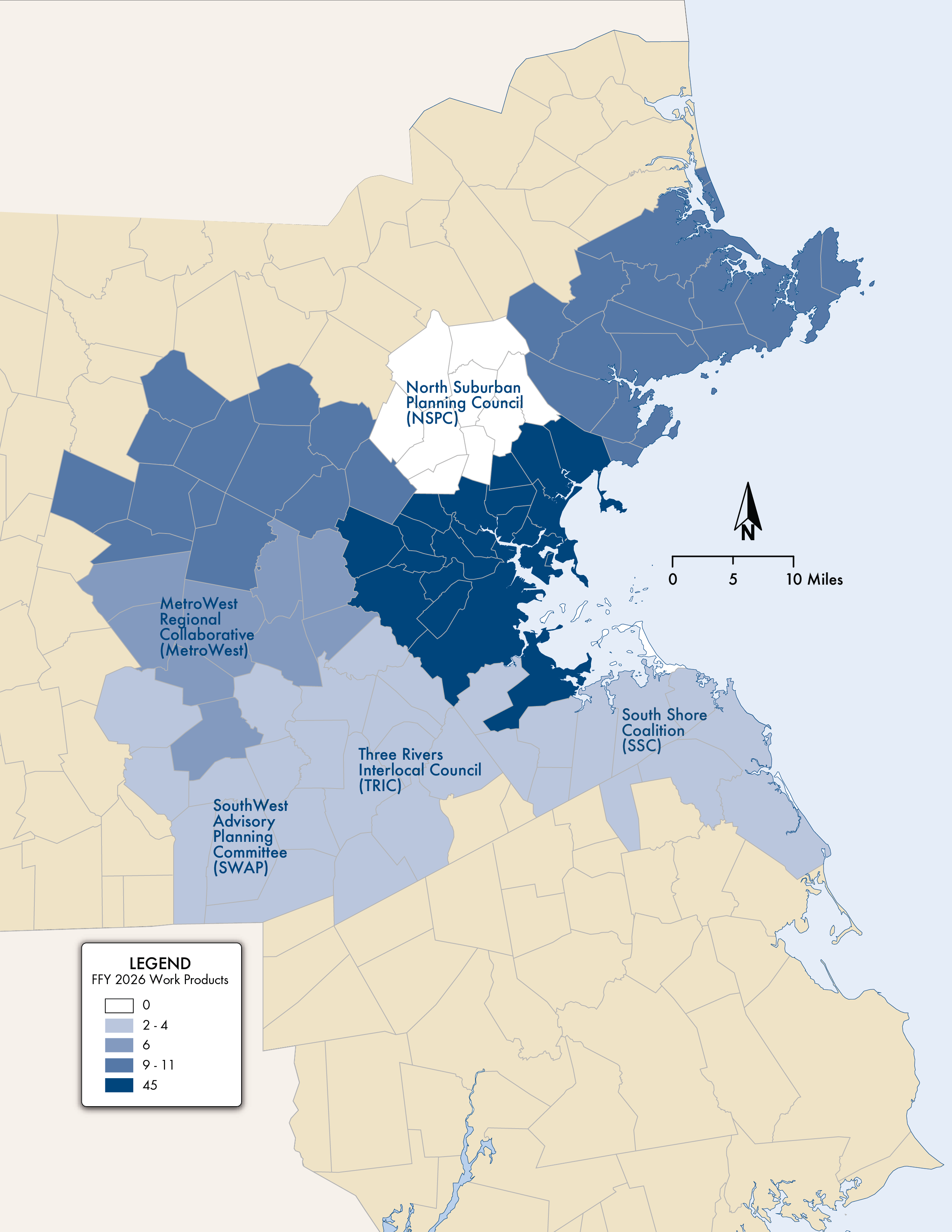
Notes:
Needham, Dover, and Milton were included exclusively in the TRIC subregion and Sherborn was included exclusively in the SWAP subregion for this analysis.
Methodology
Staff analyzed the geographic distribution of UPWP studies and technical analyses between FFYs 2022 and 2026. To generate information on the number of UPWP studies during these FFYs that benefited specific cities and towns in the Boston region, MPO staff performed the following tasks:
- reviewed all UPWP-funded work products conducted by Boston Region MPO and MAPC staff that are listed as complete in UPWPs from FFYs 2022 through 2026
- excluded all work products with a focus that was regional or not limited to a specific geography. Regionally focused work is listed in a separate chart at the end of this appendix
- excluded all work related to certification requirements (Chapter 3) and resource management and support activities (Chapter 6), which consist of programs and activities that support the MPO, its staff operations, and its planning and programming activities
- compiled a count of all reports and technical memoranda completed specifically for one municipality or reports and technical memoranda directly benefiting multiple municipalities. In the case where multiple municipalities directly benefit from a report or technical memoranda, the work product was counted once for each municipality that benefited
- reviewed and discussed the status and focus of studies, technical memoranda, and reports with project managers and technical staff
- refreshed the demographic data using American Community Survey 2020–24 five-year estimates
Planning Studies and Technical Analyses by Community
Table D-2 shows the number of completed MPO-funded UPWP work products from FFY 2022 through FFY 2026 that are determined to provide benefits to specific municipalities. Studies and technical analyses are grouped by the year in which they were completed, rather than the year in which they were first programmed in the UPWP. Examples of the types of studies and work in the table include the following:
- Active transportation support activities
- Technical assistance studies for specific municipalities, regional transit authorities, or transportation management associations
- Intersection and corridor studies
- Complete Streets analyses for specific municipalities
- Road Safety Audits
Figure D-2 maps the number of completed work products that benefited each subregion for FFY 2026.
Analysis of the data in the tables shows that there is a slight positive relationship between the percentage of the population classified as protected by Title VI in each municipality and the number of studies conducted in each municipality since 2022, but not a strong correlation. This suggests that studies are not always distributed relative to the share of Title VI populations; if they were, the number of studies would be expected to increase with the share of Title VI populations.
With regards to geographic distribution, the Inner Core Committee (ICC) subregion has had the most work products since 2022, with 183, but also the highest population, with 1,774,021 people. In 2026, the ICC also had the highest number of work products, followed by the NorthShore Task Force (NSTF) and the Minuteman Advisory Group on Interlocal Coordination (MAGIC). The North Suburban Planning Council (NSPC) had the lowest. This suggests that municipalities in the ICC, NSTF, and MAGIC subregions received disproportionately more studies than municipalities in other subregions in 2026.
As the MPO considers studies to fund in future years, it should consider prioritizing funding in those municipalities that have received less funding in the past and based on shares of Title VI populations.
Table D-2
Number of UPWP Tasks by FFY and Municipality, Grouped by Subregion
| Municipality | Number of Work Products | Demographics | ||||||||
| 2022 | 2023 | 2024 | 2025 | 2026 | 2022–26 Total | Total Population | Percentage of Minority Population | Percentage of Residents with LEP | Median Income | |
| Arlington | 0 | 3 | 1 | 1 | 1 | 6 | 46,350 | 26.2% | 5.4% | $ 150,701 |
| Belmont | 1 | 0 | 0 | 0 | 0 | 1 | 27,175 | 31.2% | 8.3% | $ 183,137 |
| Boston | 11 | 8 | 5 | 8 | 6 | 38 | 666,442 | 55.9% | 15.8% | $ 97,344 |
| Brookline | 1 | 2 | 1 | 1 | 1 | 6 | 63,266 | 35.9% | 7.5% | $ 142,101 |
| Cambridge | 0 | 2 | 1 | 1 | 4 | 8 | 118,796 | 46.2% | 8.0% | $ 130,748 |
| Chelsea | 0 | 3 | 1 | 6 | 4 | 14 | 39,908 | 82.3% | 44.4% | $ 72,179 |
| Dedham | 1 | 0 | 1 | 0 | 0 | 2 | 25,237 | 21.2% | 7.4% | $ 128,955 |
| Everett | 0 | 3 | 4 | 6 | 5 | 18 | 50,045 | 65.6% | 31.4% | $ 85,218 |
| Lynn | 1 | 2 | 0 | 0 | 0 | 3 | 101,709 | 67.3% | 27.0% | $ 75,043 |
| Malden | 0 | 3 | 1 | 4 | 5 | 13 | 65,906 | 61.3% | 26.5% | $ 100,606 |
| Medford | 0 | 1 | 1 | 4 | 3 | 9 | 59,354 | 34.0% | 10.3% | $ 129,540 |
| Melrose | 0 | 2 | 0 | 0 | 0 | 2 | 29,650 | 23.1% | 6.8% | $ 133,953 |
| Newton | 1 | 2 | 1 | 2 | 2 | 8 | 89,044 | 31.6% | 7.9% | $ 190,304 |
| Quincy | 3 | 3 | 1 | 1 | 4 | 12 | 102,114 | 46.3% | 19.6% | $ 98,882 |
| Revere | 0 | 3 | 1 | 5 | 2 | 11 | 60,012 | 53.4% | 32.8% | $ 86,969 |
| Saugus | 0 | 0 | 0 | 0 | 0 | 0 | 28,773 | 29.3% | 9.8% | $ 101,539 |
| Somerville | 0 | 5 | 1 | 5 | 4 | 15 | 81,036 | 34.4% | 9.4% | $ 132,572 |
| Waltham | 1 | 0 | 0 | 0 | 0 | 1 | 64,902 | 42.4% | 9.9% | $ 120,216 |
| Watertown | 1 | 2 | 1 | 4 | 4 | 12 | 35,543 | 29.5% | 10.2% | $ 126,265 |
| Winthrop | 0 | 2 | 1 | 1 | 0 | 4 | 18,759 | 27.2% | 8.5% | $ 116,167 |
| ICC Subtotals | 21 | 46 | 22 | 49 | 45 | 183 | 1,774,021 | 48.7% | 15.8% | |
| Acton | 0 | 1 | 2 | 0 | 2 | 5 | 24,155 | 41.1% | 9.2% | $ 158,230 |
| Bedford | 1 | 2 | 1 | 0 | 0 | 4 | 14,727 | 29.8% | 7.3% | $ 172,400 |
| Bolton | 0 | 0 | 0 | 0 | 0 | 0 | 5,737 | 18.5% | 1.7% | $ 205,449 |
| Boxborough | 0 | 0 | 0 | 0 | 0 | 0 | 5,496 | 35.9% | 7.2% | $ 144,611 |
| Carlisle | 0 | 0 | 0 | 0 | 0 | 0 | 5,239 | 19.9% | 3.1% | $ 250,001 |
| Concord | 1 | 3 | 0 | 1 | 1 | 6 | 18,223 | 18.1% | 2.6% | $ 195,350 |
| Hudson | 0 | 0 | 0 | 0 | 0 | 0 | 20,077 | 22.4% | 10.9% | $ 103,400 |
| Lexington | 1 | 1 | 0 | 0 | 0 | 2 | 34,295 | 44.8% | 9.2% | $ 238,444 |
| Lincoln | 0 | 1 | 0 | 1 | 1 | 3 | 6,948 | 31.7% | 6.8% | $ 175,117 |
| Littleton | 0 | 1 | 0 | 0 | 2 | 3 | 10,280 | 20.0% | 3.2% | $ 149,722 |
| Maynard | 0 | 1 | 1 | 0 | 2 | 4 | 10,712 | 19.6% | 4.3% | $ 124,067 |
| Stow | 0 | 0 | 1 | 0 | 1 | 2 | 7,165 | 14.9% | 2.9% | $ 185,809 |
| Sudbury | 1 | 3 | 0 | 0 | 0 | 4 | 19,306 | 21.3% | 2.8% | $ 236,250 |
| MAGIC Subtotals | 4 | 13 | 5 | 2 | 9 | 33 | 182,360 | 29.1% | 6.5% | |
| Ashland | 0 | 1 | 1 | 0 | 0 | 2 | 18,873 | 37.3% | 8.8% | $ 127,539 |
| Framingham | 1 | 2 | 1 | 3 | 4 | 11 | 72,399 | 50.1% | 21.4% | $ 107,419 |
| Holliston | 0 | 0 | 1 | 0 | 0 | 1 | 15,094 | 17.6% | 4.3% | $ 159,817 |
| Marlborough | 0 | 0 | 0 | 1 | 0 | 1 | 41,647 | 45.9% | 20.0% | $ 91,968 |
| Natick | 1 | 0 | 1 | 3 | 2 | 7 | 36,873 | 25.2% | 7.3% | $ 138,538 |
| Southborough | 0 | 0 | 1 | 0 | 0 | 1 | 10,493 | 29.3% | 7.2% | $ 196,808 |
| Wayland | 1 | 0 | 0 | 0 | 0 | 1 | 13,914 | 23.4% | 6.2% | $ 224,000 |
| Wellesley | 0 | 0 | 0 | 1 | 0 | 1 | 30,347 | 32.4% | 4.6% | $ 250,001 |
| Weston | 0 | 1 | 0 | 0 | 0 | 1 | 11,579 | 29.1% | 5.8% | $ 250,001 |
| MetroWest Subtotals | 3 | 4 | 5 | 8 | 6 | 26 | 251,219 | 37.4% | 12.9% | |
| Burlington | 0 | 0 | 1 | 2 | 0 | 3 | 26,274 | 25.6% | 5.3% | $ 146,436 |
| Lynnfield | 0 | 0 | 0 | 1 | 0 | 1 | 13,064 | 18.8% | 2.9% | $ 175,265 |
| North Reading | 0 | 0 | 1 | 0 | 0 | 1 | 15,765 | 13.6% | 1.9% | $ 147,768 |
| Reading | 0 | 0 | 0 | 0 | 0 | 0 | 25,612 | 15.7% | 4.1% | $ 165,912 |
| Stoneham | 0 | 0 | 0 | 0 | 0 | 0 | 23,355 | 19.0% | 6.1% | $ 113,964 |
| Wakefield | 1 | 2 | 1 | 0 | 0 | 4 | 27,793 | 14.5% | 3.3% | $ 134,306 |
| Wilmington | 0 | 0 | 0 | 0 | 0 | 0 | 23,336 | 13.4% | 2.0% | $ 168,152 |
| Winchester | 0 | 0 | 0 | 0 | 0 | 0 | 23,406 | 29.5% | 7.5% | $ 230,198 |
| Woburn | 0 | 0 | 0 | 2 | 0 | 2 | 41,939 | 28.3% | 10.3% | $ 111,185 |
| NSPC Subtotals | 1 | 2 | 3 | 5 | 0 | 11 | 220,544 | 20.7% | 5.5% | |
| Beverly | 1 | 1 | 0 | 1 | 3 | 6 | 42,665 | 15.7% | 3.6% | $ 106,044 |
| Danvers | 1 | 0 | 0 | 1 | 1 | 3 | 28,098 | 12.6% | 4.0% | $ 125,395 |
| Essex | 0 | 0 | 0 | 1 | 0 | 1 | 3,701 | 2.8% | 0.6% | $ 157,147 |
| Gloucester | 0 | 0 | 0 | 0 | 0 | 0 | 30,075 | 11.8% | 6.2% | $ 83,883 |
| Hamilton | 0 | 0 | 1 | 0 | 0 | 1 | 7,600 | 9.9% | 2.1% | $ 129,833 |
| Ipswich | 0 | 0 | 1 | 0 | 0 | 1 | 13,930 | 8.0% | 1.9% | $ 138,750 |
| Manchester-by-the-Sea | 1 | 1 | 0 | 0 | 1 | 3 | 5,403 | 10.4% | 0.2% | $ 206,389 |
| Marblehead | 0 | 0 | 0 | 0 | 1 | 1 | 20,413 | 7.0% | 0.9% | $ 182,132 |
| Middleton | 0 | 0 | 0 | 0 | 0 | 0 | 9,816 | 18.1% | 6.6% | $ 167,402 |
| Nahant | 0 | 0 | 0 | 0 | 0 | 0 | 3,325 | 9.6% | 1.0% | $ 112,762 |
| Peabody | 1 | 0 | 0 | 1 | 0 | 2 | 54,695 | 27.5% | 10.0% | $ 96,657 |
| Rockport | 0 | 0 | 0 | 0 | 0 | 0 | 7,009 | 5.6% | 0.9% | $ 96,250 |
| Salem | 2 | 2 | 2 | 4 | 4 | 14 | 44,795 | 33.6% | 10.4% | $ 85,153 |
| Swampscott | 0 | 0 | 0 | 0 | 0 | 0 | 15,277 | 15.9% | 10.1% | $ 134,386 |
| Topsfield | 0 | 0 | 0 | 0 | 1 | 1 | 6,564 | 13.3% | 2.8% | $ 195,718 |
| Wenham | 0 | 0 | 0 | 0 | 0 | 0 | 4,929 | 11.4% | 1.9% | $ 194,781 |
| NSTF Subtotals | 6 | 4 | 4 | 8 | 11 | 33 | 298,295 | 18.1% | 6.0% | |
| Braintree | 1 | 1 | 0 | 0 | 1 | 3 | 38,899 | 33.2% | 12.5% | $ 122,214 |
| Cohasset | 1 | 0 | 0 | 0 | 0 | 1 | 8,427 | 7.3% | 1.5% | $ 199,306 |
| Hingham | 2 | 0 | 1 | 0 | 0 | 3 | 24,283 | 7.4% | 1.6% | $ 178,390 |
| Holbrook | 0 | 0 | 1 | 1 | 0 | 2 | 11,380 | 42.4% | 2.6% | $ 115,210 |
| Hull | 1 | 1 | 0 | 0 | 0 | 2 | 10,138 | 6.8% | 0.5% | $ 115,485 |
| Marshfield | 1 | 0 | 0 | 0 | 0 | 1 | 25,879 | 7.2% | 0.9% | $ 125,986 |
| Norwell | 1 | 0 | 0 | 0 | 0 | 1 | 11,361 | 9.9% | 1.4% | $ 188,699 |
| Rockland | 0 | 0 | 1 | 0 | 0 | 1 | 17,701 | 17.6% | 5.0% | $ 112,405 |
| Scituate | 1 | 0 | 0 | 0 | 0 | 1 | 19,365 | 7.0% | 1.2% | $ 136,732 |
| Weymouth | 1 | 0 | 2 | 1 | 1 | 5 | 58,505 | 21.1% | 5.9% | $ 102,714 |
| SSC Subtotals | 9 | 2 | 5 | 2 | 2 | 20 | 225,938 | 18.0% | 4.7% | |
| Bellingham | 0 | 0 | 0 | 2 | 2 | 4 | 17,410 | 17.8% | 3.3% | $ 125,307 |
| Franklin | 0 | 0 | 0 | 1 | 0 | 1 | 33,154 | 17.8% | 3.2% | $ 145,773 |
| Hopkinton | 0 | 0 | 0 | 1 | 0 | 1 | 19,358 | 31.4% | 2.7% | $ 222,801 |
| Medway | 1 | 1 | 0 | 0 | 0 | 2 | 13,436 | 17.4% | 3.0% | $ 173,750 |
| Milford | 0 | 0 | 0 | 0 | 1 | 1 | 30,431 | 39.3% | 21.2% | $ 96,365 |
| Millis | 0 | 0 | 0 | 0 | 0 | 0 | 8,888 | 15.4% | 5.3% | $ 155,996 |
| Norfolk | 0 | 0 | 1 | 0 | 0 | 1 | 11,673 | 18.9% | 0.8% | $ 200,720 |
| Sherborn | 0 | 0 | 0 | 0 | 0 | 0 | 4,427 | 19.4% | 0.9% | $ 250,001 |
| Wrentham | 0 | 0 | 1 | 0 | 0 | 1 | 12,297 | 12.1% | 1.6% | $ 151,676 |
| SWAP Subtotals | 1 | 1 | 2 | 4 | 3 | 11 | 151,074 | 23.4% | 6.5% | |
| Canton | 1 | 1 | 0 | 0 | 0 | 2 | 24,748 | 32.8% | 5.3% | $ 143,381 |
| Dover | 0 | 0 | 0 | 0 | 0 | 0 | 5,930 | 23.6% | 3.8% | $ 250,001 |
| Foxborough | 0 | 0 | 0 | 0 | 0 | 0 | 18,615 | 22.1% | 2.6% | $ 115,833 |
| Medfield | 0 | 0 | 0 | 0 | 1 | 1 | 13,068 | 14.9% | 1.3% | $ 235,800 |
| Milton | 2 | 1 | 1 | 1 | 1 | 6 | 28,587 | 30.3% | 3.6% | $ 188,529 |
| Needham | 1 | 1 | 1 | 0 | 0 | 3 | 32,459 | 19.2% | 4.3% | $ 214,308 |
| Norwood | 2 | 2 | 0 | 0 | 0 | 4 | 31,542 | 31.4% | 12.0% | $ 107,030 |
| Randolph | 1 | 1 | 1 | 0 | 1 | 4 | 34,878 | 72.6% | 15.4% | $ 109,573 |
| Sharon | 0 | 1 | 1 | 1 | 0 | 3 | 18,574 | 34.4% | 7.3% | $ 191,835 |
| Walpole | 1 | 0 | 0 | 1 | 1 | 3 | 26,388 | 14.9% | 3.0% | $ 171,500 |
| Westwood | 1 | 0 | 0 | 0 | 0 | 1 | 16,318 | 22.1% | 4.0% | $ 223,125 |
| TRIC Subtotals | 9 | 7 | 4 | 3 | 4 | 27 | 251,107 | 31.7% | 6.6% | |
| Grand Total | 54 | 79 | 50 | 81 | 80 | 344 | 3,354,558 | 37.8% | 11.7% | |
Notes:
LEP percentage is tabulated for the population aged five years and older and the minority population percentage is tabulated for the total population for each municipality in the entire region.
People who identify as minority are those who identify as a race other than White or as Hispanic or Latino/a/x.
Needham, Dover, and Milton were included exclusively in the TRIC subregion and Sherborn was included exclusively in the SWAP subregion for this analysis.
Sources:
Minority population: US Census Bureau; 2020–24 American Community Survey, Table B03002: Hispanic or Latino Origin by Race, data.census.gov; (2026-03-19).
People with LEP: US Census Bureau; 2020–24 American Community Survey, Table C16001: Language Spoken at Home for the Population 5 Years and Over; data.census.gov; (2026-03-19).
Median Household Income: U.S. Census Bureau; American Community Survey, 2020-24 American Community Survey 5-Year Estimates, Table B19013 (Median Household Income), generated by Boston Region MPO staff; using api.census.gov; (2026-03-19).
Figure D-2
Map of 2026 UPWP Tasks by Municipality
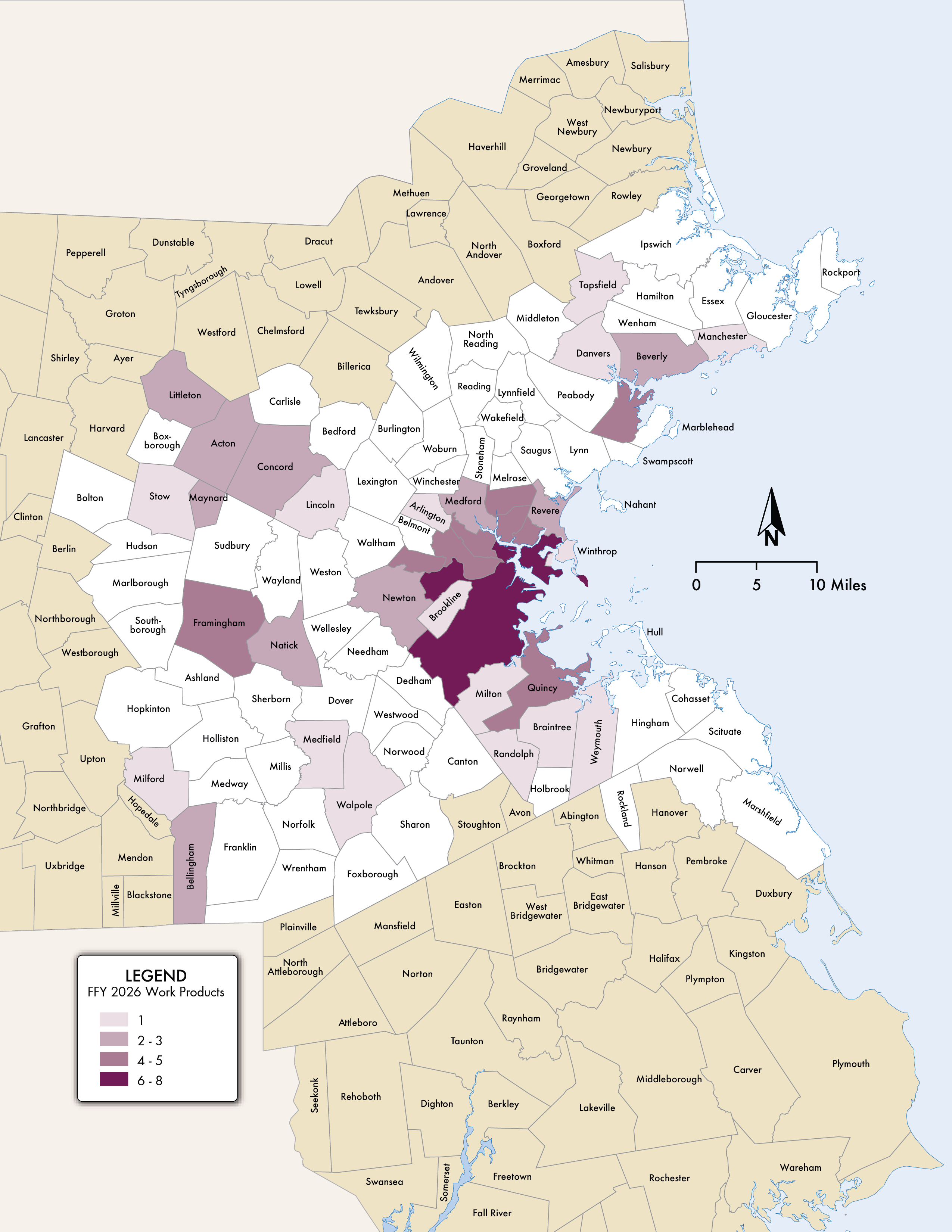
Notes:
Needham, Dover, and Milton were included exclusively in the TRIC subregion and Sherborn was included exclusively in the SWAP subregion for this analysis.
Regionwide Planning Studies and Technical Analyses
In addition to work that benefits specific municipalities, many projects funded by the MPO through the UPWP have a regional focus. Table D-3 lists MPO-funded UPWP studies completed from 2022 through 2026 that were regional in focus, meaning that they provided benefit to multiple communities in different subregions.
More information on these studies and other work can be found on the MPO’s website or by contacting upwp@ctps.org.
Table D-3
Regionally Focused MPO-Funded UPWP Studies
| FFY 2026 | |
| Boston Region MPO | MAPC |
| • Pedestrian-Scale Lighting Guide for Communities • Representing the Experience of Limited Mobility Individuals • Roadway Pricing Technical Evaluation: Iterative Scenario Analysis |
• Research and Evaluation that Support Economic Vitality and Quality of Life Improvements in Coordinated Land Use Transportation Plans |
| FFY 2025 | |
| Boston Region MPO | MAPC |
| • Bluebikes and MBTA Connections • Decarbonizing the Freight Sector: Exploring the Potential for Using E-cargo Bikes for First-/Last-mile Freight Deliveries • Roadway Pricing: Balancing the Need for a Transition to Sustainable Mobility with Equity Considerations |
• Research and Evaluation that Support Livable Communities and Sustainable Transportation |
| FFY 2024 | |
| Boston Region MPO | MAPC |
| • Lab and Municipal Parking Phase II • Parking in Bike Lanes: Strategies for Safety and Prevention • Strategies for Environmental Outreach and Engagement • Applying Conveyal to TIP Project Scoring |
Blank |
| FFY 2023 | |
| Boston Region MPO | MAPC |
| • Update Bicycle/Pedestrian Count Database • Flexible Fixed-Route Bus Service • Transit Modernization Program • Lab and Municipal Parking Study • Learning from Roadway Pricing Experiences |
Blank |
| FFY 2022 | |
| Boston Region MPO | MAPC |
| • Trip Generation Follow-up • Travel Demand Management Follow-up • The Future of the Curb Phase 3 • Identifying Transportation Inequities in the Boston Region • Staff Generated Research Topics |
• MetroCommon 2050: Greater Boston’s Next Regional Vision |
Uses for the Data
MPO staff analyzes these data annually. The findings of these analyses can potentially be used to inform UPWP funding decisions, and staff will explore the feasibility of conducting the following analyses in the next federal fiscal year:
- Develop graphics illustrating the geographic distribution of UPWP studies and spending and map that distribution relative to areas of priority transportation investment as defined in the Community Transportation Access program.
- Examine in greater detail the geographic distribution of UPWP studies and technical analyses per subregion to understand the type of tasks being completed and how these compare to municipally identified needs.
- Examine areas of priority transportation investments, as defined in the Community Transportation Access program, when selecting technical assistance, intersections improvement, and corridor studies.
Analyses such as these would provide the MPO with a clearer understanding of how the work programmed through the UPWP addresses the needs of the region.
Appendix E: Regulatory and Policy Framework
This appendix contains detailed background on the regulatory documents, legislation, and guidance that shape the Boston Region Metropolitan Planning Organization’s (MPO) transportation planning process.
Regulatory Framework
The Boston Region MPO is charged with executing its planning activities in line with federal and state regulatory guidance. Maintaining compliance with these regulations allows the MPO to directly support the work of these critical partners and ensures its continued role in helping the region move closer to achieving federal, state, and regional transportation goals. This appendix describes the regulations, policies, and guidance taken into consideration by the MPO during development of the certification documents and other core work the MPO will undertake during federal fiscal year (FFY) 2027.
Federal Regulations and Guidance
The MPO’s planning processes are guided by provisions in federal transportation authorization bills, which are codified in federal statutes and supported by guidance from federal agencies. The Infrastructure Investment and Jobs Act (IIJA) was signed into law on November 15, 2021, as the nation’s five-year surface transportation bill, and covers FFYs 2022–26. This section describes provisions established in the IIJA.
Infrastructure Investment and Jobs Act: National Goals
The purpose of the national transportation goals, outlined in Title 23, section 150, of the United States Code (23 USC § 150), is to increase the accountability and transparency of the Federal-Aid Highway Program and to improve decision-making through performance-based planning and programming. The national transportation goals include the following:
- Safety: Achieve significant reduction in traffic fatalities and serious injuries on all public roads
- Infrastructure condition: Maintain the highway infrastructure asset system in a state of good repair
- Congestion reduction: Achieve significant reduction in congestion on the National Highway System
- System reliability: Improve efficiency of the surface transportation system
- Freight movement and economic vitality: Improve the national freight network, strengthen the ability of rural communities to access national and international trade markets, and support regional economic development
- Environmental sustainability: Enhance performance of the transportation system while protecting and enhancing the natural environment
- Reduced project delivery delays: Reduce project costs, promote jobs and the economy, and expedite movement of people and goods by accelerating project completion by eliminating delays in the project development and delivery process, including by reducing regulatory burdens and improving agencies’ work practices
The Boston Region MPO has incorporated these national goals into its vision, goals, and objectives, which provide a framework for the MPO’s planning processes. More information about the MPO’s vision, goals, and objectives is included in Chapter 1.
Federal Planning Factors
The MPO gives specific consideration to the federal planning factors, described in Title 23, section 134, of the US Code (23 USC § 134), when developing all documents that program federal transportation funds. In accordance with the legislation, studies and strategies undertaken by the MPO shall
- Support the economic vitality of the metropolitan area, especially by enabling global competition, productivity, and efficiency
- Increase the safety of the transportation system for all motorized and nonmotorized users
- Increase the ability of the transportation system to support homeland security and to safeguard the personal security of all motorized and nonmotorized users
- Increase accessibility and mobility of people and freight
- Protect and enhance the environment, promote energy conservation, improve quality of life, and promote consistency between transportation improvements and state and local planned growth and economic development patterns
- Enhance integration and connectivity of the transportation system, across and between modes, for people and freight
- Promote efficient system management and operation
- Emphasize preservation of the existing transportation system
- Improve the resiliency and reliability of the transportation system and reduce or mitigate stormwater impacts of surface transportation
- Enhance travel and tourism
The Boston Region MPO has also incorporated these federal planning factors into its vision, goals, and objectives. Table E-1 shows the relationships between FFY 2027 MPO studies and activities and these federal planning factors.
Table E-1
FFY 2027 3C-Funded UPWP Studies and Programs—Relationship to Federal Planning Factors
| Federal Planning Factor | 3C-funded Certification Activities | ||||||||||||||||
| Support to the MPO and its Committees | General Editorial | General Graphics | Public Engagement Program | Long-Range Transportation Plan | Transportation Improvement Program | Performance-Based Planning and Programming | Unified Planning Work Program | Community Transportation Access Program | Congestion Management Process | Multimodal Mobility Infrastructure Program | Freight Planning Support | Data Program | Transit Working Group Support | Active Transportation Planning Program | Transportation Impact Mitigation | ||
| 1 | Support the economic vitality of the metropolitan area, especially by enabling global competitiveness, productivity, and efficiency. | • | • | • | • | • | • | • | • | • | • | • | |||||
| 2 | Increase the safety of the transportation system for all motorized and nonmotorized users. | • | • | • | • | • | • | • | • | • | • | ||||||
| 3 | Increase the ability of the transportation system to support homeland security and to safeguard the personal security of all motorized and nonmotorized users. | • | • | • | • | • | • | ||||||||||
| 4 | Increase accessibility and mobility of people and freight. | • | • | • | • | • | • | • | • | • | • | • | • | • | • | • | • |
| 5 | Protect and enhance the environment, promote energy conservation, improve the quality of life, and promote consistency between transportation improvements and state and local planned growth and economic development patterns. | • | • | • | • | • | • | • | • | • | • | • | |||||
| 6 | Enhance the integration and connectivity of the transportation system, across and between modes, for people and freight. | • | • | • | • | • | • | • | • | • | • | • | • | • | |||
| 7 | Promote efficient system management and operation. | • | • | • | • | • | • | • | • | • | • | • | |||||
| 8 | Emphasize the preservation of the existing transportation system. | • | • | • | • | • | • | • | • | • | |||||||
| 9 | Improve the resiliency and reliability of the transportation system and reduce or mitigate storm water impacts of surface transportation. | • | • | • | • | • | • | • | |||||||||
| 10 | Enhance travel and tourism. | • | • | • | • | • | • | ||||||||||
| Federal Planning Factor | Ongoing Technical Assistance | New and Recurring 3C-funded Planning Studies* | Administration and Resource Management | MAPC Activities | ||||||||||||
| Road Safety Audits | Technical Assistance Program (Boston Region MPO and MAPC) | Roadway Pricing Technical Evaluation: Iterative Scenario Analysis | Impact of Parking Supply on Property Values | Opportunities for the Boston Region MPO to Support Transit-Oriented Development | IT Resource Management | Professional Development | Corridor/Subarea Planning Studies | Alternative Mode Planning and Coordination | MetroCommon 2050 | Land-Use Development Project Reviews | MPO/MAPC Liaison Activities | UPWP Support | Land-use Data and Forecasts for Transportation Modeling | Subregional Support Activities | ||
| 1 | Support the economic vitality of the metropolitan area, especially by enabling global competitiveness, productivity, and efficiency. | • | • | • | • | • | • | • | • | • | • | • | ||||
| 2 | Increase the safety of the transportation system for all motorized and nonmotorized users. | • | • | • | • | • | • | • | ||||||||
| 3 | Increase the ability of the transportation system to support homeland security and to safeguard the personal security of all motorized and nonmotorized users. | • | ||||||||||||||
| 4 | Increase accessibility and mobility of people and freight. | • | • | • | • | • | • | • | • | • | • | • | • | |||
| 5 | Protect and enhance the environment, promote energy conservation, improve the quality of life, and promote consistency between transportation improvements and state and local planned growth and economic development patterns. | • | • | • | • | • | • | • | • | • | • | • | • | |||
| 6 | Enhance the integration and connectivity of the transportation system, across and between modes, for people and freight. | • | • | • | • | • | • | • | ||||||||
| 7 | Promote efficient system management and operation. | • | • | • | • | • | • | • | • | |||||||
| 8 | Emphasize the preservation of the existing transportation system. | • | • | • | • | • | • | |||||||||
| 9 | Improve the resiliency and reliability of the transportation system and reduce or mitigate storm water impacts of surface transportation. | • | • | • | • | • | • | • | • | • | ||||||
| 10 | Enhance travel and tourism. | • | • | • | • | • | • | |||||||||
* For ongoing FFY 2026 3C-funded studies, see FFY 2026 UPWP
** Includes Support to the MPO and its Committees, Public Participation Process, and Community Advisory Council Support
FAST Act: Performance-Based Planning and Programming
The United States Department of Transportation (USDOT), in consultation with states, MPOs, and other stakeholders, established performance measures relevant to the national goals established in the FAST Act. These performance topic areas include roadway safety, transit system safety, National Highway System (NHS) bridge and pavement condition, transit asset condition, NHS reliability for both passenger and freight travel, traffic congestion, and on-road mobile source emissions. The FAST Act and related federal rulemakings require states, MPOs, and public transportation operators to follow performance-based planning and programming practices—such as setting targets—to ensure that transportation investments support progress towards these goals. See Chapter 3 for more information about how the MPO has and will continue to conduct performance-based planning and programming.
1990 Clean Air Act Amendments
The Clean Air Act, most recently amended in 1990, forms the basis of the United States’ air pollution control policy. The act identifies air quality standards, and the US Environmental Protection Agency (EPA) designates geographic areas as attainment (in compliance) or nonattainment (not in compliance) areas with respect to these standards. If air quality in a nonattainment area improves such that it meets EPA standards, the EPA may redesignate that area as a maintenance area for a 20-year period to ensure that the standard is maintained in that area.
The conformity provisions of the Clean Air Act “require that those areas that have poor air quality, or had it in the past, should examine the long-term air quality impacts of their transportation system and ensure its compatibility with the area’s clean air goals.” Agencies responsible for Clean Air Act requirements for nonattainment and maintenance areas must conduct air quality conformity determinations, which are demonstrations that transportation plans, programs, and projects addressing that area are consistent with a State Implementation Plan (SIP) for attaining air quality standards.
Air quality conformity determinations must be performed for capital improvement projects that receive federal funding and for those that are considered regionally significant, regardless of the funding source. These determinations must show that projects in the MPO’s Long-Range Transportation Plan (LRTP) and Transportation Improvement Program (TIP) will not cause or contribute to any new air quality violations; will not increase the frequency or severity of any existing air quality violations in any area; and will not delay the timely attainment of air quality standards in any area. The policy, criteria, and procedures for demonstrating air quality conformity in the Boston region were established in Title 40, parts 51 and 53, of the Code of Federal Regulations (40. C.F.R. 51, 40 C.F.R. 53).
On April 1, 1996, the EPA redesignated the cities of Boston, Cambridge, Chelsea, Everett, Malden, Medford, Quincy, Revere, and Somerville from nonattainment to attainment for carbon monoxide (CO) emissions. Subsequently, the Commonwealth established a CO maintenance plan through the Massachusetts SIP process to ensure that emission levels did not increase. While the maintenance plan was in effect, past TIPs and LRTPs included an air quality conformity analysis for these communities. As of April 1, 2016, the 20-year maintenance period for this maintenance area expired and transportation conformity is no longer required for carbon monoxide in these communities. This ruling is documented in a letter from the EPA dated May 12, 2016.
On April 22, 2002, the EPA classified the City of Waltham as being in attainment for CO emissions with an EPA-approved limited-maintenance plan. In areas that have approved limited-maintenance plans, federal actions requiring conformity determinations under the EPA’s transportation conformity rule are considered to satisfy the conformity test. The MPO is not required to perform a modeling analysis for a conformity determination for carbon monoxide, but it has been required to provide a status report on the timely implementation of projects and programs that will reduce emissions from transportation sources—so-called transportation control measures—which are included in the Massachusetts SIP. In April 2022, the EPA issued a letter explaining that the carbon monoxide limited maintenance area in Waltham has expired. Therefore, the MPO is no longer required to demonstrate transportation conformity for this area, but the rest of the maintenance plan requirements, however, continue to apply, in accordance with the SIP.
On February 16, 2018, the US Court of Appeals for the DC Circuit issued a decision in South Coast Air Quality Management District v. EPA, which struck down portions of the 2008 Ozone National Ambient Air Quality Standards (NAAQS) SIP Requirements Rule concerning the ozone NAAQS. Those portions of the SIP Requirements Rule included transportation conformity requirements associated with the EPA’s revocation of the 1997 ozone NAAQS. Massachusetts was designated as an attainment area in accord with the 2008 ozone NAAQS but as a nonattainment or maintenance area as relates to the 1997 ozone NAAQS. As a result of this court ruling, MPOs in Massachusetts must once again demonstrate conformity for ozone when developing LRTPs and TIPs.
MPOs must also perform conformity determinations if transportation control measures (TCM) are in effect in the region. TCMs are strategies that reduce transportation-related air pollution and fuel use by reducing vehicle-miles traveled and improving roadway operations. The Massachusetts SIP identifies TCMs in the Boston region. SIP-identified TCMs are federally enforceable and projects that address the identified air quality issues must be given first priority when federal transportation dollars are spent. Examples of TCMs that were programmed in previous TIPs include rapid-transit and commuter-rail extension programs (such as the Green Line Extension in Cambridge, Medford, and Somerville, and the Fairmount Line improvements in Boston), parking-freeze programs in Boston and Cambridge, statewide rideshare programs, park-and-ride facilities, residential parking-sticker programs, and the operation of high-occupancy-vehicle (HOV) lanes.
In addition to reporting on the pollutants identified in the 1990 Clean Air Act Amendments, the MPOs in Massachusetts are also required to perform air quality analyses for carbon dioxide as part of the state’s Global Warming Solutions Act (GWSA) (see below).
Nondiscrimination Mandates
The Boston Region MPO complies with Title VI of the Civil Rights Act of 1964, the American with Disabilities Act of 1990 (ADA), and other federal and state nondiscrimination statutes and regulations in all programs and activities it conducts. Per federal and state law, the MPO does not discriminate on the basis of race, color, national origin (including limited-English proficiency), disability, age, sex, and additional protected characteristics. The MPO strives to provide meaningful opportunities for participation of all persons in the region, including those protected by Title VI, the ADA, and other nondiscrimination mandates.
The MPO also assesses the likely benefits and adverse effects of transportation projects on protected populations (populations covered by federal regulations, as identified in the MPO’s Community Transportation Access program) when deciding which projects to fund. This is done through the MPO’s project selection criteria. MPO staff also evaluate the projects that are selected for funding, in the aggregate, to determine their overall impacts and whether they improve transportation outcomes for protected populations. The major federal requirements pertaining to nondiscrimination are discussed below.
Title VI of the Civil Rights Act of 1964
Title VI of the Civil Rights Act of 1964 requires that no person be excluded from participation in, be denied the benefits of, or be subjected to discrimination on the basis of race, color, or national origin, under any program or activity provided by an agency receiving federal financial assistance. In recognition that there are people who, as a result of their nationality, have limited English proficiency and that courts have historically interpreted “national origin discrimination” to include language-based barriers, and continued USDOT requirements to provide language assistance, the MPO provides resources to allow people with limited English proficiency to meaningfully participate in the transportation planning process. This includes the development of a Language Assistance Plan that documents the MPO’s process for providing meaningful language access to people with limited English proficiency who access the MPO’s services and programs.
Americans with Disabilities Act
Title III of the ADA “prohibits states, MPOs, and other public entities from discriminating on the basis of disability in the entities’ services, programs, or activities,” and requires all transportation projects, plans, and programs to be accessible to people with disabilities. Therefore, MPOs must consider the mobility needs of people with disabilities when programming federal funding for studies and capital projects. MPO-sponsored meetings must also be held in accessible venues and be conducted in a manner that provides for accessibility. Also, MPO materials must be made available in accessible formats.
Other Nondiscrimination Mandates
The Age Discrimination Act of 1975 prohibits discrimination on the basis of age in programs or activities that receive federal financial assistance. In addition, the Rehabilitation Act of 1975, and Title 23, section 324, of the US Code (23 USC § 324) prohibit discrimination based on sex.
State Guidance and Priorities
Much of the MPO’s work focuses on encouraging mode shift and diminishing greenhouse gas (GHG) emissions through improving transit service, enhancing bicycle and pedestrian networks, and studying emerging transportation technologies. All of this work helps the Boston region contribute to statewide progress towards the priorities discussed in this section.
Beyond Mobility
Beyond Mobility, the Massachusetts 2050 Transportation Plan, is a planning process that will result in a blueprint for guiding transportation decision-making and investments in Massachusetts. MPO staff continue to coordinate with MassDOT staff so that Destination 2050, the MPO’s Long-Range Transportation Plan, is aligned with the Beyond Mobility plan.
Choices for Stewardship: Recommendations to Meet the Transportation Future
The Commission on the Future of Transportation in the Commonwealth—established by former Massachusetts Governor Charlie Baker’s Executive Order 579—published Choices for Stewardship in 2019. This report makes 18 recommendations across the following five thematic categories to adapt the transportation system in the Commonwealth to emerging needs:
- Modernize existing transportation assets to move more people
- Create a mobility infrastructure to capitalize on emerging transportation technology and behavior trends
- Reduce transportation-related GHG emissions and improve the climate resiliency of the transportation network
- Coordinate land use, housing, economic development, and transportation policy
- Alter current governance structures to better manage emerging and anticipated transportation trends
Beyond Mobility builds upon the Commission report’s recommendations. The Boston Region MPO supports these statewide goals by conducting planning work and making investment decisions that complement MassDOT’s efforts and reflect the evolving needs of the transportation system in the region.
Massachusetts Strategic Highway Safety Plan
The Massachusetts 2023 Strategic Highway Safety Plan (SHSP) identifies the state’s key safety needs and guides investment decisions to achieve significant reductions in highway fatalities and serious injuries on all public roads. The SHSP establishes statewide safety goals and objectives and key safety emphasis areas, and it draws on the strengths of all highway safety partners in the Commonwealth to align and leverage resources to address the state’s safety challenges collectively. The Boston Region MPO considers SHSP goals, emphasis areas, and strategies when developing its plans, programs, and activities.
Massachusetts Transportation Asset Management Plan
The Massachusetts Transportation Asset Management Plan (TAMP) is a risk-based asset management plan for the bridges and pavement that are in the NHS inventory. The plan describes the condition of these assets, identifies assets that are particularly vulnerable following declared emergencies such as extreme weather, and discusses MassDOT’s financial plan and risk management strategy for these assets. The Boston Region MPO considers MassDOT TAMP goals, targets, and strategies when developing its plans, programs, and activities. MassDOT’s TAMP was most recently updated in 2023.
MassDOT Modal Plans
In 2018, MassDOT released the related Commonwealth of Massachusetts State Rail Plan, which outlines short- and long-term investment strategies for Massachusetts’ freight and passenger rail systems (excluding the commuter rail system). In 2019, MassDOT released the Massachusetts Bicycle Transportation Plan and the Massachusetts Pedestrian Transportation Plan, both of which define roadmaps, initiatives, and action plans to improve bicycle and pedestrian transportation in the Commonwealth. These plans were updated in 2021 to reflect new investments in bicycle and pedestrian projects made by MassDOT since their release. In 2023, MassDOT released the Massachusetts Freight Plan, which identifies short- and long-term improvements and strategies for the state’s freight systems. The MPO considers the findings and strategies of MassDOT’s modal plans when conducting its planning, including through its Freight Planning Support and Bicycle/Pedestrian Support Activities programs.
Global Warming Solutions Act
The GWSA makes Massachusetts a leader in setting aggressive and enforceable GHG reduction targets and implementing policies and initiatives to achieve these targets. In keeping with this law, the Massachusetts Executive Office of Energy and Environmental Affairs (EEA), in consultation with other state agencies and the public, developed the Massachusetts Clean Energy and Climate Plan for 2020. This implementation plan, released on December 29, 2010, and updated in 2022 to reflect new interim targets, establishes the following targets for overall statewide GHG emission reductions:
- 33 percent reduction below statewide 1990 GHG emission levels by 2025
- 50 percent reduction below statewide 1990 GHG emission levels by 2030
- 75 percent reduction below statewide 1990 GHG emission levels by 2040
- 85 percent reduction below statewide 1990 GHG emission levels by 2050
In 2018, EEA published its GWSA 10-year Progress Report and the GHG Inventory estimated that 2018 GHG emissions were 22 percent below the 1990 baseline level.
On June 30, 2022, EEA certified its compliance with the 2020 emissions limit of 25 percent below the 1990 levels, noting that there was an estimated emissions reduction of 31.4 percent below the 1990 level in 2020.
MassDOT fulfills its responsibilities, defined in the Massachusetts Clean Energy and Climate Plan for 2050, through a policy directive that sets three principal objectives:
- To reduce GHG emissions by reducing emissions from construction and operations, using more efficient fleets, implementing travel demand management programs, encouraging eco-driving, and providing mitigation for development projects
- To promote healthy transportation modes by improving pedestrian, bicycle, and public transit infrastructure and operations
- To support smart growth development by making transportation investments that enable denser, smart growth development patterns that can support reduced GHG emissions
In January 2015, the Massachusetts Department of Environmental Protection amended Title 310, section 7.00, of the Code of Massachusetts Regulations (310 CMR 60.05), Global Warming Solutions Act Requirements for the Transportation Sector and the Massachusetts Department of Transportation, which was subsequently amended in August 2017. This regulation places a range of obligations on MassDOT and MPOs to support achievement of the Commonwealth’s goals through the programming of transportation funds. For example, MPOs must use GHG impact as a selection criterion when they review projects to be programmed in their TIPs, and they must evaluate and report the GHG emissions impacts of transportation projects in LRTPs and TIPs.
The Commonwealth’s 10 MPOs (and three non-metropolitan planning regions) are integrally involved in supporting the GHG reductions mandated under the GWSA. The MPOs seek to realize these objectives by prioritizing projects in the LRTP and TIP that will help reduce emissions from the transportation sector. The Boston Region MPO uses its TIP project evaluation criteria to score projects based on their GHG emissions impacts, multimodal Complete Streets accommodations, and ability to support smart growth development. Tracking and evaluating GHG emissions by project will enable the MPO to anticipate GHG impacts of planned and programmed projects. See Chapter 3 for more details related to how the MPO conducts GHG monitoring and evaluation.
Healthy Transportation Policy Initiatives
On September 9, 2013, MassDOT passed the Healthy Transportation Policy Directive to formalize its commitment to implementing and maintaining transportation networks that allow for various mode choices. This directive will ensure that all MassDOT projects are designed and implemented in ways that provide all users with access to safe and comfortable walking, bicycling, and transit options. MassDOT’s design justification process, which established controlling criteria for bicycle and pedestrian facilities, transit provisions and the length of off- and on-ramps, has helped to operationalize and further the goals of the original Healthy Transportation Policy Directive.
In November 2015, MassDOT released the Separated Bike Lane Planning & Design Guide. This guide represents a step in MassDOT’s continuing commitment to Complete Streets, sustainable transportation, and the creation of safer and more convenient transportation options for Massachusetts’ residents. This guide may be used by project planners and designers as a resource for considering, evaluating, and designing separated bike lanes as part of a Complete Streets approach.
In the current LRTP, Destination 2050, the Boston Region MPO continues to use investment programs—particularly its Complete Streets and Bicycle Network and Pedestrian Connections programs—that support the implementation of Complete Streets projects. In the Unified Planning Work Program, the MPO budgets to support these projects.
Congestion in the Commonwealth 2019
MassDOT developed the Congestion in the Commonwealth 2019 report to identify specific causes of and impacts from traffic congestion on the NHS. The report also made recommendations for reducing congestion, including addressing local and regional bottlenecks, redesigning bus networks within the systems operated by the Massachusetts Bay Transportation Authority (MBTA) and the other regional transit authorities, increasing MBTA capacity, and investigating congestion pricing mechanisms such as managed lanes. These recommendations guide multiple new efforts within MassDOT and the MBTA and are actively considered by the Boston Region MPO when making planning and investment decisions.
Regional Guidance and Priorities
Focus40, The MBTA’s Program for Mass Transportation
On March 18, 2019, MassDOT and the MBTA released Focus40, the MBTA’s Program for Mass Transportation, which is the 25-year investment plan that aims to position the MBTA to meet the transit needs of the Greater Boston region through 2040. Complemented by the MBTA’s Strategic Plan and other internal and external policy and planning initiatives, Focus40 serves as a comprehensive plan guiding all capital planning initiatives at the MBTA. These initiatives include the Rail Vision plan, which will inform the vision for the future of the MBTA’s commuter rail system; the Bus Network Redesign (formerly the Better Bus Project), the plan to re-envision and improve the MBTA’s bus network; and other plans. The next update of the Program for Mass Transportation began in July 2025 and is expected to be completed by the summer of 2027. The Boston Region MPO continues to monitor the status of Focus40 and related MBTA modal plans to inform its decision-making about transit capital investments, which are incorporated into the TIP and LRTP.
MetroCommon 2050
MetroCommon 2050, which was developed by the Metropolitan Area Planning Council (MAPC) and adopted in 2021, is Greater Boston’s regional land use and policy plan. MetroCommon 2050 builds upon MAPC’s previous plan, MetroFuture (adopted in 2008), and includes an updated set of strategies for achieving sustainable growth and prosperity in the region. The MPO considers MetroCommon 2050’s goals, objectives, and strategies in its planning and activities. See Chapter 7 for more information about MetroCommon 2050 development activities.
MetroCommon 2050 is the foundation for land use projections in the MPO’s LRTP, Destination 2050.
The Boston Region MPO’s Congestion Management Process
The congestion management process (CMP) is a systematic approach for managing congestion that provides accurate, up-to-date information on transportation system performance and assesses alternative strategies for congestion management. Its purpose is to provide for safe and effective integrated management and operation of the multimodal transportation system in the Boston region. The CMP formulates solutions for congestion management by
- establishing performance metrics,
- analyzing congestion on the regional transportation network using the metrics,
- identifying problem areas,
- recommending strategies to reduce congestion,
- moving those strategies into the implementation stage by providing decision-makers in the region with information and recommendations for improving the transportation system’s performance, and
- evaluating the recommendations and effectiveness of projects.
See Chapter 3 for more information about the MPO’s CMP.
Coordinated Public Transit—Human Services Transportation Plan
Every four years, the Boston Region MPO completes a Coordinated Public Transit‒Human Services Transportation Plan (CPT‒HST), in coordination with the development of the LRTP. The CPT‒HST supports improved coordination of transportation for seniors and people with disabilities in the Boston region by guiding transportation providers in their development of proposals for funding from the Federal Transit Administration’s Section 5310 Program (known in Massachusetts as the Community Transit Grant Program). To be eligible for funding, a proposal must meet a need identified in the CPT‒HST. The CPT‒HST contains information about
- current transportation providers in the Boston region;
- unmet transportation needs for seniors and people with disabilities;
- strategies and actions to meet the unmet needs; and
- priorities for implementing those needs.
The MPO is developing the next CPT-HST, which is expected to go into effect in FFY 2027.
MBTA and Regional Transit Authority (RTA) Transit Asset Management Plans
The MBTA and the region’s RTAs—the Cape Ann Transportation Authority (CATA) and the MetroWest Regional Transit Authority (MWRTA)—are responsible for producing transit asset management plans that describe their asset inventories and the condition of these assets, strategies, and priorities for improving the state of good repair of these assets. The Boston Region MPO considers goals and priorities established in these plans when developing its plans, programs, and activities.
MBTA and RTA Public Transit Agency Safety Plans
The MBTA, CATA, and MWRTA are required to create and annually update Public Transit Agency Safety Plans that describe their approaches for implementing Safety Management Systems on their transit systems. The Boston Region MPO considers goals, targets, and priorities established in these plans when developing its plans, programs, and activities.
Appendix F: Boston Region Metropolitan Planning Organization Membership
Voting Members
The Boston Region Metropolitan Planning Organization (MPO) includes both permanent members and municipal members who are elected for three-year terms. Details about the MPO’s members are listed below.
The Massachusetts Department of Transportation (MassDOT) was established under Chapter 25 (An Act Modernizing the Transportation Systems of the Commonwealth of Massachusetts) of the Acts of 2009. MassDOT has four divisions: Highway, Rail and Transit, Aeronautics, and the Registry of Motor Vehicles. The MassDOT Board of Directors, composed of 11 members appointed by the governor, oversees all four divisions and MassDOT operations and works closely with the Massachusetts Bay Transportation Authority (MBTA) Board of Directors. MassDOT has three seats on the MPO board, including seats for the Highway Division.
The MassDOT Highway Division has jurisdiction over the roadways, bridges, and tunnels that were overseen by the former Massachusetts Highway Department and Massachusetts Turnpike Authority. The Highway Division also has jurisdiction over many bridges and parkways that previously were under the authority of the Department of Conservation and Recreation. The Highway Division is responsible for the design, construction, and maintenance of the Commonwealth’s state highways and bridges. It is also responsible for overseeing traffic safety and engineering activities for the state highway system. These activities include operating the Highway Operations Control Center to ensure safe road and travel conditions.
The MBTA, created in 1964, is a body politic and corporate, and a political subdivision of the Commonwealth. Under the provisions of Chapter 161A of the Massachusetts General Laws, it has the statutory responsibility within its district of operating the public transportation system in the Boston region, preparing the engineering and architectural designs for transit development projects, and constructing and operating transit development projects. The MBTA district comprises 178 communities, including most of the 97 cities and towns of the Boston Region MPO area.
The MBTA Board of Directors provides oversight for the agency. By statute, the board consists of nine members, including the Secretary of Transportation as an ex-officio member. The MBTA Advisory Board appoints one member who has municipal government experience in the MBTA’s service area and experience in transportation operations, transportation planning, housing policy, urban planning, or public or private finance. The Governor appoints the remaining seven board members, which include an MBTA rider who is a member of a population protected by nondiscrimination regulations, and a person recommended by the President of the American Federation of Labor and Congress of Industrial Organizations.
In 2024, the Regional Transit Authorities (RTA) of the Boston Region, the Cape Ann Transportation Authority (CATA), and the MetroWest Regional Transit Authority (MWRTA) earned a shared seat on the MPO Board. CATA was founded in 1976 and operates public transportation for Gloucester, Rockport, Ipswich, Essex, Manchester-by-the-Sea, and Hamilton across 12 bus routes. CATA offers fixed-route, microtransit, and dial-a-ride service. The MWRTA was formed in 2006 and commenced service on July 1, 2007, making it the youngest of the RTAs in the Commonwealth. The MWRTA serves 16 communities across the MetroWest Region from its headquarters in Framingham. The MWRTA operates fixed route, microtransit, and paratransit service, and offers a shuttle service that provides connections to the MBTA Green Line at Woodland Station.
The Massachusetts Port Authority (Massport) has the statutory responsibility under Chapter 465 of the Acts of 1956, as amended, for planning, constructing, owning, and operating such transportation and related facilities as may be necessary for developing and improving commerce in Boston and the surrounding metropolitan area. Massport owns and operates Boston Logan International Airport, the Port of Boston’s Conley Terminal, Flynn Cruiseport Boston, Hanscom Field, Worcester Regional Airport, and various maritime and waterfront properties, including parks in the Boston neighborhoods of East Boston, South Boston, and Charlestown.
The Metropolitan Area Planning Council (MAPC) is the regional planning agency for the Boston region. It is composed of the chief executive officer (or a designee) of each of the cities and towns in the MAPC’s planning region, 21 gubernatorial appointees, and 12 ex-officio members. It has statutory responsibility for comprehensive regional planning in its region under Chapter 40B of the Massachusetts General Laws. It is the Boston Metropolitan Clearinghouse under Section 204 of the Demonstration Cities and Metropolitan Development Act of 1966 and Title VI of the Intergovernmental Cooperation Act of 1968. Also, its region has been designated an economic development district under Title IV of the Public Works and Economic Development Act of 1965, as amended. MAPC’s responsibilities for comprehensive planning encompass the areas of technical assistance to communities, transportation planning, and development of zoning, land use, demographic, and environmental studies. MAPC activities that are funded with federal metropolitan transportation planning dollars are documented in the Boston Region MPO’s Unified Planning Work Program.
The City of Boston, six elected cities (currently Beverly, Everett, Framingham, Newton, Somerville, and Burlington) and six elected towns (currently Lexington, Arlington, Brookline, Hull, Wrentham, and Norwood) represent the 97 municipalities in the Boston Region MPO area. The City of Boston is a permanent MPO member and has two seats. There is one elected municipal seat for each of the eight MAPC subregions and four seats for at-large elected municipalities (two cities and two towns). The elected at-large municipalities serve staggered three-year terms, as do the eight municipalities representing the MAPC subregions.
The MBTA Advisory Board was created by the Massachusetts Legislature in 1964 through the same legislation that created the MBTA. The Advisory Board consists of representatives of the 178 cities and towns that compose the MBTA’s service area. Cities are represented by either the city manager or mayor, and towns are represented by the chairperson of the board of selectmen. Specific responsibilities of the Advisory Board include reviewing and commenting on the MBTA’s long-range plan, the Program for Mass Transportation; proposed fare increases; the annual MBTA Capital Investment Program; the MBTA’s documentation of net operating investment per passenger; and the MBTA’s operating budget. The MBTA Advisory Board advocates for the transit needs of its member communities and the riding public.
The Boston Region MPO supports a Community Advisory Council to advance public engagement in the 3C planning process. As a public forum that guides MPO planning and decision-making, the Advisory Council includes and elevates diverse perspectives from community organizations and stakeholders representing areas and interests throughout the region. The Advisory Council’s mission is to create opportunities for knowledge-building and productive discussions about regional transportation issues, advise the MPO board and staff, and ensure that planning and policy decisions are responsive to public priorities and consistent with the MPO’s long-range vision and goals.
The Federal Highway Administration (FHWA) and Federal Transit Administration (FTA) participate in the Boston Region MPO in an advisory and nonvoting capacity, reviewing the Long-Range Transportation Plan, Transportation Improvement Program, and Unified Planning Work Program, and other facets of the MPO’s planning process to ensure compliance with federal planning and programming requirements. These two agencies oversee the highway and transit programs, respectively, of the United States Department of Transportation (USDOT) under pertinent legislation and the provisions of the Infrastructure Investment and Jobs Act (IIJA).